Sunday, September 15, 2013
Hillingdon Dinner Ladies Dispute 1985
1985 Campaign by Hillingdon school meals staff to defend term and conditions (The Conservative controlled Council wanted to stop retainer payments during holidays which would have forced many into poverty).
In 1986 The Conservatives lost power and Labour with Liberal support reversed the decision and to its credit retrospectively, such was the feeling of injustice felt that even the Conservative Councillors on the relevant committee did not oppose the move.
Unions involved NUPE, GMB and TGWU, with NUPE full time officer Eddie Coulson and well respected local branch secretary TGWU's Pete Denman taking the lead.
Labels:
Hillingdon Dinner Ladies Dispute 1985,
NUPE,
Pete Denman,
TGWU
Saturday, September 14, 2013
Wednesday, September 11, 2013
What are the conditions for the growth of Fascism
"Fascism and social revolution"
are the general conditions for the growth of Fascism ?
He listed them as follows
1) Intensification of the Economic crisis and of the class struggle
2) Widespread disillusionment with parliamentarianism
3)
The existence of a wide petty bourgeois inter mediate strata, slum
proletariat, and sections of the workers under capitalist influence
4) The absence of independent class conscious leadership of the main body of the working class
Tuesday, September 10, 2013
Gagging Free Trade Unions and "Gleichschaltung" in 1930's Germany
For the German trade unions of the Weimar Republic the union journal was the primary means of communication; the leadership of the trade unions used them as a platform for organising and political messages.
This
was particularly the case with the "free" trade unions of the
workers. Gathered under the umbrella of the largest trade union
federation the
General German Trade Union Federation (Allgemeiner Deutscher Gewerkschaftsbund) or ADGB, they subscribed to
the slogan: "Knowledge is power - power is knowledge". Therefore they
invested a great deal of money in their press and educational work.
In
the year 1929, for example, the member combined trade unions of the ADGB federation spent 13.2 million Reichsmarks on press and
education campaigns,
while the cost of all their industrial action
that year was only 1000,000 Reichsmark higher.
The ADGB published 33
union journals, 12 union branch journals and other union magazines, 16 union youth
papers and 16 technical journals with a total circulation of 6.1 million
copies.
This obviously gave the trade unions an
impressive power base and therefore represented a danger for the Nazi'- National
Socialists. Immediately after taking power on 30 January 1933 the
Nazi regime began
harassing the editors of the trade union journals and ordered a temporary "ban"
on publication.
However, the
smashing of the free labour trade unions began with the occupation of the
union headquarters on 02 May 1933 by Nazi SA and SS raiding squads. Trade union assets were seized, union leaders arrested, tortured and jailed, later some of the union leaders were brutally murdered.
The
Nazis crushed
the free trade unions, but retained their press organs for themselves. The aim
of the Nazis was "Gleichschaltung"; to bring the union members as much
into line as practical with the ruling Nazis Party as had already been achieved with union journals.
This is why we need unions that educate, unions that are free and unions that fight fascism
Trade Unionist must never forget 2nd May 1933
Labels:
Anti Fascist,
German Trade unions,
Holocaust,
WW2
Southall Socialist Sunday School
Southall Socialist Sunday school was established in 1922. (probably May 1922)
meeting at the Co-operative Hall, King Street, Southall every Sunday at 11:30am
The Secretary was Mrs L Groundsell of 34 Milford Avenue, Southall
Other local London Socialist Sunday Schools included
Willesden (Hamilton Hall, 375-377 High Road ) Sec L.V. Dean Chaplin Road, Cricklewood
Ealing A. V Barrett / J. Sherman Superintendent Sec J. Morey
Hounslow 50 High Street, Hounslow Sunday 3pm Sec: Mrs J. Tierney 75 Barrack road
Hammersmith
Fulham Co-op Room 245 Dawes Road Sec Alf Blackburn 7 Disbrowe Rd
South Norwood
Clapham
Plaistow J. Kebbell ILP Hut Cumberland Road
Woolwich (closed around 1930)
Tottenham A.H. Nancy
Dagenham A.E Brant
South West Ham Established 1898
Barking Labour Hall Ripple Road - Sec Miss Rhoda Bradford 28 Keith Road, Grays
London SSS Summer camp held at Keston (Kent)
South West Ham camp was for two weeks at Hainault forest
Willesden SSS could boast up to 100 members in attendance at its SSS meetings at one point in its history
Crystal Palace Socialist Sunday School met in the old Clarion Club ? and was linked to Penge and Beckenham Socialist Society of which Patman of the builders union (his daughter Rosa Patman was secretary of South London Socialist Sunday School union/federation but died December 29th 1929 aged 28)
October 20th 1930 was a red letter day at Ealing SSS, three babies to be named and welcomed into our movement Saxon May Fairbain, Ivan Godier and Anthony Bishop
all presented with a beautiful certificate designed by F.J. Bourne
Fulham Socialist Sunday School SSS established in 1904evicted from using school premiss by the council. Alex Gossip Superintendent since Fulham SSS opened in 1904
1936 Fulham Jean and Brian Pollitt "named 26th April 1936
Fulham Socialist May Queen
Barking SSS established 1921
South West Ham established 1897
East Bradford established 1909 secretary in 1930 was H. Nichol, in 1930 had its own SSS Choir
(1935 )Bradford (East Bowling) meet ILP Rooms 29a Paley Terrace - Sec Gladys Winterbottom 7 Prospect St, Cutler Heights
(1935) Bradford (Great Horton) Paternoster Lane Sec Mr E Stott 9 Galsworthy Ave, Chellow Grange
London sec 1935 Mr F.A. Rogers 9 Moss Road Dagenham
London Federation Camp Mr Jack Allam 92 Oban Road, Barking
Essex Federation Mr E. Kebbell 16 Greenwood Road, Plaistow
West London SSS Federation J. Tierney 75 Barrack Road, Hounslow
Bradford Secretary Mr L. Hammond 370 Moorside Road, Fagley
Leeds Mr F Stork 182 Dewsbury Road
Ayshire Mr R. Crawford 15 Aird Ave, Ellis Park Kilmarnock
Edinburgh Miss J Fisher 6 Boswall Parkway Wardie
Lanarkshire James Hynd 21 Hyndford St Douglas Water by Lanark
National Press Secretary Mr J. Simmons 41 Salisbury Road, Davyhulme
National Hon President Mrs Clarice McNab Shaw 1 Portland Terrace Troon Ayrshire
National secretary Mr D.D. Hopkinson 8 Springwood Avenue, Shipley Yorksire
International secretary Miss Nancie Dean, 45 Chaplin Road, Cricklewood
Young Socialist education Bureau Mr G Malton 300 Moorside Eccleshill, Bradford
Dramatic and Ents Bureau Cllr Ada Wilson 50 Chapel House Nelson Lancs
National Needlecraft sec Miss L. Fogg 18 Bowman Terrace, Hanson Lane, Halifax
Ashington ILP (Independent Labour Party) Rooms Bolsover Street
Ayr ILP (Independent labour Party) Rooms 26 Sandgate
Barking Labour Hall
Sweedish SSS Unga ornar (Young Eagles also Sagostunder
Placing of the flag for which the assembly stood singing of the welcome song and singing. After the singing of England Arise and Lift up the peoples banner" other The Proletariat and the Internationale
meeting at the Co-operative Hall, King Street, Southall every Sunday at 11:30am
The Secretary was Mrs L Groundsell of 34 Milford Avenue, Southall
Other local London Socialist Sunday Schools included
Willesden (Hamilton Hall, 375-377 High Road ) Sec L.V. Dean Chaplin Road, Cricklewood
Ealing A. V Barrett / J. Sherman Superintendent Sec J. Morey
Hounslow 50 High Street, Hounslow Sunday 3pm Sec: Mrs J. Tierney 75 Barrack road
Hammersmith
Fulham Co-op Room 245 Dawes Road Sec Alf Blackburn 7 Disbrowe Rd
South Norwood
Clapham
Plaistow J. Kebbell ILP Hut Cumberland Road
Woolwich (closed around 1930)
Tottenham A.H. Nancy
Dagenham A.E Brant
South West Ham Established 1898
Barking Labour Hall Ripple Road - Sec Miss Rhoda Bradford 28 Keith Road, Grays
London SSS Summer camp held at Keston (Kent)
South West Ham camp was for two weeks at Hainault forest
Willesden SSS could boast up to 100 members in attendance at its SSS meetings at one point in its history
Crystal Palace Socialist Sunday School met in the old Clarion Club ? and was linked to Penge and Beckenham Socialist Society of which Patman of the builders union (his daughter Rosa Patman was secretary of South London Socialist Sunday School union/federation but died December 29th 1929 aged 28)
October 20th 1930 was a red letter day at Ealing SSS, three babies to be named and welcomed into our movement Saxon May Fairbain, Ivan Godier and Anthony Bishop
all presented with a beautiful certificate designed by F.J. Bourne
Fulham Socialist Sunday School SSS established in 1904evicted from using school premiss by the council. Alex Gossip Superintendent since Fulham SSS opened in 1904
1936 Fulham Jean and Brian Pollitt "named 26th April 1936
Fulham Socialist May Queen
Barking SSS established 1921
South West Ham established 1897
East Bradford established 1909 secretary in 1930 was H. Nichol, in 1930 had its own SSS Choir
(1935 )Bradford (East Bowling) meet ILP Rooms 29a Paley Terrace - Sec Gladys Winterbottom 7 Prospect St, Cutler Heights
(1935) Bradford (Great Horton) Paternoster Lane Sec Mr E Stott 9 Galsworthy Ave, Chellow Grange
London sec 1935 Mr F.A. Rogers 9 Moss Road Dagenham
London Federation Camp Mr Jack Allam 92 Oban Road, Barking
Essex Federation Mr E. Kebbell 16 Greenwood Road, Plaistow
West London SSS Federation J. Tierney 75 Barrack Road, Hounslow
Bradford Secretary Mr L. Hammond 370 Moorside Road, Fagley
Leeds Mr F Stork 182 Dewsbury Road
Ayshire Mr R. Crawford 15 Aird Ave, Ellis Park Kilmarnock
Edinburgh Miss J Fisher 6 Boswall Parkway Wardie
Lanarkshire James Hynd 21 Hyndford St Douglas Water by Lanark
National Press Secretary Mr J. Simmons 41 Salisbury Road, Davyhulme
National Hon President Mrs Clarice McNab Shaw 1 Portland Terrace Troon Ayrshire
National secretary Mr D.D. Hopkinson 8 Springwood Avenue, Shipley Yorksire
International secretary Miss Nancie Dean, 45 Chaplin Road, Cricklewood
Young Socialist education Bureau Mr G Malton 300 Moorside Eccleshill, Bradford
Dramatic and Ents Bureau Cllr Ada Wilson 50 Chapel House Nelson Lancs
National Needlecraft sec Miss L. Fogg 18 Bowman Terrace, Hanson Lane, Halifax
Ashington ILP (Independent Labour Party) Rooms Bolsover Street
Ayr ILP (Independent labour Party) Rooms 26 Sandgate
Barking Labour Hall
Sweedish SSS Unga ornar (Young Eagles also Sagostunder
Placing of the flag for which the assembly stood singing of the welcome song and singing. After the singing of England Arise and Lift up the peoples banner" other The Proletariat and the Internationale
The First Labour Party 1869 TUC/Labour Representation League


The Labour Representation League
(Left Alexander MacDonald (Stafford) - Right Thomas Burt (Morpeth)
It can be argued that The Labour Representation League is Britain’s first working class party.
The LRL was essentially a product or off shoot of the Trades Union Congress (TUC) and its main proponent was John Stuart Mill.
The
Labour Representation League was established in 1869 and at the 1874
secured the election of Britain's first two Labour Members of Parliament
(both miners union representatives) Alexander MacDonald (Stafford) and
Thomas Burt (Morpeth)
They were later joined by Henry Broadhurst MP for Stoke in 1880, at its peak the LRL could claim fifteen MP’s.
The
LRL lacked direction and a coherent programme beyond that of securing
the election of working class and trade union MP’s and was crippled by
the trade union leader’s historic reluctance to break with the Liberal
Party.
In
1893 the Labour Representation League ceased to exist as a separate
organisation, many of its MP’s by this time having being integrated into
the Liberal Party.
In August 1871 The Labour Representation League officers were
President: R. Marsden Latham
Treasurer: William Allen
Secretary: Lloyd Jones
The Labour Representation League headquarters were based at 21 Cockspur Street, London
100 years ago, in an inspiring and relevant even to day, call to arms, the Labour Representation League issued the following statement in August 1872
“We call on you to again engage in your old fight with men in power.
Gather
yourselves together in every constituency. Disregard meaningless party
cries and as a first necessary step for vindication of your claims,
punish by exclusion from Parliament the men who by their political
treachery, cowardice and vulgar worship of wealth have decreed that you
shall not cause to have branded on you the degrading stigma of political
inferiority”
NOTES
On Britain's first Labour MP's elected in 1874
Alexander
MacDonald - Stafford (27 June 1821 – 31 October 1881) son of an
agricultural worker from New Monkland, Lanarkshire, Scotland
Thomas Burt - Morpeth (12th November 1837 - 12th April 1922) son of a miner from Murton Row in Northumberland
Parti Communiste Guadeloupeen
The Communiast Party of Guadeloupe has always been historically strong on the islands, it was founded in 1958 and has been historically one of the strongest parties on the islands. In the 1968 elections to the French National Assembly, the GCP received 37.3 percent of the vote; one of the three deputies elected from Guadeloupe in the French Parliament was a Communist.
In 1971 the GCP occupied a significant role in ten of the 34 municipalities of Guadeloupe; it headed eight of them.
Labels:
Communist Party,
French Communist Party,
Guadeloupe
20th anniversary of murder of Irish Citizen Army leader James Connolly 1936
Irish Embassy in London - Irish Republicans attach a banner to the balcony on the anniversary of James Connolly's death 12th May 1936.
A Battle Hymn of the Irish Citizen Army (ICA) words by Constance Markievicz.
Labels:
Irish,
Irish Citizen Army,
James Connolly
The Russians Lost 27 Million Fighting Fascism - Prime Minister
How dare Tory Prime Minister David Cameron suggest in Russia, that it was the British (alone) who wiped the Nazi's from Europe.
When the Soviet union lost 27 million fighting the Nazi invaders.
Meanwhile, in the British administered Channel Islands, the good old British bobby and British bureaucrats handed every Jew on the Islands over to the Germans where they were all transported to the concentration camps in Germany and Poland.
Resistance on Jersey as in the rest of Europe was primarily lead by the small Jeresy Communist Party lead by Norman Le Brocq. A Resistance Movement that after the War far from being honoured was systematically written out of Jersey history and it's leaders victimised.
Remember Jersey was the only place in Europe that had the same Government before, during and after the War
Labels:
Holocaust,
Jersey,
Norman Le Brocq,
WW2
Thursday, September 05, 2013
"A people's art is the genesis of their freedom" Claudia Jones - Notting Hill 1959
Claudia Jones the great community organiser and committed trade unionist stated at the launch of the first Notting Hill Carnival on 30th January 1959 that
"A people's art is the genesis of their freedom"
The first British Caribbean carnival was held at St Pancras Town Hall as an act of defiance, to local fascists who encouraged by Osward Mosley and local Teddy boy thugs had launched a wave of violent attacks upon the black community in Notting Hill area of west London, culminating in the racist Notting Hill riots and later the murder by a white racist gang of a 32 year old Antiguan carpenter, Kelso Cochrane in Golborne Roard, NW10.
The first carnival included many cultural acts including Calypso singers, dancing, Cleo Laine (with Mike McKenzie) and the Trinidad Hummingbirds Steel Band.
At the 1960 carnival steel bands included, Russ Henderson Trinidadian Steel Band and The Tropican's Steel band.
New Paddington RMT (formally National Union of Railwaymen) banner first public outing Burston School Strike Rally (Diss, Norfolk) 1st September 2013 - includes representation of Claudia Jones (Left bottom corner)
The Tropicans' Steel band playing at the YCL London Festival of Socialism December 1957, The national Festival of Socialism was held Witsun 1958
Never Forget: Conservative Party poster London 1964 (note cannot even spell Burdened)
Labels:
Claudia Jones,
Kelso Cochrane,
Notting Hill,
NUR,
Paddington
Wednesday, September 04, 2013
Burston School Strike - Southall National Union of Railwaymen
A brick commemorating a donation to the Burston School strike school in Burston, nr Diss, Norfolk from Southall National Union of Railwaymen (NUR) 1917 (NUR now RMT union)
Other branches of the NUR with commemorative bricks at Burston include
Twickenham NUR
Tottenham NUR
Shepherds Bush NUR
Paddington NUR
West Ham NUR
Crewe NUR
Ipswich NUR
Kings Cross NUR
Poplar NUR
Bridgewater NUR
Labels:
Burston School Strike,
NUR,
NUR West Drayton,
Southall,
Southall NUR,
Uxbridge NUR
Daily Herald 1930 - Will You Do this Great Thing For Labour
"Will you do this great thing for Labour".....
"I think you will !"
Ernest Bevin
This statement and pictures relate to the relaunch of the Daily Herald on 17th March 1930.
As part of the relaunch the TUC agreed to hand over 51% of shares to Odhams, but kept the remaining 49%
The relaunch was a huge success as it built on the Labour Party supporters network "Daily Herald Helpers" who encouraged working people to buy the paper, which continued to push a primarily Labour party line. By 1933 the Daily Herald became the world's best-selling daily newspaper, with certified net sales of 2 million.
Daily Herald 1930 Relaunch - Labour Women
Susan Lawerence MP
Ellen Wilkinson MP
Marion Philips MP
Cynthia Mosley MP
Margaret Bondfield MP
Ethel Bentham MP
Jenny Lee MP
Mary Hamilton MP
E Picton Turbervill MP
Julia Varley (Nat Fed Women Workers)
Barbara Ayrton Gould (Suffragette & later Labour MP for Hendon)
Miss Anne Loughlin (Nat Union of Tailors & Garment Workers)
J. L. Adamson ?
This statement and pictures relate to the relaunch of the Daily Herald on 17th March 1930.
As part of the relaunch the TUC agreed to hand over 51% of shares to Odhams, but kept the remaining 49%
The relaunch was a huge success as it built on the Labour Party supporters network "Daily Herald Helpers" who encouraged working people to buy the paper, which continued to push a primarily Labour party line. By 1933 the Daily Herald became the world's best-selling daily newspaper, with certified net sales of 2 million.
Saturday, June 15, 2013
The People's Convention of January 1941 - The Peoples Assembly 2013
The People's Convention January 1941


The Peoples Convention
Sunday 12th January 1941
London 2,300 delegates
Delegates tell of their struggle
Daily Worker 14th January 1941
Continuing the discussion on the political resolution in the after noon session of the People's Convention, Councillor Craig Walker, of Yorkshire, spoke of the great movement which had been begun by workers of all kinds—textiles, clothing, miners, engineers, civil servants and administrative workers—in the West Riding. This movement spread far outside the shores of this country;
It was going to revolutionise politics. Mr. Steve Lawther, of Tyneside, said that in this war, as in the last, we were promised a brave, new world.
Depression and derelict industries were Tyneside's share in the new world.
Recently the president of the Dur ham Miners' Association had said that in their struggle the miners and the owners were on one side and Hitler on the other. The biggest coal owner in the north. Lord Londonderry, had been a friend of Hitler. The coal owners' organ had written that there was. something to be said for Nazi methods. These people were not on the same side as the miners.
Mr. Lawther emphasised Point Four of the Convention's purposes, for emergency powers to take over banks, land and industry and organise production in the interests of the people as of vital Importance.
Bomb Proof Shelters
Mr. Warman, of Coventry, spoke of the air bombardment of that city in relation to the Convention. Under the raids, the whole of the social amenities of the town had broken down. Among the people, many had been brought, through the failure to provide adequate bomb-proof shelter, to realise that the policy of the Government was not in the Interests of the people but of the wealthy, and to support demand Number Two, for adequate ARP.
Mr, Scanlon, of Manchester, described how workers in factories and works there had collected large sums to send delegates to the Convention. They welcomed the Convention's economic programme, realising that only the people themselves could solve their problems. The meetings at which these delegates would reported back to the workers who had s them would be most important. The Rev. Bryn Thomas, of Swindon, said the old economic system had failed us. "Ledger wealth" would have to go, "real wealth" would take its place. Mr. Morrison had said the Convention was a Communist plot to entrap the people.
Continuing the discussion on the political resolution in the after noon session of the People's Convention, Councillor Craig Walker, of Yorkshire, spoke of the great movement which had been begun by workers of all kinds—textiles, clothing, miners, engineers, civil servants and administrative workers—in the West Riding. This movement spread far outside the shores of this country;
It was going to revolutionise politics. Mr. Steve Lawther, of Tyneside, said that in this war, as in the last, we were promised a brave, new world.
Depression and derelict industries were Tyneside's share in the new world.
Recently the president of the Dur ham Miners' Association had said that in their struggle the miners and the owners were on one side and Hitler on the other. The biggest coal owner in the north. Lord Londonderry, had been a friend of Hitler. The coal owners' organ had written that there was. something to be said for Nazi methods. These people were not on the same side as the miners.
Mr. Lawther emphasised Point Four of the Convention's purposes, for emergency powers to take over banks, land and industry and organise production in the interests of the people as of vital Importance.
Bomb Proof Shelters
Mr. Warman, of Coventry, spoke of the air bombardment of that city in relation to the Convention. Under the raids, the whole of the social amenities of the town had broken down. Among the people, many had been brought, through the failure to provide adequate bomb-proof shelter, to realise that the policy of the Government was not in the Interests of the people but of the wealthy, and to support demand Number Two, for adequate ARP.
Mr, Scanlon, of Manchester, described how workers in factories and works there had collected large sums to send delegates to the Convention. They welcomed the Convention's economic programme, realising that only the people themselves could solve their problems. The meetings at which these delegates would reported back to the workers who had s them would be most important. The Rev. Bryn Thomas, of Swindon, said the old economic system had failed us. "Ledger wealth" would have to go, "real wealth" would take its place. Mr. Morrison had said the Convention was a Communist plot to entrap the people.
Mr. Thomas said he had made thorough study of the policy of the Communist Party, and he was con-vinced that unless we secured a People's Government and made an ally of the Soviet Union we should be relegated to the limbo of the past.
Land Workers
Mrs. Allison McLeod, of Somerset, declared that the land workers were coming in on the side of the factory workers. No industry was so inefficiently run as agriculture : it needed to be run by the people—collectivised and socialised.
Referring to the bad housing conditions of land workers and the problem of evacuation, Mrs. McLeod said there were many great houses round Bath and Bristol, all standing empty. They should be taken over.
Mr. Parry, speaking for London Tube Shelter Committees, said that when the " blitz " began, the whole Metropolitan population was totally unprovided with deep shelters or adequate protection. He sketched the movement for organising shelter in the tubes, the struggles which they had to secure and maintain rights, the efforts which were still being made to drive them out of such shelters and concluded with a message of support from the Shelter Committees for the aims of the Convention.
During the afternoon session, Mr. W. J. R. Squance introduced the resolution on the organisation and campaign of the Convention, In a speech which was reported In the DAILY WORKER yesterday.
He was followed by Mr, F. Anderson. a worker In. Parkhead Forge, Glasgow who described the intense conviction with which workers in that plant and throughout Clydesidee supported the Convention and were prepared to do anything that was necessary to win a People's Government.
A speaker from the Engineering and Allied Trades Shop Stewards' Council said he believed that the hot reception given to Bevin at Glasgow was a sign that the workers were prepared to do something.
The shop stewards were the key to real leadership in the workshops. The speaker urged that workers in factories should elect shop stewards, get together with workers in other factories and aet up a local shop stewards' movement, join the national organisation, build up their own Press, and particularly the DAILY WORKER. (Applause.)
Councillor Frank Davies, of Ammanford, said he spoke mainly on behalf of unemployed miners, of whom there were thousands in the Amman Valley. Yet when he came to London he was told of high prices charged for coal.
Soldier Speaker
Those
thousands of unemployed miners were ready and anxious to give the
people coal, but they must have a People's Government to make that
possible.
The next speaker was a soldier, and as he mounted the rostrum in uniform he was greeted with tumultuous cheering.
Thanking the Convention for the opportunity to speak on behalf of "civilians in uniform," he gave a vivid and rapid review of conditions of Army life which had made him and other soldiers come to support the People's Convention.
Food—a dominating consideration to a soldier—came, first. He described how good material was spoiled by bad management and unskilled cooks, yet men who commented on it in plain soldier's language were given punishment.
Barrack-room discipline—the Imposition of absurd regulations by officers of public school tradition; promotion given because of family or class relationships; leave given as a privilege when it should be organised as a right—these were matters which had led him and his comrades to think of a People's Government as the way to win the soldier a square deal.
Harry Pollitt, who followed, also received an ovation. He recalled how in 1911 Tom Mann had set afoot a great movement among the people of this country, and showed how the present People's Convention ' movement was in the tradition of the great struggle for democracy Its policy programme was no paper development. This Convention would be followed by such a campaign of reporting to the people as this country had never seen before.
The essence of the Convention was not only the talk for which they had come together, but the bringing of the masses into action by every conceivable means.
It was a race against time. On Tuesday and Wednesday of this week, hand-picked trade union functionaries would meet to formulate a policy the essence of which was industrial conscription That challenge could only be met in that way, " and you," said Pollitt, " know what that is."
Let them feel that they were the real custodians of the liberties of the people. The soldiers, as the previous speaker had shown, were with them; by uniting and using their forces they had the power to realise the People's Government.
Convention Elects Leaders for New Battles
By FRANK PITCAIRN
The next speaker was a soldier, and as he mounted the rostrum in uniform he was greeted with tumultuous cheering.
Thanking the Convention for the opportunity to speak on behalf of "civilians in uniform," he gave a vivid and rapid review of conditions of Army life which had made him and other soldiers come to support the People's Convention.
Food—a dominating consideration to a soldier—came, first. He described how good material was spoiled by bad management and unskilled cooks, yet men who commented on it in plain soldier's language were given punishment.
Barrack-room discipline—the Imposition of absurd regulations by officers of public school tradition; promotion given because of family or class relationships; leave given as a privilege when it should be organised as a right—these were matters which had led him and his comrades to think of a People's Government as the way to win the soldier a square deal.
Harry Pollitt, who followed, also received an ovation. He recalled how in 1911 Tom Mann had set afoot a great movement among the people of this country, and showed how the present People's Convention ' movement was in the tradition of the great struggle for democracy Its policy programme was no paper development. This Convention would be followed by such a campaign of reporting to the people as this country had never seen before.
The essence of the Convention was not only the talk for which they had come together, but the bringing of the masses into action by every conceivable means.
It was a race against time. On Tuesday and Wednesday of this week, hand-picked trade union functionaries would meet to formulate a policy the essence of which was industrial conscription That challenge could only be met in that way, " and you," said Pollitt, " know what that is."
Let them feel that they were the real custodians of the liberties of the people. The soldiers, as the previous speaker had shown, were with them; by uniting and using their forces they had the power to realise the People's Government.
Convention Elects Leaders for New Battles
By FRANK PITCAIRN
AS its National Committee to carry forward the people's fight in these next crucial weeks and months, the People's Convention has elected already 26 men and women whom the people can rely on for fighting spirit, for understanding, for the force that gets things done.
Here they are—and I would like the capitalist Press to give an exhibition of just how it is going to " laugh this off," considering that this National Committee very obviously consists of the leading figures of the militant trades union movement, of the Labour movement, of the scientific world, and of all those who are fighting for a better life for the people.
Harry Adams is known to all. Harry Adams is District Organiser of the Amalgamated Union of Building Trade Workers. Harry Adams knows more about the working conditions in the biggest city of Britain than Bevin and Morrison will ever learn.
There is W. J. R. Squance—needs no introduction, as a former member of the General Council of the Trades Union Congress.
There is D. N. Pritt, K.C., M.P.,— expelled from the Labour Party because, in his own phrase "the leaders wouldn't even follow."
Next we have Lieutenant-Commander Edgar Young, whose work to try to save Czechoslovakia from the machinations of our ruling class at the moment when our ruling class was busy handing it and its great arms factories over to Hitler is well known.
J. B. S. Haldane, the man who—if the callous Government had listened to the finest scientific advice In the country could have saved the lives of thousands, is a loudly applauded member of the National Committee.
As
Mr. Pritt said recently: " Just ask yourself whether you would rather
have in charge of A.R.P. a great and expert scientist, who himself has
been in the front line in the last war and in Spain—or Ellen Wilkinson?"
Arthur Horner, President of the South Wales Miners' Federation Is on the Committee.
So is Krishna Menon, of the Indian National Congress.
Arthur Horner, President of the South Wales Miners' Federation Is on the Committee.
So is Krishna Menon, of the Indian National Congress.
And along' with these sit:
The Dean of Canterbury,
W. Zak, ot the Amalgamated Furnishing Trades Association,
R. P. Dutt, of the Communist Party,
William Gallacher, Communist M.P.,
George Dutch, of the London Co-op Society Management Committee,
William Pearson, President of the Lanarkshire Miners' Union,
Jack Owen, famous figure of the Amalgamated Engineering Union in Manchester,
Dr. Barton, of London,
Michael Best London Tenants' leader
Councillor Skilbeck of Hammersmith,
Councillor Craig Walker, of Leeds,
Reverend Stanley Evans, East London clergyman,
Councillor Mrs. Mabel Lewis, of South Wales, famous in ARP work,
Jack Sussman, representing the youth,
W. Swanson, aircraft shop steward,
George Crane, another prominent shop steward.
Miss Beatrix Lehmann, the most famous of West End actresses,
Ben Frankel, internationally known musician,
Miss Mary Baxter, of Scotland.
WHO WERE THERE
You were there at the People's Convention. You had your spokes man there.
The figures prove it. You, man or woman in one or other of the big air craft factories : you, man or woman in the great war industries of the entire country.
So here are the preliminary figures to date: —
Trades Union organisations elected 531 out of the total of more than 2,000 delegates. Through these were represented three Executive Committees, 14 District Councils, and nearly 400 Branches. No less than 20 Trades Councils were directly represented.
From 220 of the biggest factory Jobs in the country—including the whole core of the armament business— came 433 delegates. The Co-operatives—73 organisations- sent 81 delegates—thus much frightening not only 'the Daily Express which has so often attacked the Co-ops, but also the Co-op, leaders who have lined up with the Big Combine men in the Government. Fourteen women's organisations were represented, 57 youth organisations —and remember that from these youth organisations thousands of young men and women have already been called into uniform.
These figures are still Incomplete. The estimate given here, magnificent as it is, certainly falls very far below the real total of, representation.
What They said
THE People's Convention as it really was—not as they had tried to tell the world it was going to be—hit the capitalist Press like a depth charge.
They had tried to smother it with silence. They had tried to get it "suppressed." They had lied and they had sneered. They had said it was a " Communist manoeuvre."
Then this mighty concourse of the men and women, really gathered—and the mixture of astonishment, concern, and general embarrassment in the capitalist Press was pitiable to see.
TIME'S SILENCE BROKEN
Even The Times was compelled by the importance of the event itself to devote a third of a column to a flat little report of a small part of the proceedings—omitting any mention of the speeches from the factory delegates, the Army delegates, the miners' delegates and the youth.
The Daily Mirror Political Correspondent nervously declared that:—
“ It the Government knows lie job it will make a careful study of the ' People's Convention ' held in London. "More than 2,000 delegates drawn from factories, coalfields, railway yards and offices all over Britain attended." Then, after a bit of the customary red-herringism about the Communist Party, he kindly remarks that " 90 per cent. of these men and women, brought from every part of Britain were honest-to-God British citizens."
And he proceeded with the admission that—
" they have too many grievances the Government leaves unanswered. They expected the Labour Ministers in the Government to be their champions. They are disappointed in them.
Labour Ministers behave like pale imitations of Tory Ministers.
" So the people (eel themselves leaderless. They are beginning to turn to the Communist Party."
He concluded with a pathetic appeal to the Government itself to carry out a large part of the Convention demands—just as though the Government had not been furiously rejecting these demands all along and threatening those who raise them.
HERALD IS SCARED
The Dally Herald report was long, bitter, scared, embarrassed, and reeked of red herrings. Apparently suffering a twinge of conscience, Mr.' Maurice Webb, Herald Political Correspondent,
admitted he expected to be denounced tor " Yellow journalism."
Even he had to admit the tremendous success of the Convention and declared in a comical whine that " the Communists " had " exploited a situation which puts even the Labour Party at a disadvantage."
He concluded with a threat "as to what will happen if "they attempt to carry out the decision to start to capture the workshops, factories and armed forces for their policy."
The News-Chronicle sent their gossip writer who found the Convention "typical of an English crowd," and In the course, of a longish story admitted he had found It "difficult to discover"
the new policy the Convention stands for—a dimcutly not experienced by the delegates.
EXPRESS VERSION
The Daily Express sent Its Mr. William Barkley to do his best with a bagful of old jeers and denunciations. He got so excited he nearly doubled the number of delegates actually present—giving an estimate of 4,000. Suddenly dropping the story that the Communists had organised, the Convention, he started a new version—- the Communists, said he, " have muscled in."
Nevertheless he gave, In the course of a violent attack on Mr. Pritt, a number of useful quotations from Mr. Pritt's speech, and lamely declared that the whole thing is due to the political truce—which has prevented people " airing their views."
WHO WERE THERE
You were there at the People's Convention. You had your spokes man there.
The figures prove it. You, man or woman in one or other of the big air craft factories : you, man or woman in the great war industries of the entire country.
So here are the preliminary figures to date: —
Trades Union organisations elected 531 out of the total of more than 2,000 delegates. Through these were represented three Executive Committees, 14 District Councils, and nearly 400 Branches. No less than 20 Trades Councils were directly represented.
From 220 of the biggest factory Jobs in the country—including the whole core of the armament business— came 433 delegates. The Co-operatives—73 organisations- sent 81 delegates—thus much frightening not only 'the Daily Express which has so often attacked the Co-ops, but also the Co-op, leaders who have lined up with the Big Combine men in the Government. Fourteen women's organisations were represented, 57 youth organisations —and remember that from these youth organisations thousands of young men and women have already been called into uniform.
These figures are still Incomplete. The estimate given here, magnificent as it is, certainly falls very far below the real total of, representation.
What They said
THE People's Convention as it really was—not as they had tried to tell the world it was going to be—hit the capitalist Press like a depth charge.
They had tried to smother it with silence. They had tried to get it "suppressed." They had lied and they had sneered. They had said it was a " Communist manoeuvre."
Then this mighty concourse of the men and women, really gathered—and the mixture of astonishment, concern, and general embarrassment in the capitalist Press was pitiable to see.
TIME'S SILENCE BROKEN
Even The Times was compelled by the importance of the event itself to devote a third of a column to a flat little report of a small part of the proceedings—omitting any mention of the speeches from the factory delegates, the Army delegates, the miners' delegates and the youth.
The Daily Mirror Political Correspondent nervously declared that:—
“ It the Government knows lie job it will make a careful study of the ' People's Convention ' held in London. "More than 2,000 delegates drawn from factories, coalfields, railway yards and offices all over Britain attended." Then, after a bit of the customary red-herringism about the Communist Party, he kindly remarks that " 90 per cent. of these men and women, brought from every part of Britain were honest-to-God British citizens."
And he proceeded with the admission that—
" they have too many grievances the Government leaves unanswered. They expected the Labour Ministers in the Government to be their champions. They are disappointed in them.
Labour Ministers behave like pale imitations of Tory Ministers.
" So the people (eel themselves leaderless. They are beginning to turn to the Communist Party."
He concluded with a pathetic appeal to the Government itself to carry out a large part of the Convention demands—just as though the Government had not been furiously rejecting these demands all along and threatening those who raise them.
HERALD IS SCARED
The Dally Herald report was long, bitter, scared, embarrassed, and reeked of red herrings. Apparently suffering a twinge of conscience, Mr.' Maurice Webb, Herald Political Correspondent,
admitted he expected to be denounced tor " Yellow journalism."
Even he had to admit the tremendous success of the Convention and declared in a comical whine that " the Communists " had " exploited a situation which puts even the Labour Party at a disadvantage."
He concluded with a threat "as to what will happen if "they attempt to carry out the decision to start to capture the workshops, factories and armed forces for their policy."
The News-Chronicle sent their gossip writer who found the Convention "typical of an English crowd," and In the course, of a longish story admitted he had found It "difficult to discover"
the new policy the Convention stands for—a dimcutly not experienced by the delegates.
EXPRESS VERSION
The Daily Express sent Its Mr. William Barkley to do his best with a bagful of old jeers and denunciations. He got so excited he nearly doubled the number of delegates actually present—giving an estimate of 4,000. Suddenly dropping the story that the Communists had organised, the Convention, he started a new version—- the Communists, said he, " have muscled in."
Nevertheless he gave, In the course of a violent attack on Mr. Pritt, a number of useful quotations from Mr. Pritt's speech, and lamely declared that the whole thing is due to the political truce—which has prevented people " airing their views."
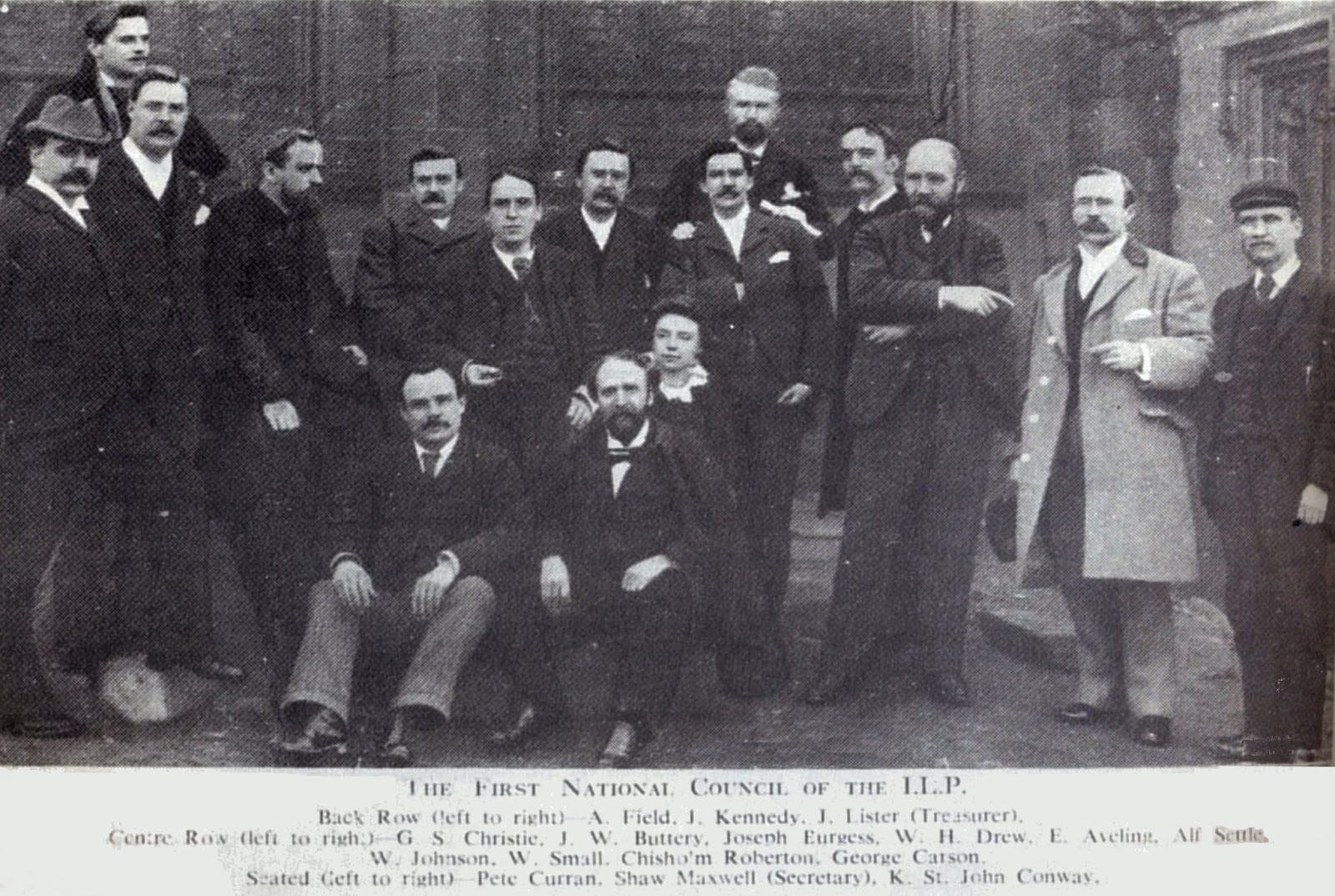
Independent Labour Party (ILP) First National Council
Independent Labour Party (ILP) First National (Executive) Council
Back Row Left - Right
A. Field, J. Kennedy, John Lister (Treasurer)
Centre Row Left - Right
G.S. Christie, J.W. Buttery, Joseph Burgess, William Henry Drew, Edward Aveling, Alf Settle, W. Johnson, William Small, Chisholm Robertson, George Carson.
Seated Left- Right
Pete Curran, J. Shaw Maxwell (Secretary) Miss Katharine.St John Conway .
Back Row Left - Right
A. Field, J. Kennedy, John Lister (Treasurer)
Centre Row Left - Right
G.S. Christie, J.W. Buttery, Joseph Burgess, William Henry Drew, Edward Aveling, Alf Settle, W. Johnson, William Small, Chisholm Robertson, George Carson.
Seated Left- Right
Pete Curran, J. Shaw Maxwell (Secretary) Miss Katharine.St John Conway .
Friday, June 14, 2013
"Tramp Trust Unlimited" - Socialist Pioneers
In May 1920 Socialist speakers who scorned "respectability" formed the "Tramp Trust Unlimited" , This new organisation was headed by leading Scottish Socialist, John Maclean and four of his loyal lieutenants
Peter Marshall, Alexander "Sandy" Ross, James D McDougall and Harry McShane.
These men were the best "Worker intellectuals" the Scottish working class had produced, nearly all had victimised for their political and trade union activities
They toured or "tramped" (walked between towns, sleeping where they could) across Scotland speaking at meetings and leafleting, demanding support for a "Fighting Programme" which included a minimum wage of one pound a day, a six hour day, full unemployment benefits
John Maclean paid tribute to the Tramp Trust Unlimited, declaring that it was "the greatest insitution Scotland had ever produced".
"In three months it had published, paid for, and distributed almost half a million leaflets"
Maclean stated
"If there were fifty of us working thus in unison we would put the Glasgow Herald and the robbers of Scotland out of action in six months"
Alexander "Sandy" Ross - from Dundee an ex Glasgow Policeman
Peter Marshall - A Glasgow Post Office Clerk
Harry McShane - The youngest, had a special talent for political writing
James McDougall - Maclean's chief assistant
John Maclean
The headquarters of Tramp Trust Unlimited was the Old British Socialist Party (BSP) South Side branch rooms in Morrison Street, Glasgow
Wednesday, May 29, 2013
Clarion Van No:2
Clarion Van No:2 at Erith (Erith Socialist Sunday School meeting) circa 1900
Note banner of the Social Democratic Party
Slogan on back of the Clarion Van Workers of the "World unite"
Subscribe to:
Posts (Atom)