Peter Pink was born in 1929 at Stockwell, South London. His father was a policeman, leading to Peter being born in the police wing of Putney hospital. His father was posted to Southall in 1932 and the family consequently moved to Hayes, West Middlesex.
He joined the Young Communist League in 1945 and the Communist Party in 1947 and, in time, became the Secretary of Hayes Communist Party.
Peter Pink was born in 1929 at Stockwell, South London. His father was a policeman, leading to Peter being born in the police wing of Putney hospital. His father was posted to Southall in 1932 and the family consequently moved to Hayes, West Middlesex.
He joined the Young Communist League in 1945 and the Communist Party in 1947 and, in time, became the Secretary of Hayes Communist Party.
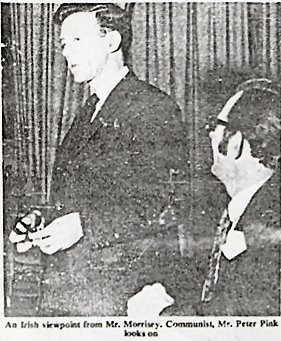
Amongst many successful meetings the Communist Party in Hayes organised was one with the Civil Rights leader Sean Morrisey (Chairman of the Turf Lodge Residents Association and education officer of the ATGWU) held in February 1972.
Peter worked at EMI and was Chairman of Hayes branch of the Clerical Workers Union (then CAWU, later APEX, now part of GMB).
For much of this period, Peter lived at 35 Camden Avenue, Hayes, later he moved to 1 Hambledon Close, Hillingdon.
His sister was Labour councillor in Yeading Ward, Hayes.
He was the Advertising Manager of the Morning Star for a while but Peter Pink is perhaps best known for having been the writer of the Morning Star’s daily Peoples’ Press Fighting Fund column during the nineteen eighties and nineties.
Peter died in 2012.
Trade Union banner of the Association of Engineering & Shipbuilding Draughtsmen (AESD), May day Glasgow 1949 AESD Established 21st May 1913, Clydeside, Glasgow, Scotland by William Herd
AESD OFFICERS 1949 No1 Scotland
AESD Regional Secretary T. Mc Lennan 224 Archerhill Road, Glasgow, Scotland
AESD Clyde Area Study Circle meetings at highland Insitute, Glasgow Chairman Mr T. McLennam key organiser Convenor Hugh McQuiston (21 years up to 1949) and treasurer Miss Annie Fitzsimons. Other officers Mr Alex, Finlay, Motherwell Branch and fergus Reid Glasgow South branch
FORMATION OF THE AESD DRAUGHTSMEN UNION
The AESD was established on Wednesday 21st May 1913 at 158 West Regent Street, Glasgow, with William Herd (draughtsman at John Brown's shipyard) the key speaker.
The first Glasgow branch included James Young, George Thomson, Archie MacKellar and W. C. Keay
Young, Thomson and MacKellar became AESD union officals, W C Keay joined the association a few weeks after formation, the first member from outside shipbuilding. Keay became General secretary of the federation of professional Workers for nine years.
William Herd AESD died in the nineteen-twenties
GEORGE WALKER THOMSON
George Thomson died in Birmingham on Thursday 7th July 1949; so passed on one of the outstanding personalities of the Association of Enginnering & Shipbuilding Draughtsmen (A.E.S.D)., and a man who had attained to the highest honour which the trade union movement can bestow, namely, president of the Trades Union Congress (TUC).
The outstanding characteristic of George Thomson was his integrity and honesty of purpose, a man who would always do what was right, irrespective of the possible personal con-sequences.He was a man it was an honour to count as a friend, and we were colleagues and close friends for over thirty years.
He was a native of Glasgow, Scotland educated at Allan Glen’s school in that city.He started his industrial career as a wood carver and modeller and he attended the Glasgow School of Art for two years under a bursary which he had won.He did not continue this vocation but switched to engineering, serving his apprenticeship with Ross & Duncan, a marine engineering firm.
His father, a chief engineer, was for some time in charge of a fleet of trawlers and. as a youngster George frequently sailed with the fishing fleet and there learned the difficult life which those engaged in the occupation have to undergo.Whether this experience was responsible for his change of occupation, I cannot say.Whilst serving his apprenticeship he attended classes at the Royal Technical College, Glasgow, gaining the diploma of the College, and on completion of his apprenticeship was for a considerable time in the Preston area employed as a draughtsman.He then returned to Glasgow where he became the leading boiler draughtsman with Barclay Curie & Co., and was so employed until he became full-time editor of TheDraughtsman in June, 1920.
His introduction to the socialist and Labour movement took place whilst he was attending the Glasgow School of Art.One of his two friends who were also attending the school had obtained some early socialist pamphlets and all three soon became interested and active members of the movement.Later, his two friends became Labour councillors in the city of Glasgow, while George subsequently became active in the industrial side of the movement.In his late ‘teens and early twenties he was active in the Clarion Scouts and was for a considerable period the general secretary of the Glasgow branch.
I first met George Thomson at an A.E.S.D. general meeting in 1916, when he played an active part in defeating a proposal to try to get the Association accepted as an approved society.It was not until a year later that I came into close contact with him.He, together with Peter Doig and Archie Mac-Kellar, came on to the executive committee of the Association in the early autumn of 1917, the E.C. at that time being drawn from the membership residing in and around Glasgow.It was then discovered that Doig and Thomson had been in the same class at Alien Glen’s.
During the 1914-1918 war, the New Age, under Orage, was advocating guild socialism and George Thomson, together with a number of other socialists in the west of Scotland, became interested.Later, three of them became responsible for the editorship of The Guildsman, a publication run by the Glasgow branch of the National Guilds League, which was an active organisation during and after the 1914-1918 war.His two colleagues were John Paton, a shop steward of the A.S.E., and. Edwin Muir, the well-known essayist, then a clerk in a Renfrew shipyard.His knowledge and activity in connection with this publication resulted in his being appointed towards the end of 1917, as the convener of the A.E.S.D.
Publications and Propaganda CommitteeIn1918, the Executive Committee decided to revive The Draughtsman, two issues of which had previously been published.George was appointed, honorary editor, with the undersigned in charge of the business side.The editorial committee consisted of George Thomson, Willie Herd (who has rightly been given the credit of forming the Association (AESD) ), D. Clark and the under-signed (James Young).Although politically. Herd and Thomson were poles apart, they became very firm friends.This, indeed, was another characteristic of George Thomson ;his ability to make firm friendships even with people with whom he was frequently in strenuousopposition.For two yearshe carried on the editorship of The Draughtsman, which was published every two months, whilst working as a draughtsman during the day.At the beginning of 1920 when I became assistant general secretary, George Thomson took over the complete responsibility for The Draughtsman.
In those days the paper was sold to the members and at the 1919, December, conference, when making my report on the business side of the paper I directed attention to the fact that if the paper was published monthly, it could easily support a full-time editor.This suggestion was seized on by the then general treasurer and at the next meeting of the Representative Council, held in the middle of 1920, conference decided that The Draughts-man should be issued monthly and George Thomson was offered the full-time editorship, which he accepted, and which he occupied with distinction until he retired about a year ago.
In the first Notes in The Draughtsman he stated. :—“We conceive the chief function of this journal to be that of acting as a weather cone to the Association to indicate to the best of our ability where the real storm centres are, to provide a platform of our own for the discussion of our own peculiar problems, and to assert the Association’s will forcibly and with what power of thought and language we can command.” A study of The Draughtsman during the thirty years he was responsible for its editorship will clearly demonstrate that he was faithful to the principles he set out in his first Notes.He received severe criticism from many quarters, some from the right and some from the left, but he continued to express the views which he personally considered were correct, irres-pective of the criticism of others.
His work in the Association is well known.Outside the Association he occupied many important posts in the trade union movement.He was elected to the General Council of the T.U.C. in 1935 and became chairman of. the General Council and presided over the 1947 Congress.His work during that year undoubtedly took a heavy toll on his physique.
He took a prominent part in the work of the National Federation of Professional Workers, and during his lifetime he was honorary secretary of the Science Advisory Committee of the Labour Party.He was elected chairman of the tech-nical section of the International Federation of Commercial, Clerical and Technical Employees and acted as the represen-tative of the T.U.C. at many conferences in connection with the InternationalLabourOrganisation (ILO) bothinEuropeand America.
During his career he had many tempting offers to leave the movement and undoubtedly he would have been a success in any sphere he chose to enter, but he felt that his rightful job was to serve the movement and the membership of the A.E.S.D. in particular.This he has done faithfully and the membership, both past and present, mourn the loss of one of the outstanding figures. thrown up from the drawing offices in this country.Our sympathy goes out to his wife and son at the present time.
James Young
The Draughtsman August 1949
EXTRA NOTES
1949 AESD Draughtsmen Union - Branches West London
Southall AESD J.F. Goodyer 9 Chatsworth Road, Yeading, Hayes
Acton AESD V. F. Colle 55 Muriel Street, Islington
Ealing AESD Miss D.E. Bareham 35 Northfield Avenue, West Ealing
Wembley North AESD D.W. Fairwater 80 uppingham Avenue, Stanmore
Wembley South F. Holmes 49 Chartley Avenue, Neasden NW2
London West AESD K.T. McKenzie 33 Cedar Road, London NW2
London West Central AESD R.H. Smith 424 London Road, West Croydon
London North West AESD C.S. Heiht 89 Vallance Road Bethnal Green E1
Slough AESD C.S. Brown "Bartletts" Wymers Wood Road, Burnham, Buckinghamshire
Southall AESD Draughtsmen union branch established 1948 (included members at AEC Southall)
Southall AESD Secretary J.F. Goodyer and Chairman Mr MaCullam
* AESD very active at Fairy Aviation but not sure if Southall or West London branch
Belfast North AESD Draughtsmen Union branch established a "Mixed Voice Choir" in Autumn 1949 and won remarkable sucess in its short period of existence, it won second place at the Belfast Musical festival and at Coleraine Musical Festival(Mr J Duncan - Secretary)
Born 1929 at Stockwell, South London his father was a Policeman (and Peter was born in the Police wing of Putney hospital)
Father posted to Southall in 1932 and the family consequently moved to Hayes, West Middlesex at this time time.
Later Peter lived at 35 Camden Avenue, Hayes, later Ashford Avenue,
Joined the Young Communist League in 1945 and the Communist Party in 1947.
Secretary of Hayes Communist Party, regularly contested election on behalf of Hayes Communist Party.
Peter highlighted the role of leading Hayes Communist, who he held in high esteem, people such as Frank Foster (AEU Fairey Aviation), Bob Good (EMI Covenor, blacklisted from Enfield) and Jack Maling (worked at EMI wrote a regular column for Hayes News, had worked on Forces newspapers in the War)
Peter stated that one of the most successful meetings the Communist party in Hayes organised was that of the Civil Rights leader Sean Morrisey (Chairman of the Turf Lodge Residents Association and education officer of the ATGWU) held in February 1972. Worked at EMI.
He was Chairman of Hayes branch of the C.A.W.U (Clerical Workers Union at EMI).
Peter's sister was a Labour councillor in Yeading Ward, Hayes
Peter Pink wrote the daily fund raising column in the Morning Star newspaper in the nineteen eighties and nineties.
Edward "Ted" Vance (Labour) 11 Raeburn Road, Hayes Married with three children and works as a dispatch supervisor locally. Chairman of the O.P.WC (Old Peoples Welfare ?) Secretary Hayes C.C (Cricket Club?) Labour Party Agent TGWU member 16 years.
William C. Mongor (Labour) 27 York Avenue Has served on the Hayes UDC since 1940 Chairman of Hayes UDC 1947 - 1948. Married Wood Machinist "Father" of the Council (Longest serving)
Mr H. Matthews (Labour) 23 Coronation Road, Hayes Member of Hayes UDC for three years Chairman of Civic catering Committee Special interest in welfare and youth issues Member of A.E.U for 32 years
E.C. Perkins (Labour) 116 Shakespeare Avenue, Hayes UDC member for nine years Specialist in Staffing issues and local government organisation Past Labour Party election agent
Other Labour candidates standing in Hayes UDC 1960 Mrs R.E. Beard, Mr Robert Came, H.R. Hann and Simon Geldberg
COMMUNIST CANDIDATES 1960
Peter Pink (Communist) 35 Camden Avenue, Hayes is 31 and has lived in Hayes since 1932 a member of the Party since 1947. YCL 1945 He is at present Secretary of Hayes Communist Party. He is Chairman of Hayes branch of the C.A.W.U (Clerical union at EMI) Worked at EMI.
Joyce Miller (Communist) Moray Avenue, Hayes Born in Portsmouth 1920 Joined Portsmouth Labour League of Youth and YCL Took Civil Service exams Personal Assistant to Lord Wooton (Food Minsiter) during war Former member of Highgate (Waterloo Park) Communist Party lived in the house of the famous Communist conductor Geoffrey Corbett Arrived in Hayes 1958 with son and daughter Communist party member twenty years (1939) February 1950 delegation of women for peace to American Embassy Active in CND and Aldermaston marches
1959 LABOUR ELECTION CANDIDATES HAYES 1958 election turnout 22.8%
W.R.G. Denyer (Labour) 5 Pendell Avenue Aged 50 Lived in Hayes for 22 years Staff Clerk at North Thames Gas Special interest Housing
Ossie Garvin (Labour) 44 Church Road, Hayes Lived in Hayes for 30 years Married aged 46 Interested in Athletics
M. Wheeler (Labour) 9 St Dunstan's Close, Hayes aged 40 born and bred in Hayes Married with four Children Building and maintenance surveyor interested in Youth club activities
Ernest Kirby Harding (Labour 21 Clayton Road, Hayes Lived in Hayes for 40 years (since 1919) Married Editor local newspaper Hayes News Interested in local government
other Labour candidates A. Smith, J. Johnson and S.G.Chilton
TORY CANDIDATE - TRADE UNIONIST 1959
R.E. Salt (Conservative) 373 Cranford Lane, Hayes Lived in Hayes 20 years Bachelor aged 44 Estimator with a large company Vice chairman of the Conservative Trade Unionist and Chairman of Hayes & Harlington Trades Union Council
The Labour movement in Hayes, has always taken a keen intrest in Irish freedom and the first meeting in the Borough can be traced backed to a Quaker meeting in Uxbridge in the 1880's. Which reported on a delegation to Ireland.
The first Labour candidate for Uxbridge Constituency (including Hayes) Harry Gosling called for Irish independence in his election address.
John Ryan MP for Uxbridge in the 1960's was an active supporter of the Irish Civil Rights Association
In February 1972, the Hayes Communist Party organised a meeting (According to Peter Pink one of their best) with Sean Morrisey as speaker. Civil rights leader and Chairman of the Turf Lodge Residents Association, he was also an Executive Committee member of the Communist Party.
Sean Morrisey, hit out at the British Army claiming “They shot down these people in Derry and thought that they’d finished us”
"But the struggle continued, he said doubting that a solution to the problems could be brought about by violence” – either by the Army or the IRA."
It was stated that, Mr Morrisey who lives in Belfast with his wife and three children continued “Although the civil rights movement supports the aims and objectives of the IRA, we do not support their methods."
“If we thought they could succeed we would all be members ourselves, We’re trying to get political action and bring northern Ireland back on the political platform"
"We don’t think any elitist group will about political changes in northern Ireland, it depends on the masses"
Mr Morrisey also attacked the Stormont Government.
Not only had the government failed to provide employment – 11% were out of work but also to provide normal amenities
"If unionism and democracy cant exist together, one of them has to go, and its not going to be democracy"
The Irish trade union movement also came in for criticism but he said “the trade union movement is the one common platform which could bring the two sections of the community together”Chairman Mr Peter Pink said his Party endorsed the speakers view
Mr Morrisey returned home on Saturday following the meeting on Thursday at Townfield School. He was one of two Civil Rights leaders to visit Britain.s
Sean Morrisey Education Officer for Ireland Amalgamated Transport & General Workers Union Speaking in 1980 he stated " When we explain the actual reasons for unemployment and the worsening living conditions to the workers, we show them that vital problems can be resolved not by patching up contradictions but by fundamentally changining the present socio-economic system, Our Party's strength lies in its ability to bring this truth home to the people"
the leader of the Labour Group and Hayes Parliamentary Labour Candiate was Peter Fagan, born in Dublin In the 1980's a delegation of Sinn Fein Councillors were invited to various meetings in Hayes and to meet the Labour group Councillors, the delegation included Barbara de Brun (then Barbara Brown).
John McDonnell has used his position on the GLC and in the House of Commons to continue this tradition, including the GLC funding of the Hillingdon Irish Centre