Showing posts with label John Bedford Leno. Show all posts

Sunday, June 14, 2015

National Union of Boots and Shoe Operatives


The National Union of Boots and Shoe Operatives was established in Stafford  in 1874. By 1918 the union could report that over 20,000 of its members were in military service and over 2,000 had been killed. Over £80,000 had been paid to keep serving members in benefit; £12,000 had been paid out in death benefit

An ambulance had been purchased and sent to France

National Union of Boots and Shoe Operatives though not the largest union in the country - the industry precluded that - was one of the most enlightened, most progressive, most successful, and for it size, most influential in Great Britain, or indeed, "in the whole world"

Membership
49,000 in 1914
83,000 in 1918

The National Union of Boots and Shoe Operatives union was established in 1874
Delegates to the first conference in Northampton included

Hull - J. Chapman
Birmingam - G. Sedgwick
Stafford H. Greenwood
Wolverhampton F Weare
Walsall - H. Clements
Leicester - J. Tilley
Dundee J. Forbes
Ansty - J. Bosworth
Nottingham N. Coyne
Arbroath J. Irving
Dublin J. Kelly
Leicester A. Clark
Glasgow J. O' Hara
Stafford J. Simmons
Leicester M. Leader
Northampton W. C. France
Leicester C. Smith
Newcastle - J. Collins
Bristol - T. Heron

New machinery was introduced cost and not necessarily improve quality. Each innovation involved a further splitting up of the productive process "The division of labour in a modern bookmaking establishment is enough to drive the art critic mad", John Ruskin, 

John Bedford Leno (Uxbridge) The art of boot and shoe making John Beford Leno 1885

new unionism send for John Burns socialist

"I for one am not going to follow the new trade unionism of dragging men through the gutter with flags and big drums" friend of Freak at Shoreditch town hall

London strike 24th March 1890

The national union of clickers and rough stuff cutters was established in London in 1891  had six or seven branches and about 2,000 members . it prime objective was the limitation of boy labour it had ambitious plans "capture Ipswich, attack Colchester then go into the Midlands and organise the whole country if possible" The Norwich union of clickers and rough stuff cutters merged into the National  union in 1894 as Norwich No2 Branch with Walter R Smith as president of the Norwich union in 1893

Women delegates first attended national conference im 1904 Jane Bell-Richards and Ruth Woolley from Leicester

Elizabeth "Lizzie" Willson  elected secretary Leicester Women's section in 1906 - the Leicester women's section had been formed in 1904 with 1,213 members
"The British National Union of Women's Shoe Operatives. She was the first women elected to the executive


Ted Poulton was in many was a pro type of the twentieth century trade union leader
a sober and responsible negotiator; extremely able on organisation and administration; committed to the pursuit of a welfare state by constitutional political action; holder of unpaid office in a wide and diverse range of voluntary and statutory bodies; invariably overburdened with a mass of committee work which falls to the over willing horse; Poulton for a mid twentieth century reader is a familiar figure

He took over the general secretaryship with an already impressive record

born in Northampton in 1865 he worked for eight years at the bench and became branch secretary at he age of twenty five. this post he was still occupying in 1908. in 1890 he started the trade union club in Northampton and became its first secretary; in 1892 he was president of the local trades union council and played an important part in forming the Midlands federations of trades union councils, in 1895 he became the first "direct labour" representative on the Northampton school board; in 1898 the first working man alderman on Northampton town council; in 1906 the first working man mayor of Northampton. he was also a member of the Northampton technical institute committee; governor of Northampton general hospital; active in Sunday school work (he was a lifelong Wesleyan) s teacher, secretary and superintendent. When in 1902 the Education Act did away with School Boards he became Chairman of the Education committee of Northampton Town Council

Poulton was no believer in the Class War ".... employers are largely the creaturers of circumstances" he declared in 1911

He believed strongly that centralised of power and finances was desirable in the interests of union efficiency and effectiveness

In 1904 union adopted resolutions adopting socialist ideas into rules by large majority "the socialisation of the means of production to be controlled by a democratic state in the interests of the entire community and the complete emancipation of labour from the domination of capitalism and landlordism, with the establishment of a social and economic equality between the sexes"

Thomas Frederick "Freddy" Richards
Was junior vice president of the Leicester no1 branch in 1892 vice president 1894  in 1894 also elected to the town council and union branch president 1897 by 1899 executive council
1903 an acquaintance referred to his "pale face and sharp almost ascetic cast of features by 1913 counted among the first dandies of the trade union movement bow tie and white spats were a keynote (together with was known in the Labour movement, with affectionate derision as an "anarchist hat" a few sneered at the "Beau Brummell" others satisfaction that he dressed more smartly than some employers other were merely suspicious

"full of activity and born fighter great organising ability
first dandies of the trade union movement
speak on a soap box white spats and white waistcoat and a straw hat

Thomas Frederick Richards born Wednesbury he moved to Leicester and became Leicester Branch of the Boot and Shoe Operatives From 1894–1903. He became a Leicester councillor was adopted in 1903 as Wolverhampton Trades Council Labour Representation Committee for West Wolverhampton and Richards won the seat in 1906. Later he contested East Northamptonshire 

Street Union branch Secretary Fred Laver a street officer in local Street independent Labour Party (ILP) while the chair was William Page active Tory


By 1945 the general secretary Mr G. Chester could report that

 "there are still difficulties in the odd factories, but in the main it is true to say that there is no boot factory, with one well known exception (BATA) which is not recognising and applying the terms of the national agreement" BATA did a year later


Shoe Makers Union strikes

Bata  1937
Bristol 1894
Chesham 1921
Freshwater 1894
Higham ferrers 1890
Leicester 1940
London 1891
Northampton 1887
Norwich 1897
Raunds 1905
Stoney Middleton 1918
Wellingborough 1932

1895 Lock out National
1891 London Lock out
1887 Lock Out Northampton (key in securing Northampton as a union town)
1875 Lock Out Stafford


Fred Gould of the elected MP for Frome Somerset in 1923


Walter Smith MP for Wellingborough and Norwich 


Thomas "Freddy" Richards MP for Wolverhampton West

Sunday, October 10, 2010

Uxbridge History


Leno's History of Uxbridge

In 1870, Matthew Leno had a shoe and clothing shop in the place now occupied by Mr Butler, opposite the market house, Uxbridge and he published a sixpenny pamphlet, entitled "The history of Uxbridge", in a condensed and popular form from the earliest times to the present; by John Bedford Leno author of "Drury lane Lyrics"The Autobiography of a Shilling "etc ,

The main portion of the earlier history was doubtless compiled from the more complete work of George Redford and Thomas Hurry Riches, but quite a lot of new and later details were included, some of these being quaint and little known to the present generation. For instance, he tells us that "The chief business thoroughfares are London Street, high Street, Windsor Street (formerly called the lynch) and Vine Street (formerly Blind Lane or Woolwind Lane). also that the town was divided into two wards under the local Board of health, the old township being known as the "Inward" and the part lying without as the "outward".

28 September 1917 The Advertiser & Gazette


St Margaret National School erected in 1864
A School of industry for girls erected 1816 (George's Fields)
The British School for Boys (Cowley Road)
The Public Rooms (or Town hall) erected 1836 (London Street)
Belmont Hall erected 1866
The Uxbridge Old bank established 1806


A Petty Session has been held for over 150 years prior to 1917, held every Monday at the uxbridge Town Hall

Theatre buit 1869

The Grand Junction Canal was opened at Uxbridge in 1805

The Uxbridge (Vine Street) Station of the Great Western Railway 8 th September 1856

Uxbridge Fair Days

25th March
31st July
29th September
11th October

Uxbridge Wool Fair 1st August


Sheep worrying at Southall
In late 1917 at Uxbridge County Court William Goddard of Waxlow Manor farm, Southall sued William Morgan of the "Hare & Hounds" Northolt for £37, 8 s, 9d being damages for injury to twelve in lamb ewes by the defendants Airedale terrier dogs at Waxlow Manor Farm, Southall on the morning of 29th December 1916

The defendant William Morgan was now serving with Royal Marines at Chatham

The case continued

SIGNALMAN

Mr W. M Cheney retired from service as a signalman for the Great western railway after thirty eight years service. twenty three at Slough GWR station then later at west Drayton and maidenhead. Retired September 1917

HAYES SALEM CHAPEL

The Rev Henry R Rutherford who is coming from Slaithwaite, Huddersfield, Yorkshire to take up the pastorate of Hayes Salem Baptist Church September 1917, H
ayes. Rev Henry Rutherford is a native of Ulster, but as his name indicates his ancestory comes from Scotland.

Rev Rutherford was in business for several years before taking up religious work aged 21 at Chadderton, Oldham, at one point he worked at the baptist Chapel in Athlone, Ireland and later
(in July 1912) to Slaithwaite.

NATIONAL UNION OF RAILWAYMEN (NUR)
Uxbridge Branch of the National Union of Railwaymen (NUR) established 1913.
W. Tulett Chairman since 1913.

By July 1917 it had been reported that the National Union of Railwaymen (NUR) has had 2,785 members killed in the War to date.

Michael Walker

Friday, July 10, 2009

Denham Agricultural Labourers Union 1872


Denham Branch
National Agricultural Labourers Union 1872


"When at Denham the winter before last I found 18 adults out of the small population, destitute of employment and poor rates higher than they have ever been"
John Bedford Leno May 1872

Average Weekly Wages of Ordinary Agricultural Labourer in Buckinghamshire
1850 8 shillings 6d pence
1872 - (approx 15s)
1898 13s6d
1910 14s8d
1914 16s
1919 36s 6s
1924 27s
1934 30s for 50 hours (new Agricultural Wages Act)
1938 35s 6d
1947 90s

Denham, Buckinghamshire
Local Newspaper Report


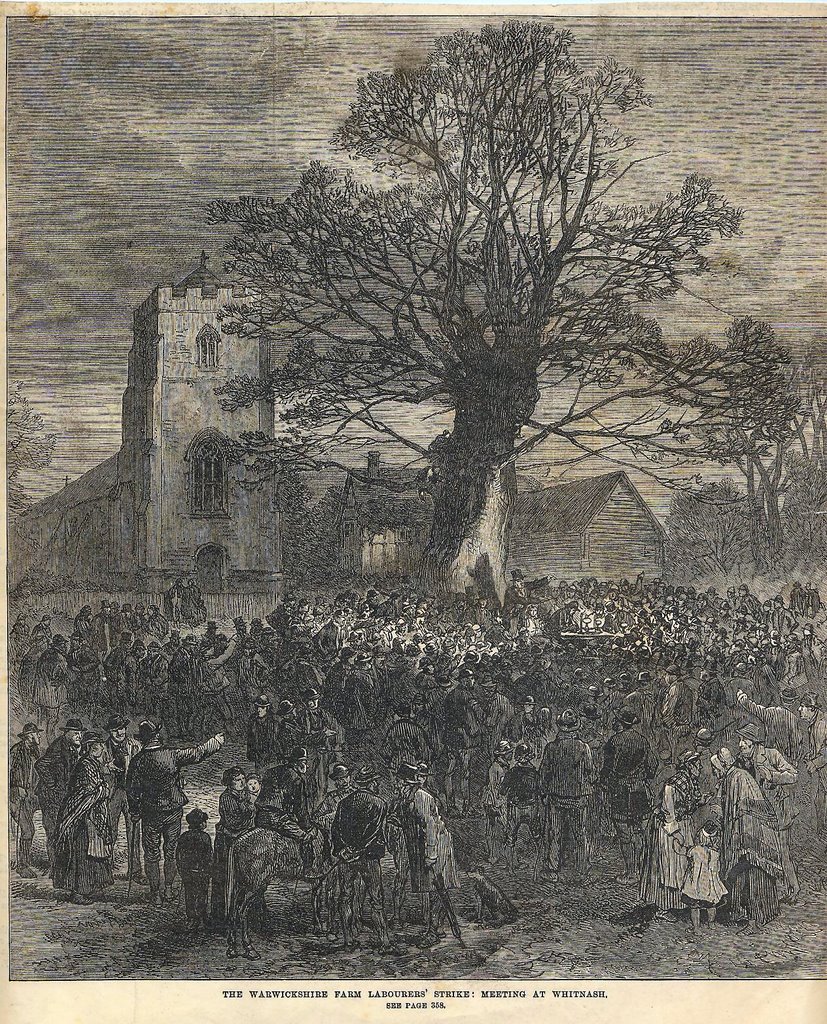
At 6pm on Friday 12th April 1872 two to three hundred agricultural labourers assembled at the quiet village of Denham, Buckinghamshire to discuss their grievances and adopted measures for an increase of wages and shorten the hours of labour.

Poverty as a passing peer inside the cottages evidence that poverty of the direst was prevalent.

The place of meeting was alongside a wall that bounds one side of the highway, a large table to do the duty as a platform

The men had come to hear the union organiser Robert Clay
for the National Agricultural Labourers Union.

At the meeting reference is made to the plight of John Smith of Stretton on Dunsmore (near Rugby), who was rebuked for living extravagantly in supporting his family on 11s a week, when a loaf of bread cost 8d.

It was reported at a following meeting of the union in May 1872 that the Denham union branch had fourty members and had sent delegates to the April conference in London (Willis Room,King Street, St James, London now Almack House).

Joseph Arch leader of the union states that at Denham they joined in their hundreds

Auberon Herbert, Liberal Member of Parliament for Nottingham had stated that

"the trade societies (unions) were barriers between us and revolution"

Apart from John Bedford Leno, Lieutenant Whellams was a key organiser of the agricultural workers locally.

One Farmer a Mr King of Denham agreed to advance the wages 2 shillings, he had not been asked to do so but it was a voluntary offer. Meanwhile Major Gaskell JP was sympathetic to better labourers and cottages but "depreciated unionism generally as a selfish principle"

One local report states that a union speaker stated "That the social waggon was deep in the mire but they had got in the thin edge of the wedge and he hoped that they would come forward and help the Denham and Chalfont st Peters men drive it right home"

An elderly man named Robinson spoke at Denham, stating he had followed the plough for thirty five years and once earn't 35s a week and could compete with any man in Bedfordshire.

One of our poets stated
A blessed prospect,

"To toil while there is strength, in age the workhouse, A parish shell at last, and the village bell tolled hastily for the pauper's funeral"

By Robert Southey's

"Jem Pizzey" also spoke

Lieutenant Craesey Whellams the local union organiser stated in May 1872 that

"It was wrong that women should be compelled to work in the field at all, and considered that every Englishmen ought to earn sufficient to provide for his family and keep the women in the household. so far as single women were considered he actually believed that it was the for runner of a great deal of immorality

Whellams
speaking at a National Union of Agricultural Labourers meeting on the evening of Friday 24th May 1872 at Chalfont St Peters Buckinghamshire stated "With respect to single women who earn from 3s - 4s a week that they did not get the wages of a general servant in London or £10 per year anywhere he mentioned that women labourers were a bad principle and if young women obtained respectable situations they would not wear out their clothes as they did in the fields"

Burnham National Agricultural Labourers Union It was reported that 60 men had joined the union at Burnham, it was reported that the cottages and sanitation at Burnham was very poor

The men of Wooburn had attended a large meeting (400-500) and joined the union. Whellams being meet at the station and proceeded by the town band to the meeting
.

The Chalfont St Peters branch of the National Agricultural labourers Union was established in May 1872
handbills had been circulated in the area and on Monday 20th May 1872

The agricultural labourers rushed to the station to meet Whellams the union organiser he replied "how do you do boys"

The meeting took place in front of the Greyhound Public House, where a table and chairs were arranged for the speakers

150 to 200 were present and they started the proceedings by singing the unions anthem with the chorus "Come and join the union...there's nothing like the union"

at the conclusion of the song there was a "hearty hurrahas as can very seldom heard in the village"

A picture of Joseph Arch the leader of the union was then shown to the meeting,

It should be remembered that Joseph Arch the union President was considered "agitator, an apostle of arson, who was setting class against class

a popular song of the time sung by the labourers had a chorus of

"Joe Arch he raised his voice,
'twas for the working men,
Then let us all rejoice and say
We'll all be union men"

Whellams reported that one agricultural labourer had been horse whipped for daring to join the union.

He stated that agricultural labourers in Canada were earning 28s a week

Whellams also stated that it was his view that they needed their own Members of Parliament
"Until they were able to send men to the legislative who spoke on their behalf they would never be justice done to them"

Union organisation in Buckinghamshire goes back before Joseph Arch's union in 1872. In 1867 some agricultural labourers at Gawcott near Buckingham went on strike for a rise in wages from 9s to 12s a week, but though the movement spread into Hertfordshire, it died away, largely it seems because the agricultural labourers could get no outside help even from prominent Liberals in the area. Later there was more agitation around Aylesbury in Buckinghamshire, and a schoolmaster at Dinton is said to have gone around addressing the agricultural labourers and urging them to combine, this could be Edward Richardson who emerges in 1872 as founder of the Bucks Labourer's union/ Buckinghamshire Farm Labourers Union

The local newspaper (15th June 1872) reports that


Edward Richardson a School teacher of Dinton, Buckinghamshire had been for over two months organising the Buckinghamshire Farm labourers Union

However it was reported by Richardson that
"it appears that a union calling itself by the name was then in existence in Denham this fact was totally unknown to myself otherwise we should have adopted another name"

"I hold to be the founder and organiser of those unions already formed or bring formed in the immediate neighborhood of Haddenham, Long Crendon , Stone, Aylesbury Cuddington,. (Richardson) "having been the only speaker upon the subject in these parishes at present, having defrayed the whole expenses of thirty open air meetings out of my own private purse."

George Howell, a bricklayer and active trade unionist fought Aylesbury as a Labour candidate in 1868 and again in 1874, a startling and daring innovation for those days. He got much support in the villages, and when threatened by Tory roughs was able to muster a bodyguard of labourers carrying sticks from surrounding villages. The labourers of Haddenham, long a stronghold of radicalism and later on of the union, were prominent in support of Howell


Manitoba Historical Society Site

Creasey J. Whellams (1842-1918)

Immigration promoter.

Born in St. Ives, Huntingtonshire, England on 8 January 1842, he was educated in private schools in Cambridge. In 1866 he moved to Liverpool and entered business as an insurance and shipping agent.

He first visited Canada in 1872 and was successful in obtaining governmental support for agricultural immigrants. In 1876 he was commissioned to visit Manitoba and make a report on its potential for immigration. He travelled west from Winnipeg by ox-cart and was so impressed with the agricultural possibilities that he made application, and obtained for colonization, six townships on the Little Saskatchewan River just west of the old Manitoba boundary line. On this land he founded the present town of Rapid City.

On 14 January 1886, he married Charlotte Emily Sudlow of Liverpool and had seven children. In 1892 he went to St. Paul, Minnesota but returned to Winnipeg in 1910 to become business secretary of the Millions for Manitoba League. He was later secretary of the Western Canada Development Bureau. He wrote many articles for the newspapers and periodicals of the day, in which he extolled the advantages of settlement in Manitoba.

Whellams died in Winnipeg. The funeral was from St. Martin’s Mission with interment in St. John’s Cemetery.


NOTE:

The banner at the top of the page "United we Stand - Devided we Fall" is allegedly the banner of the National Agricultural Labourers Union (NALU) lead by Joseph Arch and was discoverd in Oxfordshire

The banner was left to Nuffield College, Oxford . A 1961 letter in the associated documentation for this banner states:
‘Although the banner is probably the only one in existence belonging to the unique period of Joseph Arch’s great union, it was not… the most unique feature of the collection. Pride of place must go to the minute book of the Oxford branch which [the donor] left to Nuffield College. This showed conclusively that a branch was in existence in the Wychwood area of Oxfordshire before the date of Arch’s meeting under the Wellesbourne chestnut tree. // More important… was the evidence it provided to support [the] theory that one of the chief causes of the failure of the National Agricultural labourers Union was local autonomy. Any of the individual branches based on hamlet or village were at liberty to give strike notice so long as the committee based on Oxford agreed.’


Photo
Museum of English Rural Life

Thursday, June 21, 2007

Uxbridge Progressive Chartist - John Bedford Leno


John Bedford Leno (1826-1894)
Chartist Leader and Poet
He was friends or meet with Owen, Marx, Jones, Harney,Morris, Kossuth, Garibaldi, Palmerston, Disraeli, Derby, Gladstone

His Autobiography "Aftermath" printed 1892 (only copy held by Uxbridge Library
)

Born 29th June 1826 at No 14 Bell Yard, Uxbridge


Grandfather landlord of Catherine Wheel Public House in Cross Street,Uxbridge
. His Father was a footman and Mother was a lady's maid and ran a Dame School

Left school aged 11, then a cow boy for his aunt at Stanwell Moor, rope maker, postman and many other jobs became an apprentice printer aged 14 starting at 6 in the morning and travelling 16 miles to work and back
When young he states he was to young to go to the Turks Head Public House were "intellectual gatherings" were held.

He left home after his second year of
apprenticeship, however at the end of his apprentice printer was made bankrupt (as were many others) and Leno had to seek work abroad, tramping thousands of miles. He returned to Uxbridge in 1848 "disheartened and penniless" he then bought a press and went into printing

Married twice First wife "Sarah" 2 sons and 4 daughters, second wife 1 son and 4 daughters
"She (Sarah) lies in Finchley cemetery the daughter of a small Harefield farmer
"

Leno had read the Northern Star Chartists paper and had gone on to help establish branch of Chartists in Uxbridge But Leno would recall that he and his friends were personally to scared "act of cowardice" to attend the Great Chartist Rally in London on 10th April 1848 convinced their would be violence from the Soldiers

He along with Gerald Massey and others Kimber, Hudson, Gurney, produced a manuscript paper which became the Uxbridge Pioneer.


Leno recalls that "The first number was hardly in existence before a split occurred among the conductors, owing to political differences and Gerald Massey and myself proposed to start a new paper in opposition"This paper became famous as The Uxbridge Spirit of Freedom


The Uxbridge Spirit of Freedom had been started with 15s raised from friends and the first edition arrived in April 1849


The chief contributors was Massey and Leno
(as well as George Redrup and Edward Farrah a Shoemakers and John Rymill of Northampton)


Leno recalls "In order to attract attention Massey proposed that my brother Frederick then a mere youth should be dressed in imitation Guarde Mobile clothing, the reason given for the selection being the Civil Corps of Paris had joined the People."
"How the clothing was obtained I do not remember, but on market day my brother was so dressed and to be seen vending to the farmers town and country people the first issue of this terrible in earnest treasonable publication"

According to later editions of the Spirit of Freedom 900 copies of the first edition were sold and secured "such a furore in the tory town of Uxbridge, as supposed ensued in the Temple when Christ upset the money changers" and the publication denounced from pulpits in the town.


John Bedford Leno in his autobiography "The Aftermath" states: "We had read the Northern Star and most of the Chartists' Publications then in existence and possibly turned to fthe idea that the effectiveness of an article was dependant upon the amount of treason it contained."


The Northern Star reported on the first edition of the Uxbridge Spirit of Freedom "Such a publication appearing in Manchester or Leeds would be nothing wonderful; but we must say we are agreeable surprised to find a small town like Uxbridge containing men who not only dare think of themselves, but who also determined to give free thoughts utterance, with the view of hastening the political and social emancipation of their order; and we most earnestly we wish them success"


The Uxbridge Spirit of freedom was also well received by Chartist leaders William Howitt and W.J. Linton. Howitt stating "Working men thus ably and eloquently advocating their own rights"

Leno states "After eight or ten numbers had been published Massey who had formed an acquaintance with Walter Cooper and Thomas Shorter both lecturers, the later at the Working Men's College. Left Uxbridge to take a berth as Secretary to the Tailors Association in Castle Street off Oxford Street within a month I was at his recommendation sent to take charge of the Working Printers Association" .

"Both Massey and myself on arriving in London were able to command a leading position".

Leno was narrowly defeated in an election the the Chartist Executive in 1850

"I had determined to be of the rank & file rather than a commander"


"In truth I was for rebellion and civil war, and despaired of ever obtain justice or what I then conceived it to be, save by revolution. while bitterly opposed to thoughts savouring of physical force now, i still hold that given certain condition its use is fully justifiable, the fact being that those who condemn its use in favour of right, seldom object to its use when wrong is to be conserved
We have the examples of America, of France, of Italy of England before us, to confute those who declare that nothing is to be done by force but in nations where tyranny prevails and every attempt to obtain right is met with imprisonment, rebellion and war are justified"

"In my long life, I have had but one strong desire and that has been justice and freedom to all mankind"


Leno had marched with Fergus O'Connor from Windsor to set up his Land Colony at O'Connorville, Rickmansworth

Leno was a close fiend of George Julain Harney and attended the First International held in a cafe for French Exiles in Chapel street off Oxford Street. Leno became a member of the First International was a member of the International which meet in an upstairs room of Jacques Coffee Shop
.

Leno was on the Board of the Chartist paper the Red Republican

Leno helped organise protest of 10,000 of Bonaparte visit in 1888 and organised the massive welcome demonstration for the great Italian liberator Garibaldi
He helped print revolutionary leaflets to flood Russia in aid of Alexander Herzen

Leno from his early days a socialist, initially revolutionary but later Christan Socialist in his autobiography he states "With regard to socialism, i feel persuaded there is justice at the bottom of it, there is however no well thought out or rather satisfactory and its advocates seem to me to eager"
Leno meet Karl Marx on several occasions and seems to have worked with George Eccarius a close associate of Marx

He went to Boston in America, but the employment opportunity fell through
He wrote for the"Commonwealth" The Future, The Christian Socialist, The Workman's Advocate, The and various other publication

Leno's "Song of the Spade", first published in the Dispatch, attracted the attention of Edward Capern 1819-1894), the Bideford postman, who said it one of best labour songs ever. His 100 Songs of Labour sold extensively in Britain and also in America

John Bedford Leno carried out organising work on behalf of the Joseph Arch new union for Agricultural labourers in 1872 many home counties, but especially Buckinghamshire, and Berkshire. he was also active in the eight hour day movementIn later life he was Election agent for Mr Rickman and James Acland Liberal Parliamentary candidate


Leno was a great admirer of Fergus O'Connor the great Irish liberator and Chartist leader Leno had marched with Fergus O'Connor from Windsor to set up his Land Colony at O'Connorville, Rickmansworth. And later organised funeral for O'Connor when Williams and O'Dally were imprisoned
Leno states "I had determined to be of the rank & file rather than a commander"

"In my long life, I have had but one strong desire and that has been justice and freedom to all mankind"

John Bedford Leno also wrote a book on Shoe making "The art of boot and Shoemaking - A practical handbook

Died 31st October 1894
buried at Uxbridge Cemetery

A plaque to John Bedford Leno was errected on the site, the chapel at the Kingston road end was demolished in the early 1950's and may have been lost then.

NOTE:
Reviews of the Uxbridge Spirit of Freedom
The sight of such a work has given us unfeigned pleasure. Go on, ye high spirited sons of toil, and the example ye have no nobly set in Uxbridge shall be imitated elsewhere.

Reynolds Miscellany

It is a thoroughly democratic journal and boldly written vindicator of the rights of the proletarian. We cordially wish it success, let the enemies of Justice look to it.

Northern Star.

This little periodical is highly creditable to the working class - it is full of a glowing spirit of freedom and independence. There is much talent displayed in it and the poetry, especially of Mr.Massey is of high promise. We recommend the work to the patronage of the industrial clashes .-

Standard of Freedom.

It is full of the talent and fire of true democracy, its' poetry is usually of a high order.

Democratic Review.

A thorough-going advocate of democracy, plainspeaking, and fearless utterance characterise every paper.

The Progressionist

I have just received the first number of your "Spirit" and am very much pleased with it. I trust you will succeed.

Thomas Cooper.

William Howitt expressed his pleasure at seeing "working men thus ably and eloquently advocating their own rights."


Quotes from August. No5 Uxbridge Spirit of Freedom.

NOTE

John Rymill of Spring gardens, Northampton

He (and his bothers also of Northampton) associated with Red Republican, and Friends of the People both Chartist/radical paper run by Harney

wrote for The Uxbridge Spirit of Freedom articles such as "Englands true nobility" and "Why are we poor"


John Rymill also wrote for John Small (Buckingham) "The Progressionist" and that periodical was acquired by R.G. Gammage was turned into a weekly periodical but lasted just 48 editions
John Rymill refers tin the Uxbridge Spirit of Freedom edition 7 article Something for Democrats to do October 1849 of the Chartist prisoners "immured in gloomy dungeons" or
"Transported far from their land of birth, because they loved it, not wisely, but too well"


He also refers to Clayton and Holbery were murdered by horrible prison discipline of the base, brutal, and bloody whigs and that another victim has fallen Williams

he ends withthe following rallying call

"Solders of Democracy, unfurl the red banner-
Red! blood red! ay, wherefore not!
the Freeman's and, but ernest sign!

Arouse, from all lethargy! stand up in glorious manhood - and do battle for our common rights; spread the flag of Chartism to the breeze; political and social justice be the watch-word!

We fight to vanquish tyranny - we fight to punish wrong-
we fight to free the slave
Hurrah! hurrah! for the fight!

John Rymill I understand was also involved/established the Northampton Democratic Tea League
-----------------------------------------------------------------------------------
Chartist Uniform

Chartist rosette, white blouses, black belts,green caps with red stripes

--------------------------------------
John Rymill Northampton Chartist Born Banbury 6th November 1824 Died Northampton 10th June 1913 
At Young age Cork Cutter apprenticed to Mr Bissell (Bridge Street, Northampton) - Later set up Cork cutting business with two brothers at 15 Newland
A Wesleyan joined breakaway Baptist church Rev H Bradford (St Michael's Road) 

Friend of Ernest Jones & Gerald Massey 
Bradlaugh Riot (made his escape from the Lord Palmerston)

Nine Children 

later life resided with daughter Mrs Shape at Wantage road
Buried Billingham Road Cemetery


Wednesday, June 20, 2007

Wednesday, January 10, 2007

The Uxbridge Spirit of Freedom and Working Men's Vindicator

The Uxbridge Spirit of Freedom and Working Men's Vindicator


Gerald Massey and John Bedford Leno
Edition 1 April 1849
Review Chartist newspaper – The Northern Star 4th April 1849
Uxbridge Spirit of Freedom
Conducted Men No. 1. April
Published by J.Redrup. Uxbridge. Middlesex. London :
J. Watson Queen’s Head-passage, Paternoster Row.

A NEW monthly publication, of thoroughly democratic character conducted by Working Men. We Shall let our friends speak for themselves ;—
We shall be accused of class-feeling and party spirit; Well be it so. We would fain clasp the whole world in the arms of love; but ye will not ye who spit upon us and flout us with being the “swinish multitude” What can be the nature of that union where the subjection of the one party is maintained by the force of the other This is treason to the sovereignty of the people and treason to god, by destroying that moral beauty of unity which the creator intended for mankind: and, if to work out our own redemption be called “party feeling” we accept it.

We call upon true democrats of all ranks to support us; but especially on the working class; we invite them to contribute to our pages, for we want the sledge hammer strokes which working-men who do think can give, and, if we cannot reach the head of the present system of things why we’ll let drive at the feet ! Keep at work, and the mighty Triune which crushes us now, shall ere long make way for an educated and enfranchised people, who shall yet make Old England a land worth living and worth dying for.

Such a publication appearing in Manchester or Leeds would be nothing wonderful; but we must say we are agreeably surprised to find a small town like Uxbridge containing men who not only dare think for themselves, but who also, are determined to give their free thoughts utterance, with the view of hastening the political and social emancipation of their order.
Such men claim our respect and good wishes; and most earnestly we wish them success. 

The whole of the article in the number are well written; their titles are significant – “The Labour Question”, “Letter of a Labourer” “Emigration and the Aristocracy” “Where is Religion to be found” &c, &c We must make another extract from this boldly-written “Vindicator” of the rights of the proletarians:-
“We have to play a grand part in the history of the future. Our gallant brothers of Paris, Vienna and Berlin, must not bleed on the barricades for labour’s rights in vain. The problem will again and again force itself on the world. And, if our rulers dare not grapple with it, we must do the work ourselves. Working men, we must understand each other – let us learn what wrongs have been perpetrated for that is the first step towards redress. We must ourselves, assert our rights or we shall never win them. We have been listeners in the political arena – now let us mount the platform.

The Schoolmaster is abroad. Let the enemies of justice look to it. 
Work, on ye “MEN OF THE FUTURE”.

Advert NORTHERN STAR
The Uxbridge Spirit of Freedom and Working Man’s Vindicator
A monthly journal devoted to the advocacy of the rights of the working classes. Price one penny. Conducted by Working Men. All profits arising from the sale of this journal will be given to the (Chartist) Victim Fund or Executive

Monday, April 24, 2006

Agricultural Workers Union in Middlesex 1872

Agricultural Workers
in West Middlesex

The agricultural workers in this part of Middlesex were not immune to the ebbs and flows of the agricultural workers struggles.
 
While many local agricultural workers were forced into migration to Australia, New Zealand and Canada because of poverty. (especially from the Yiewsley area)

Other workers did try to resist the Land owners. Swing riots came to close Hayes and while no riot took place locally, a man arrested for “agitation’ in Hayes was released because no one in Hayes would testify against him.
 
This at a time, when even owning a print of the Peterloo massacre was an imprisonable offense.
However, when in February 1872 Joseph Arch set about organising Agricultural Workers in what Karl Marx referred to as the “great awakening” the response was huge.
Arch spoke for over one hour and recalled "These white slaves of England with the darkness all about them, like the children of Israel waiting for someone to lead them out of the land of Egypt"

On May 29th 1872 a meeting of sixty delegates from England and Wales at Leamington, Temperance Hall, Warwickshire to establish the National Union of Agricultural Labourers (NUAL)


The local Uxbridge newspaper reported that
“The agitation amongst the agricultural labourers is now spreading into the remote parts of Buckinghamshire un-traversed by railways and far away from large hives of industry Editorial 25th May 1872.


One of those leading the union campaign locally was Uxbridge radical and former Chartist leader John Bedford Leno. he spoke on behalf of the union in many villages in the home counties including, Middlesex, Berkshire, Buckinghamshire Huntingdonshire, Cambridgeshire.

It was John Bedford Leno, who along with Robert Clay spoke at the inaugural meeting of the Denham branch of the National Union of Agricultural Workers when it was established on 12 April 1872 . When some 40 local agricultural workers joined the union .
 
Leno stated “John Ploughman had awoke”
But joining the union was not without consequences and a number of agricultural workers were victimized and sacked.
Another union, the Buckinghamshire Labourers’ union led by School teacher Edward Richardson of Dinton was also active in 1872 in recruiting agricultural workers into unions.

In July 1872 John Bedford Leno spoke to agricultural workers in West Drayton
“If the masters feared the union, it was a reason why the men should cherish it, he did not advice them to strike that was a very serious thing but if necessary…he had been accused of being a disturber of the public peace he had been into several counties in England and was happy to inform them that the rights of the agricultural labourer were beginning to be recognised”.

In January 1891 the Dock and Riverside Workers union reported that the position of the Dockers was seriously prejudicial by the great influx of into the metropolis of individuals from agricultural districts who, dissatisfied with conditions of life there or having no employment at all flock to London and are in due course at the dockyard gates ready to do the work at any price statement by Dock & Riverside.
As a result the Dockers union (and the local branch of the Gas Workers union who were active amongst the brick makers) tried to organise the burgeoning market gardening workers in the West Drayton area
Meanwhile, in Berkshire, Lorenzo Quelch (brother of Harry Quelch of the socialist SDF (Social Democratic Federation) organised the Berkshire Agricultural & General Workers Union around 1893.
 
Joseph Arch’s union collapsed towards the end of the eightieth century (1896), however a new union was established in Norfolk in July 1906 changing its name to the National Agricultural Labourers & Rural Workers Union in 1910 , of which a branch was established at Longford, West Middlesex in October 1913. The speaker was Mr Harry Maskell who pointed out that local agricultural workers were paid just 18s 7d a week in West Middlesex while in Lancashire they were paid 19s 2d.
As a result of the meeting a branch of the union was established but was followed by the inevitable victimisations, when six Longford members were sacked for daring to join the union.
 
Another branch of the National Agricultural Labourers and Rural Workers Union was established at Harmondsworth, West Middlesex on 23 August 1918 and meet at the Five Bells .
 
The inaugural meeting speaker was F.W. Paul organising secretary for Essex who stated
“The labourer was waking up, already a hundred thousand members were enrolled in the twelve hundred branches, and members were coming in at the rate of a thousand a week”

”Education was largely a sham to the sons of labourers who had to leave school at ten and who had no opportunity for continuing their studies”
“The housing condition s of agricultural labourer’s in many parts of the county , he did not say Middlesex was an absolute disgrace".


NOTE
In 1920 the union changed its name to the National Union of Agricultural Workers and in 1982 became part of the TGWU now Unite