Showing posts with label COHSE. Show all posts

Monday, October 28, 2013

Hayes Cottage Hospital Occupation 25th October 1983 - 30th Anniversary

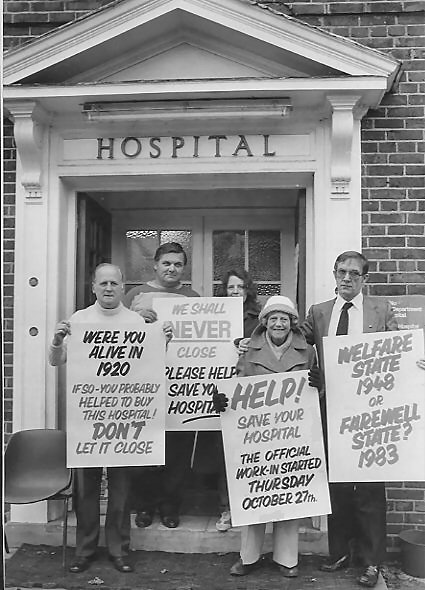
Hayes Cottage Hospital Occupation 25th October 1983


30th Anniversary


Hayes Cottage hospital, West London. Occupied 25th October 1983 until late December 1983, when the local health authority backed down and the hospital was saved.


Marge Bayne, Sylvia Tebbenham, Susan Marshall led the Occupation for the staff members of COHSE and NUPE.


Northwood & Pinner Cottage Hospital was also occupied at the same time starting 26th October, led by the Matron Jean Carey COHSE member
.

Wednesday, May 29, 2013

Hillingdon Hospital Dispute - pre strike July 1995


Hospital Staff threaten strike over contracts


Workers at Hillingdon Hospital are threatening strike action after being told they will be sacked if they do not agree to work longer hours for less money.

Private contractors Pall Mall Services handed out letters last Friday to about 80 cleaning, cooking and portering staff, threatening them with redundancy if they had not accepted new contracts by 30th September 1995.

UNISON representative, Cllr Len Smith, a  porter at the Hospital said:

"Everyone here is angry and frightened. This is worse than our worst fears of what would happen .

"We we  holding a meeting on July 25th. I should like to think we will go for a strike ballot, but its down to the members."

The sack threat follows three months of pressure on staff to sign up for reduced   pay and conditions.

These are different from the ones legally guaranteed under employment law when the services were transferred to the Pall Mall company in October 1984

Shift porters on £4.64 an hour are being asked to go down to £4:27. Other staff face losing up to ten days holiday a year.

About 30 workers escaped the ultimatum because they had already signed new contracts and earned one-off bonuses of up to £1,000. 

In a letter to staff the company said the cuts and other changes in working practices were needed so it could "meet contractual requirements".

Cllr Smith said the company had tendered too low to win the contract and wa now trying to "claw back the money from workers.

He also accused the hospital's managers of betraying staff because they have stayed neutral in the dispute.

They promised last yes workers would not suffer under Pall Mall

"Surely the hospital has got to take an interest now because they were the ones who sold us down the river"

Hospital chief executive Philip Brown, denied he had misled staff when he told them last July conditions under the private contractors would be "no less favorable than currently enjoyed"

But he admitted he had known it was always likely the company would try to make changes about a year after it took on the workers from the hospital.

He refused to become involved in the dispute even though Pall mall had not consulted him before making the redundancy threat. Pall Mall declined to comment.


Uxbridge Gazette 12th July 1995


Hillingdon Hospital Cleaners strike 1st October 1995 to 29th October 2000

Thursday, January 17, 2013

St Bernards (Southall) Union Activist - Dan Moriarty

DAN MORIARTY
NEC Member


Dan Moriarty (St Bernards - Southall) was one of the most popular and respected members of the COHSE health care union National Executive Committee until his retirement last year (1972). He had represented No. 6 Region since 1968 and was also a member of the Legal and Parliamentary Committee and the Staff Superannuation Committee.
 

Dan, accompanied by his wife, was the guest of honour at the Annual General
Meeting of his former region on 16 April and was presented with a cheque and
framed life-membership certificate.
 

In making the presentation, Tom Hedditch.  Regional Chairman during Dan's
term of office, referred to his exceptional personal qualities saying: 'He was never
too busy to try to help not only his fellow trade unionists but his fellow men.' His
generosity  and  compassion  were  well known and demonstrated in his everyday
approach to life: although he had suffered the horrors of a Japanese prisoner of war
camp, he bore no resentment towards his former captors - his regard for his fellow
men was not limited by race or creed.
 

St Bernard's Hospital Branch, where he was branch secretary, owes a great deal to
Dan's organising abilities; it is now one of the largest branches in the country, and
Charlie Wood, who spoke as a member of the National Executive Committee, said
that Dan's point of view had always been respected  and  he  paid  tribute  to  his
diligence and devotion to duty.

  Mrs Moriarty, who was presented with a bouquet of flowers, was described as
'The good woman behind the man'. There is no doubt that her support had contributed to her husband's success.

  In reply Dan, who now lives in South Wales, said it had always been a pleasure
to carry out the various duties required of him, and referred to No. 6 Region as the
most vigilant and enthusiastic in the Confederation. He sincerely hoped that the
standards he had set over the years were acceptable.

  As Regional Secretary, may I say that for No. 6 Region there is no doubt that
Dan Moriarty's standards were most acceptable - the point is whether we who
follow him can even attempt to follow in his footsteps. We wish him all the best for
a long and happy retirement.


COHSE Journal - June 1973

Friday, November 23, 2012

Hillsborough and The Miners Strike


The recent revelation that Police colluded to ensure the prosecution and jailing of miners during the 1984-85 miners strike, comes as no surprise to those active at the time.


The only surprise is that it has been revealed in our lifetime, a fact only due to the tireless efforts of the Hillsborough campaign for justice, which highlighted the establishments successful attempts to hide the truth of what really happened to 96 innocent Liverpool supporters killed at Hillsborough on 15th April 1989

Not only were the 96 football fans who died, defamed but the Tories and their establishment friends attempted to vilify the whole City of Liverpool, that rallied to support the families. 


The Hillsborough Inquiry, highlighted establishment collusion and police collusion at the highest levels and it soon became evident that the same tactics used to marginalise the Hillsborough families, had also been used extensively during the miners strike.

During the Miners  strike 11,291 people were arrested, of whom 8,392 were charged, we now know many of those charged were totally innocent.

COHSE activists at the time feared that the sequestration and imprisoning of miners was simply an attempt by the establishment to smash a democratic and free trade union in Britain.


COHSE had always had a strong bond of friendship towards the miners and a "debt of gratitude" had grown over many years, not least because the miners had often taken action in support of nurses and NHS staffs pay and they campaigner alongside us to defend hospitals from closure.


So it was that a "middle of the road" union like COHSE would play a critical role in ensuring, that to the surprise of Neil Kinnock and Labour Party apparatchiks a resolution at the October 1985  Labour Party conference was carried calling for a future Labour Government to investigate the jailing of miners and a full scale amnesty. 

The Labour Party leadership were sure of victory so it was to their great shock to find that the decisive vote in favour was cast by COHSE. 

To COHSE's great pride and the Labour Party leadership's shock.


Of course the Blair government did nothing about the Amnesty or for that matter Hillsborough, but the truth has finally begun to appear and those of us who stated that the jailing were a simply political act have been vindicated. 

Unfortunately many convicted and framed miners lost their pensions and employment, many died not knowing that their innocence would one day be revealed.

We salute those brave striking miners once again for their courage and fortitude against overwhelming forces.

NOTE:Hillingdon Miners Support Group raised over £12,000 pounds (about £50,000 today) during the 1984-85 miners strike.

Miners from Kent slept at the Hillingdon TUSU in the High Street, West Drayton. Special recognition should go to Mothers Pride Bakery workers, and the Bakers Union who organised a very effective 50p a week levy.

Hillsborough: The London Borough of Hillingdon made a donation of £10,000 to the Liverpool Mayors Hillsborough Appeal, one of the largest donations made to the appeal. Having have had at least one of it's young residents killed at Hillsborough, The Hillingdon Labour Group felt honour bound to move a resolution to make the donation, which secured the support of just one Liberal councillor (The others abstained), this was enough on the "Hung Council" to secure the donation was made. The Conservative Councillors to their utter shame opposed, referring to the anti Liverpool fans statements in the press.

Below: NUM Coal not Dole snowman, Hayes, Middlesex 1984


Tuesday, June 21, 2011

Hayes Cottage Hospital Work-In 1990


Sit-In protest at the Cottage

STAFF staged a 24-hour sit-in at Hayes Cottage Hospital yesrerday (Tuesday 29th May 1990) ) in the first stage of a campaign to halt privatisation plans.

Nursing and ancillary staff at the Grange Road hospital, which cares for the elderly,
claim there has been no consultation with them or families over the planned privatisation.

They are demanding full discussions with management.

Hillingdon Health Authority general manager Mike Bellamy said: "I very much regret
the action taken by some staff".

No decision has been taken on the future of Hayes Cottage, although the health authority is fully committed to modernising it, expanding its bed numbers and securing its future.

"It will discuss the various options at its meeting on June 12, but a final decision will not be made then.

"This 24-hour sit-in really is a nonsense and helps no one."

One 92-year-old long-stay patient, Maud Ashley, is threatening a hunger strike if she is forced to move out.

More than 3,000 signatures were collected in Hayes on Saturday by staff who claim theirpported by GPs and the community.
COHSE Health union representative Michael Walker said: "It is a local service offering high-quality care for the people of Hayes and Harlington.

This is a very local service offering high quality care for the the people of Hayes & Harlington - This is a very much loved facility"

Much of the hospital's equipment had been provided by local fund-raising, he added.

Protesters say that, if the hospital was privatised, beds would go to the highest bidder from anywhere in the country and would cease to be a local centre for communitycare

Mr Walker says managers have gone back on guarantees that the hospital would stay open and accused Mr Bellamy of being "economical with the truth" over his statements about its future.

In 1983, Hayes Cottage Hospital was occupied by staff and supporters (work-in) for several months as staff successfully fought to save it from closure.


See previous postings on 1983 Hayes Cottage Hospital Occupation and Northwood & Pinner Cottage Hospital occupation

click to enlarge photos

Sunday, March 20, 2011

Ambulance Dispute - Hillingdon 1989-1990


Click on pictures tio enlarge

COHSE Hillingdon & District 618 Banner
Uxbridge Labour Party Banner

Hillingdon Hospital Accident & Emergency and Theatre Nurses

Note Cllr Simon Geldberg, Pete Marshall, COHSE, Wally Kennedy

Ambulance Dispute 1989-1990


Ambulance workers enjoyed unprecedented levels of public support
during the six-month dispute as opinion polls found more than four out of five people consistently backed the unions.

Successive Gallup polls for the Daily Telegraph found even a majority of Conserative voters felt Health Secretary Kenneth Clarke should come up with more cash as he took the brunt of the blame for the disruption to patient services.

Electors said they would even be prepared to pay a little more income tax to fund a deal, while other health service staff, including nurses, disclosed that they would not demand an equal pay rise if ambulance crews and control room staff were awarded more than the going rate.

Such sympathy was evident daily by the millions of pounds that filled the buckets
thrust forward by the ubiquitous, fluorescent-jacketed ambulance staff that became as much a part of shopping centres as Boots and McDonalds.

TUC General Secretary Norman Willis told how would-be queue-jumpers were ordered to the back of the line while he waited patiently to add his name (no doubt again) to the record-breaking petition.

All good stuff for the unions but, of course, it was never ordained to be so, as prevous disputes involving NHS workers in the 1970s and early 1980s demonstrated.

This time round the five unions involved COHSE, NUPE, TGWU, NALGO and GMB — paved the way for their own success by breaking new ground with a slick public relations campaign that went further than any previously used by a workforce during a dispute.

The initiative was seized with a strategy that had its effect on the wider world of statements and actions worked out, instead of merely addressing the troops, and realised the importance of newspaper, radio and TV in getting a message across.

Once a groundswell of public opinion had been generated, every opportunity was taken to portray the crews and not the Government as the patient's friend and to hammer home a simple message.

Initiatives were repeatedly launched to make the running rather than merely provide reaction which, by staying one step ahead, often wrong-footed the Government and kept the Departmental of Health on the defensive for much of the time.

Frequent press conferences, a national demonstration, the petition, a quarter-hour of action and even a hunger strike kept the dispute in the public eye when it might have been forgotten.

The unity displayed by the five unions and the absence of what for the NHS used to be traditional in-fighting, rivalry and factionalism allowed a united front to be displayed which forced journalists to look towards the Government for splits and divisions.

In that vein, tasks were allocated to avoid repetition and confusion. NUPE's Roger Poole, the chief negotiator, became the public voice and was constantly in the media, modelling a new hair cut and a businessman's suit to look as well as sound the part.

Meanwhile, COHSE's Bob Abberley beavered away behind the scenes in Parliament to put crucial political pressure on Ministers which was as important.

Several years ago everyone would have been clamouring to appear on TV as they jockeyed for status and, no doubt, future members. Now a trio of those involved, COHSE, NUPE and NALGO, could end up merging — partly as a result of the demonstration that they can work together.

The two immediate goals of the dispute

— a substantial pay rise and new pay machinery — were constantly pressed home in simple, relevant terms by the unions, while other issues such as local bargaining and privatisation which the public would either not understand or have less sympathy with were left in the background.

Opinion polls showed that the ambulance worker-supporting public did not know what the Government's offer was or how the pay mechanism demanded would work. But what they did believe was that crews were worth more, and the new system would just about rule out future industrial action.

The employers, on the other hand, varied their official spokesman between Kenneth Clarke, NHS chief executive Duncan Nichol, and David Rennie, who chairs the employers' side on the Whitley Council negotiating body, with the result that apparent differences of opinion were interpreted as splits.

In many respects the unions' public relations campaign set a model for others to follow and established standards by which they will be judged in the future.

The strategy was not entirely new, although the effective use of the latest communications technology which meant Poole and Abberley could always be reached for an instant quote did break new ground.

After all. National Union of Railwaymen General Secretary Jimmy Knapp
projected himself very successfully last summer as the passengers' friend in the confrontation with BR over pay and bargaining rights by hammering home a simple message and making it relevant to the wider travelling public rather than limiting the dispute to the interests of his members.

And the Confederation of Shipbuilding and Engineering Unions hired a PR firm with close links to the labour movement to get their message across in the shorter working week campaign.

But the five national negotiators, dubbed the "famous five" for the way they often appeared together and even started wearing matching overcoats, took PR a significant step further.

The dispute was right for the tactics. Ambulance workers had a reasonable it not a good case and have a high public profile because of the life-and-death nature of the job. The timing of the dispute was also right in that the polls had already started to move against the Government, which the unions were able to capitalise on.

Flashing blue lights and 999 sirens provided excellent TV pictures in particular and the service has something of a glamorous image for outsiders.

Further, crews used to dealing with the public in high-pressure situations adapted
well to the glare of TV lights and, judging by the number of local stunts launched,
actually liked the media attention.

Running a similar campaign on behalf of other low-paid groups such as ancillary workers — however deserving — will not be as easy. But the lessons are there and should be learnt.

Splits and in-fighting in the union camp would have been reported. Violent picketing and clashes with the police would have made attention-grabbing TV pictures. Disputes will be covered in the form they occur. It's up to the unions how they want to run their campaigns, but if it's public opinion they want on their side, they could do worse than copy the ambulance workers.

Kevin Maguire is the Daily Telegraph labour correspondent.

He writes here in a personal capacity.

COHSE Journal May 1990

NOTES

In my experience, this was undoubtedly one of the best led strikes in the NHS, the ability to use the media and the discipline of local Ambulance union reps and members was key to winning and maintaining public support.

The hub of the dispute was undoubtedly London and West London in particular most notably Park Royal, Feltham, Twickenham and Hillingdon ambulance stations.

Crews in Birmingham, Merseyside and Dorset were also very strong

The tactic of slowly increasing pressure on employer (overtime bans, emergencies only etc) forced the management in frustration to effectively “lock out” ambulance staff by refusing to send any calls to these stations and bring in the Army.

The Crews responded by occupying the ambulance stations as they did at Hillingdon, the management being forced to issue injunctions, but with little effect.

Elsewhere, in the country, Ambulance management in many areas did not follow London’s tactics and the crews remained at work, allowing them to secure even more support and money for those “locked out”.

Nine weeks into the dispute the Health Service Journal reported that an estimated 27 out of 44 ambulance services were operating a 999 only service.

Kenneth Clarke’s remarks that ambulance workers were little more than “professional drivers” totally incensed the crews.

On January l3th 1990 75,000 attended a TUC national demonstration in support of the ambulance workers and on 30th January a day of solidarity, when South London bus drivers came out on strike.

While the dispute was not a total success, the public was confident the unions had rightly won and gave a big fillip of confidence to NHS trade unionists.

Roger Poole was an excellent public speaker and with a CP background understood the need to keep both the public and the members on side. Bob Abberley became know as “Rogers bag carrier” and Jeanette Roe COHSE Regional Officer did Stirling work with Pete Marshall COHSE Regional Secretary in galvanising COHSE members in London.

As the ambulance service had been initially part of Local Government( London County Council) most staff in London were members of NUPE 70-80%. However COHSE had from 1964 built up a small but significant membership based around the leadership of Bill Dunn at Hanwell, West London (The other key COHSE branch being at Park Royal)

The Ambulance dispute started October 1989 – March 1990 and lasted six months

The Great Ambulance petition secured 4.5 million signatures


Pictures of the Ambulance dispute in Hillingdon (Marion Way NUPE Ambulance Steward) in Uxbridge town centre collectining signaturers, on the front line at Hillingdon ambulance station, lastly army ambulance at Hillingdon Hospital


The Ambulance Strike 1989-1990

In November 1989 Ambulance crews at Hillingdon, Heathrow and Pinner
were suspended during the Ambulance pay dispute of 1989-1990.

They had refused to cover non-emergency calls
as did 68 other London stations

All were suspended and police and army were brought in to cover both emergency and non-emergency


However, suspended ambulance crews continued to provide an emergency service with a dedicated phone line/ Including a plea from staff at mount Vernon to take a severely injured car crash victim to Charring Cross Hospital.

The first local Army ambulance was used in Pinner on November 13th

The staff maintained a vigil at Hillingdon Ambulance station as well as collecting signatures in Uxbridge town centre.

The Ambulance staff had huge public support and the campaign was well run by union leader Roger Poole of NUPE. The success of which helped in securing at least a partial victory on pay and a rare defeat for the Conservatives

Local Stewards
Marion Way (NUPE)
John Drewery (COHSE)