Hayes Communist Party plans for a transport terminal in Hayes for Hayes UDC Elections 1946


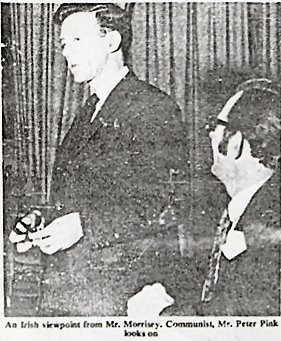
 Frank Stanley Frank StanleyFrank Stanley (pictured above addressing the 1967 Communist Party Congress at Camden Town hall and left in one of his election addresses) Frank Stanley was born in 1920 in Acton. His father was an active trade unionist and steward. At the end of life in his junior school, Frank won a scholarship to the local Grammar School. But, because his father was unemployed at the time and unable to afford the loss of wage to the family, or the cost of a uniform, he was unable to take his place and eventually left school at the age of 14. In 1937 he joined the Young Communist League and in 1940 became a full member of the Communist Party, in the same year he married his wife Joan who he met through the YCL and with whom he would have two daughters. From 1942-1946 he served in the REME (14th Army) for three and a half years in Burma and became a Warrant Officer. An instrument maker by trade, he started work at EMI Hayes in 1950 and became an Amalgamated Engineering Union (AEU) steward the following year. From 1959 he was AEU convenor and Secretary of the Joint Stewards Committee, negotiating on behalf of 6,000 workers at EMI. In February 1962 a one day strike took place at EMI at which a number of scuffles with police broke out. The local MP was to state that, in Blythe Road, Hayes, the police "appeared to encourage them to drive at the pickets". That March 700 AEU members marched from Hayes to Southall protesting at the Government imposed a "Pay Pause". They were addressed by Mr Sheeny convenor at Alladin's factory. The local paper refers to a Wally Hannington, a retired Jarrow engineer being present on the march. This must be Wal Hannington (1896-1966), former AEU and National Unemployed Workers Movement organiser (See entry for Hannington). Stanley was Chairman of West Middlesex District Committee of the Communist Party and national chair of the Communist Party’s Central Committee and was a pallbearer at Willie Gallacher’s funeral in 1965. Frank Stanley lived in Hayes and was the Communist Party candidate for Hayes & Harlington constituency on a number of occasions. In his first attempt in the General Election of October 1964, he stood on a platform of: 1) Put yourself before the Monopolies and land speculators 2) Vote to abolish nuclear weapons 3) Break the American grip on our country He also featured a campaign for a branch line linking Hayes with the Central or Piccadilly Underground line). Frank and the local Communists canvassed over 16,000 houses in Hayes during this election and John Gollan, Communist Party general secretary, spoke at his adoption meeting on Monday 14th September at the Civic Restaurant, Coldharbour Lane. He was one of 36 Communist parliamentary candidates at the 1964 election and took part in the Communist Party Election rally at Hyde Park and march to the BBC to demand air time on Sunday, September 13th. He also appeared in the Communist Party’s election broadcast in the following General election. Frank Stanley was also active in the promotion of the Trades Union Congress inspired Centre 42 arts programme in 1962 (named after the arts resolution number on the agenda at TUC Congress), Centre 42 "aimed to provide an outlet for cultural ambitions and entertainment of the ordinary person" The public face of which was Arnold Wesker and toured Britain visiting Hayes and Southall November 19th - 24th, 1962, this stop included the first presentation of "Enter Solly Gold" by Bernard Cops, a Youth Theatre production of "Hamlet", Music Theatre presented "The Soldiers Tale” and the "Nottingham Captain", a Jazz band, poetry reading, photograph exhibition, drawings, folk singing including Ewan MacColl and Peggy Seeger. Ill-health forced Stanley to retire to Banbury, Oxfordshire. |


HAYES EMI
COMMUNIST PARTY FACTORY REPORT 1953
From the work inside our factory, and especially from the movement around redundancy and the wages campaign, in which our factory were the leaders in that part of West Middlesex, we have learned that it would "have been impossible for us to have achieved such a level of activity, to have so influenced the course of events in other factories, without the existence of a Communist Party branch which was recognised and known in the factory as a public force.
Inside our factory there are 100 shop stewards, of whom only eight are members of the Communist Party, yet invariably, on all major questions, the standpoint of the Shop Stewards Committee is a progressive one, and it was possible to win some 5,000 signatures in the factory on the demands against rearmament, for a Five Power Peace Pact and for the defeat of the Tory Government. It is obviously not just a question of voting strength, especially when you consider that the attendance at the fortnightly shop stewards' meeting is round about fifty. It is because the Party has become known through the public meetings it has conducted outside the factory, where the convenor is known as a Party member, who speaks for the Party outside and inside the factory.
That is the basis on which we have been able to make this contribution towards the broader movement on wages and redundancy. But we have now reached a stage for some time where we know that if the policy of the Tory Government is not to be more heavily and sharply felt in Hayes, there is one essential and necessary condition, and that is, the building up of the Communist Party.
Inside the factory we are proud of the contribution we have made over the past twelve months; but we recognise serious weaknesses in the way we have not faced up to the building of the Party. In twelve months, up to the annual meeting of our branch last May, we had increased our Party membership by 25 per cent.
This was in a period of a number of outstanding events, including the formation of an "Anti-Tory Committee" at the time of the elections in 1951, which the Shop Stewards Committee elected and which formulated its own points of policy, and spoke outside the factory along with the local candidates for Uxbridge and Hounslow on the policy of the Shop Stewards Committee.
The No. 1 Question
Since May 1952 we have only been able to increase membership from thirty-eight to forty-one inside the factory. Yet that period is one in which we have had tremendous opportunities and possibilities. The work of our, Party Branch, its activity, has not been on a lower level. On the contrary, it has been much higher; the Party Branch has issued leaflets, held more meetings, and the work of our Communist stewards has been improved. Yet in spite of this, we have not had the growth that we expected, and it is because we have always supposed that the question of Party building is the last thing instead of the first.
Frank Stanley World News & Views in May 1953
Note workforce at Hayes EMI about 6,000

The Daily Worker, (now the Morning Star) was the organ of the Communist Party, The first edition was produced on 1 January 1930 from the offices of the newspaper at 41 Tabernacle Street, London. In January 1934 The Daily Worker's offices move to Cayton Street off the City Road. On 1 October 1935, the first eight page Daily Worker was produced.
 The Daily Worker offices at Cayton Street were totally destroyed by fire during German bombing on Wednesday 16 April 1941. The Daily Worker moved temporarily in 1942 to the former Caledonian Press offices in Swinton Street (from where the old Communist Party Sunday Worker had been printed until 1929). In 1945 new offices were acquired at a former brush makers warehouse at 75 Farringdon Road, London EC1 for the sum of £48,000 (picture left). A Scottish edition of the Daily Worker was produced from its plant in Glasgow starting on 11 November 1940.
 31st October 1948 was acclaimed by the Communist Party's General Secretary, Harry Pollitt, as the 'greatest and proudest day' in the Daily Worker's history; for a revamped Daily Worker came off the new Goss press in the new building in Farringdon Road. A torchlight procession of 20,000 demonstrators stopped all traffic as crowds surged round Bill Rust and carried him shoulder-high to Clerkenwell Green, where he auctioned the first two copies for the staggering sum of £45 each (perhaps £1,500 to £2,000 today!). Next day, he received a telegram from George Loveless, a descendant of the 1834 Tolpuddle Martyrs: 'Today is a proud day for us all. This is what our ancestors fought for. Long live the people's paper.'
Since September 1945 the paper has been owned and published by a readers' Co-operative, the People's Press printing Society, which operates on a one-vote-per-shareholder basis. The last edition of the Daily Worker came out on Saturday 23 April 1966, being re-launched as the Morning Star, the first edition of which appeared the following Monday, 25 April 1966.
The Daily Worker's last editorial stated
 "On Monday this newspaper takes its greatest step forward for many years. It will be larger, it will be better and it will have a new name.......During its 36 years of life our paper has stood for all that is best in British working-class and Socialist journalism. It has established a reputation for honesty, courage and integrity. It has defended trade unionists, tenants, pensioners. It has consistently stood for peace. It has always shown the need for Socialism. Let all Britain see the Morning Star, the inheritor of a great tradition and the herald of a greater future".
 9
9
 Reg Neal
In October 1950, Middlesex County Council Tory dominated Education Committee refused to endorse the appointment of Reg Neal of Yeading Junior School, Hayes to the Headship of Bounds Green School, and then imposed a blanket ban on appointment of Communists Headships in the County.
The leading opponent of the Communists was the Conservative Chairman of the Education Committee, Alderman Archer Hoare, a supporter of the anti-Communist campaigning group, 'Common Cause'
The attack on Reg Neal was a direct result of the activities of the famous Acton CommunistG.C.T Giles was a committed Communist party member and headmaster of Acton County School from 1926 to 1956. He became a member of the Executive of the National Union of Teachers and eventually its national President
Alderman Hoare regularly attacked G.C.T Giles accusing him of Communist indoctrination in the school.

 station.

 Those of us who had the honour to be there should be keenly aware of the importance of visit
 (Photo Left) What's the first thing you look for in France ? why, L'Humanite of course