Showing posts with label SDF. Show all posts
Friday, October 30, 2015
Social Democratic Party - StGeorge's & Wapping Banner
Members of the Social Democratic Party (formally Social Democratic Federation pre 1908) selling their journal Justice
Thursday, October 29, 2015
The First May Day - 1890
The First May Day - History Today
In London there was a much smaller demonstration on May 1st supported by those purists who preferred to meet the hopes of the most radical at the Paris Congress for action on the day itself, rather than to recognise the realities of British trade unionism. It was led by Jack Williams, a working man from the East End of London, who was a stalwart of the Marxist Social Democratic Federation (SDF), in his capacity as a leader of the National Federation of all Trades, a short lived general union centred on south-west London.
However, its main support came from the Socialist League, a breakaway group from the SDF which, by this time, was increasingly being dominated by anarchists. Jack Williams' demonstration mustered between 1,000 and 1,500 people who flocked from the Embankment to Hyde Park. This procession was marked by bands playing the Marseillaise, including one wearing French redcaps, and by companies of young men carrying red flags topped with caps of liberty. On the evening of May Day the Socialist League held a demonstration at Clerkenwell Green, attended by several thousand people, which was addressed by William Morris and other leading League figures. However, as E.P.
Thompson wrote in his biography of Morris, 'For the sake of this principle [demonstrating on May Day itself, which they held to honestly in the belief that they were acting in true international fraternity, they rejected the chance of sharing in the leadership of one of the greatest demonstrations since the last days of Chartism.'
The main demonstration in London, held on Sunday, was one of the largest, quite possibly the largest, in British history. A delighted Engels, who was present on one of the platforms, wrote afterwards:
The demonstration here on 4th May was nothing short of overwhelming and even the entire bourgeois press had to admit it... 250 to 500,000 people, of whom over three-quarters were workers demonstrating...All in all, the most gigantic meeting that has ever been held here.
To Karl Marx's daughter Laura, Engels wrote:
I can assure you that I looked a couple of inches taller when I got down from that old lumbering wagon that served as a platform – after having heard again, for the first time since 40 years, the unmistakeable voice of the English Proletariat.
For all its vast size the main London May Day demonstration was notable for divisions among its sponsors. The Times, which testified to the scale of the event, also noted:
The whole affair, long though it had been in planning, was on the whole, not well organised, probably because there was a lack of unanimity among the leaders. The simple truth of the matter appears to be that orders came from three different sources, that three sets of minds were at work, and that the result was confusion.
The three groups were the Central Committee for the Eight Hours Legal Working Day Demonstration, the London Trades Council and H.M. Hyndman and the SDF.
The Central Committee for the Eight Hours Legal Working Day Demonstration had been formed on April 6th, 1890. It represented ninety-four trade union, socialist and radical groups, most of which had been campaigning for the eight-hour day. One of the most important of these bodies was the National Union of Gas Workers and General Labourers which had won an eight-hour day through strike action in 1889. When its secretary, Will Thorne, was asked to organise a May Day demonstration he turned to Eleanor Marx and Edward Aveling (the socialist with whom she lived). As well as being a major influence on Thorne's development as a socialist, Eleanor Marx had been very active in the struggle to set up the gasworkers' union. She and Aveling were leading figures in the Bloomsbury Socialist Society, which itself had started to make preparation for May Day. Along with the gasworkers and the Bloomsbury Socialist Society, the other major body involved in the formation of the Central Committee was the Labour Electoral Association which had been set up by the TUC in 1886. The Central Committee was committed to the statutory enactment of the eight-hour day.
In contrast, the London Trades Council in 1890 would go no further than to declare itself in 'favour of the principle of reducing hours of labour, leaving the precise method to the future'. It was dominated by an older generation of trade unionists who were nervous about supporting even the Sunday demonstration. However, as one of the old guard of trade unionists, 6eorge Howell, the Liberal Member of Parliament for Bethnal Green, put it, 'Goaded by the attacks of the Socialists and New Trade Unionists, the London Trades Council found itself obliged to participate in May Day celebrations in favour of "solidarity of labour", Eight Hours and other idealist proposals' Tom Mann, a leading socialist and New Unionist, succeeded in getting round the majority's opposition to a legal, eight-hour day by proposing that the London Trades Council hold a separate demonstration on May 4th. Hence the Trades Council made its own separate arrangements, including marching to Hyde Park by a different route from the Central Committee's procession and having seven separate platforms for its speakers in the Park.
To add to organisational disarray. H.M. Hyndman and the SDF were a third element in the great demonstration of May 4th, 1890. Hyndman had long fallen out with Engels and with the Central Committee's leading figures. He arranged with the London Trades Council to have two of its seven platforms in Hyde Park.
By all accounts the London Trades Council's attempt at separate organisation was a disaster. The Leicester Daily Mercury's correspondent gave the following assessment:
The fact is that the Trades Council were beaten by their very numbers. They marched into the park in straggling detachment, and all interest in the demonstration had died away and the crowd had gone before the last detachment arrived, weary and forlorn, at ten minutes to six. Thus the Eight Hours Bill party gained a triumphant victory. They showed their full strength, and their opponents, the numerically stronger, never even looked imposing. They occupied the ground first and engaged the interest of the crowd. They had excellent and well-known speakers, whereas their opponents confined themselves to working men orators. Last, but not least, they had a clear and definite proposition to make.
The only Trades Council platform which drew a large crowd was the main one, at which Tom Mann and Ben Tillett of the Dockers' Union spoke. This was surrounded by dockers, barge-builders, ropemakers and railwaymen. Mann, though he was a well-known advocate of the legal eight-hour day, loyally spoke to the Trades Council motion.
The Central Committee's organisation coped better with the huge number of demonstrators. At 4.00 p.m. a bugle sounded, and their speakers, standing on the seven wagons serving as platforms, began. However as The Times correspondent noted 'Procession after procession came streaming into the park, bands played through speeches and it was a medley of sounds.'
The biggest crowd gathered around platform five, the Gas Workers' Union's platform, to hear John Burns. Burns, then thirty-one, was at the height of his radical reputation; he gave his audience a fiery speech, which included very blunt criticism of the older generation of trade union leaders on the TUC and London Trades Council. He said that he and the men on that platform 'had done more for unionism in the last twelve months and had formed more trade unions in that time than all the Broadhursts and Shiptons put together'. Burns said that although the gas workers 'had got an eight hours day by voluntary effort and by combination', they knew that 'directly trade declined and the boom was passed' the employers would take such gains away unless they were protected by an act of parliament.
While the main theme on the Central Committee's platforms was the eight- hour day, it was not the sole one. On their second platform Thomas Sutherest, then Radical prospective parliamentary candidate for Doncaster, gave a vigorous speech against sweated labour. Michael Davitt, the great Irish Nationalist advocate of land nationalisation, also spoke from that platform, urging not only that 'the land should belong to the people' but also that, 'It rested with the people themselves to send to Parliament men from their own ranks who were really representatives of labour, and the working classes would never achieve any satisfactory reform until they realised and acted upon this fact'. The Central Committee's other platforms had other famous socialist and trade union figures on them. As well as Engels, these included Fabians George Bernard Shaw and Graham Wallas, Edward Bernstein, Eleanor Marx, George Lansbury, R B. Cunningham Graham MP, and Pete Curran.
While the massive London demonstration of May 4th, 1890, received international attention, there were others elsewhere in Britain. These were held in places with marked SDF, Socialist League or New Union activity or a blend of these. Within England, the largest May Day demonstrations appear to have been in Northampton and Leeds.
In Northampton, in spite of pouring rain, there was a large procession headed by a temperance hand. The Times reported that:
Nearly 10,000 working men assembled in the market square, representing almost every branch of labour in the town and district, including about 2,000 agricultural labourers from adjacent villages.
In Leeds some 6,000 workers marched in procession, with a band playing the Marseillaise. At their head was a banner of the Leeds Jewish Tailors, Pressers and Machinists, and those in the march included 1,100 Jewish tailors, 900 slipper makers and 800 gas workers, followed by contingents of dyers, maltsters, teamsters and general labourers. There were also sizeable demonstrations in Bristol and Plymouth.
In Scotland the largest demonstration was in Aberdeen on Saturday, May 17th. Some 6,000 trade unionists took part in the procession and between 10,000 and 20,000 heard H.H. Champion speak at the open-air meeting. In Edinburgh, in spite of the opposition of the trades council to a demonstration, between 400 and 600 people turned out to hear Keir Hardie and other speakers on Sunday, May 4th.
NOTE
As late as March 1949 West Ham Trades Union Council were claiming that they were the pioneers of the first ever may day in 1890 (probably via the Gas workers union militancy)
source Daily Worker 9 April 1949
The 1890 May day procession was marked by bands playing the Marseillaise, including one wearing French redcaps, and by companies of young men carrying red flags topped with caps of liberty.
In London there was a much smaller demonstration on May 1st supported by those purists who preferred to meet the hopes of the most radical at the Paris Congress for action on the day itself, rather than to recognise the realities of British trade unionism. It was led by Jack Williams, a working man from the East End of London, who was a stalwart of the Marxist Social Democratic Federation (SDF), in his capacity as a leader of the National Federation of all Trades, a short lived general union centred on south-west London.
However, its main support came from the Socialist League, a breakaway group from the SDF which, by this time, was increasingly being dominated by anarchists. Jack Williams' demonstration mustered between 1,000 and 1,500 people who flocked from the Embankment to Hyde Park. This procession was marked by bands playing the Marseillaise, including one wearing French redcaps, and by companies of young men carrying red flags topped with caps of liberty. On the evening of May Day the Socialist League held a demonstration at Clerkenwell Green, attended by several thousand people, which was addressed by William Morris and other leading League figures. However, as E.P.
Thompson wrote in his biography of Morris, 'For the sake of this principle [demonstrating on May Day itself, which they held to honestly in the belief that they were acting in true international fraternity, they rejected the chance of sharing in the leadership of one of the greatest demonstrations since the last days of Chartism.'
The main demonstration in London, held on Sunday, was one of the largest, quite possibly the largest, in British history. A delighted Engels, who was present on one of the platforms, wrote afterwards:
The demonstration here on 4th May was nothing short of overwhelming and even the entire bourgeois press had to admit it... 250 to 500,000 people, of whom over three-quarters were workers demonstrating...All in all, the most gigantic meeting that has ever been held here.
To Karl Marx's daughter Laura, Engels wrote:
I can assure you that I looked a couple of inches taller when I got down from that old lumbering wagon that served as a platform – after having heard again, for the first time since 40 years, the unmistakeable voice of the English Proletariat.
For all its vast size the main London May Day demonstration was notable for divisions among its sponsors. The Times, which testified to the scale of the event, also noted:
The whole affair, long though it had been in planning, was on the whole, not well organised, probably because there was a lack of unanimity among the leaders. The simple truth of the matter appears to be that orders came from three different sources, that three sets of minds were at work, and that the result was confusion.
The three groups were the Central Committee for the Eight Hours Legal Working Day Demonstration, the London Trades Council and H.M. Hyndman and the SDF.
The Central Committee for the Eight Hours Legal Working Day Demonstration had been formed on April 6th, 1890. It represented ninety-four trade union, socialist and radical groups, most of which had been campaigning for the eight-hour day. One of the most important of these bodies was the National Union of Gas Workers and General Labourers which had won an eight-hour day through strike action in 1889. When its secretary, Will Thorne, was asked to organise a May Day demonstration he turned to Eleanor Marx and Edward Aveling (the socialist with whom she lived). As well as being a major influence on Thorne's development as a socialist, Eleanor Marx had been very active in the struggle to set up the gasworkers' union. She and Aveling were leading figures in the Bloomsbury Socialist Society, which itself had started to make preparation for May Day. Along with the gasworkers and the Bloomsbury Socialist Society, the other major body involved in the formation of the Central Committee was the Labour Electoral Association which had been set up by the TUC in 1886. The Central Committee was committed to the statutory enactment of the eight-hour day.
In contrast, the London Trades Council in 1890 would go no further than to declare itself in 'favour of the principle of reducing hours of labour, leaving the precise method to the future'. It was dominated by an older generation of trade unionists who were nervous about supporting even the Sunday demonstration. However, as one of the old guard of trade unionists, 6eorge Howell, the Liberal Member of Parliament for Bethnal Green, put it, 'Goaded by the attacks of the Socialists and New Trade Unionists, the London Trades Council found itself obliged to participate in May Day celebrations in favour of "solidarity of labour", Eight Hours and other idealist proposals' Tom Mann, a leading socialist and New Unionist, succeeded in getting round the majority's opposition to a legal, eight-hour day by proposing that the London Trades Council hold a separate demonstration on May 4th. Hence the Trades Council made its own separate arrangements, including marching to Hyde Park by a different route from the Central Committee's procession and having seven separate platforms for its speakers in the Park.
To add to organisational disarray. H.M. Hyndman and the SDF were a third element in the great demonstration of May 4th, 1890. Hyndman had long fallen out with Engels and with the Central Committee's leading figures. He arranged with the London Trades Council to have two of its seven platforms in Hyde Park.
By all accounts the London Trades Council's attempt at separate organisation was a disaster. The Leicester Daily Mercury's correspondent gave the following assessment:
The fact is that the Trades Council were beaten by their very numbers. They marched into the park in straggling detachment, and all interest in the demonstration had died away and the crowd had gone before the last detachment arrived, weary and forlorn, at ten minutes to six. Thus the Eight Hours Bill party gained a triumphant victory. They showed their full strength, and their opponents, the numerically stronger, never even looked imposing. They occupied the ground first and engaged the interest of the crowd. They had excellent and well-known speakers, whereas their opponents confined themselves to working men orators. Last, but not least, they had a clear and definite proposition to make.
The only Trades Council platform which drew a large crowd was the main one, at which Tom Mann and Ben Tillett of the Dockers' Union spoke. This was surrounded by dockers, barge-builders, ropemakers and railwaymen. Mann, though he was a well-known advocate of the legal eight-hour day, loyally spoke to the Trades Council motion.
The Central Committee's organisation coped better with the huge number of demonstrators. At 4.00 p.m. a bugle sounded, and their speakers, standing on the seven wagons serving as platforms, began. However as The Times correspondent noted 'Procession after procession came streaming into the park, bands played through speeches and it was a medley of sounds.'
The biggest crowd gathered around platform five, the Gas Workers' Union's platform, to hear John Burns. Burns, then thirty-one, was at the height of his radical reputation; he gave his audience a fiery speech, which included very blunt criticism of the older generation of trade union leaders on the TUC and London Trades Council. He said that he and the men on that platform 'had done more for unionism in the last twelve months and had formed more trade unions in that time than all the Broadhursts and Shiptons put together'. Burns said that although the gas workers 'had got an eight hours day by voluntary effort and by combination', they knew that 'directly trade declined and the boom was passed' the employers would take such gains away unless they were protected by an act of parliament.
While the main theme on the Central Committee's platforms was the eight- hour day, it was not the sole one. On their second platform Thomas Sutherest, then Radical prospective parliamentary candidate for Doncaster, gave a vigorous speech against sweated labour. Michael Davitt, the great Irish Nationalist advocate of land nationalisation, also spoke from that platform, urging not only that 'the land should belong to the people' but also that, 'It rested with the people themselves to send to Parliament men from their own ranks who were really representatives of labour, and the working classes would never achieve any satisfactory reform until they realised and acted upon this fact'. The Central Committee's other platforms had other famous socialist and trade union figures on them. As well as Engels, these included Fabians George Bernard Shaw and Graham Wallas, Edward Bernstein, Eleanor Marx, George Lansbury, R B. Cunningham Graham MP, and Pete Curran.
While the massive London demonstration of May 4th, 1890, received international attention, there were others elsewhere in Britain. These were held in places with marked SDF, Socialist League or New Union activity or a blend of these. Within England, the largest May Day demonstrations appear to have been in Northampton and Leeds.
In Northampton, in spite of pouring rain, there was a large procession headed by a temperance hand. The Times reported that:
Nearly 10,000 working men assembled in the market square, representing almost every branch of labour in the town and district, including about 2,000 agricultural labourers from adjacent villages.
In Leeds some 6,000 workers marched in procession, with a band playing the Marseillaise. At their head was a banner of the Leeds Jewish Tailors, Pressers and Machinists, and those in the march included 1,100 Jewish tailors, 900 slipper makers and 800 gas workers, followed by contingents of dyers, maltsters, teamsters and general labourers. There were also sizeable demonstrations in Bristol and Plymouth.
In Scotland the largest demonstration was in Aberdeen on Saturday, May 17th. Some 6,000 trade unionists took part in the procession and between 10,000 and 20,000 heard H.H. Champion speak at the open-air meeting. In Edinburgh, in spite of the opposition of the trades council to a demonstration, between 400 and 600 people turned out to hear Keir Hardie and other speakers on Sunday, May 4th.
NOTE
As late as March 1949 West Ham Trades Union Council were claiming that they were the pioneers of the first ever may day in 1890 (probably via the Gas workers union militancy)
source Daily Worker 9 April 1949
The 1890 May day procession was marked by bands playing the Marseillaise, including one wearing French redcaps, and by companies of young men carrying red flags topped with caps of liberty.
In
London there was a much smaller demonstration on May 1st supported by
those purists who preferred to meet the hopes of the most radical at the
Paris Congress for action on the day itself, rather than to recognise
the realities of British trade unionism. It was led by Jack Williams, a
working man from the East End of London, who was a stalwart of the
Marxist Social Democratic Federation (SDF), in his capacity as a leader
of the National Federation of all Trades, a shortlived general union
centred on south-west London. However, its main support came from the
Socialist League, a breakaway group from the SDF which, by this time,
was increasingly being dominated by anarchists. Jack Williams'
demonstration mustered between 1,000 and 1,500 people who flocked from
the Embankment to Hyde Park. This procession was marked by bands playing
the Marseillaise, including one wearing French redcaps, and by
companies of young men carrying red flags topped with caps of liberty.
On the evening of May Day the Socialist League held a demonstration at
Clerkenwell Green, attended by several thousand people, which was
addressed by William Morris and other leading League figures. However,
as E.P. Thompson wrote in his biography of Morris, 'For the sake of this
principle [demonstrating on May Day itself, which they held to honestly
in the belief that they were acting in true international fraternity,
they rejected the chance of sharing in the leadership of one of the
greatest demonstrations since the last days of Chartism.'
The main demonstration in London, held on Sunday, was one of the largest, quite possibly the largest, in British history. A delighted Engels, who was present on one of the platforms, wrote afterwards:
The Central Committee for the Eight Hours Legal Working Day Demonstration had been formed on April 6th, 1890. It represented ninety-four trade union, socialist and radical groups, most of which had been campaigning for the eight-hour day. One of the most important of these bodies was the National Union of Gas Workers and General Labourers which had won an eight-hour day through strike action in 1889. When its secretary, Will Thorne, was asked to organise a May Day demonstration he turned to Eleanor Marx and Edward Aveling (the socialist with whom she lived). As well as being a major influence on Thorne's development as a socialist, Eleanor Marx had been very active in the struggle to set up the gasworkers' union. She and Aveling were leading figures in the Bloomsbury Socialist Society, which itself had started to make preparation for May Day. Along with the gasworkers and the Bloomsbury Socialist Society, the other major body involved in the formation of the Central Committee was the Labour Electoral Association which had been set up by the TUC in 1886. The Central Committee was committed to the statutory enactment of the eight-hour day.
In contrast, the London Trades Council in 1890 would go no further than to declare itself in 'favour of the principle of reducing hours of labour, leaving the precise method to the future'. It was dominated by an older generation of trade unionists who were nervous about supporting even the Sunday demonstration. However, as one of the old guard of trade unionists, 6eorge Howell, the Liberal Member of Parliament for Bethnal Green, put it, 'Goaded by the attacks of the Socialists and New Trade Unionists, the London Trades Council found itself obliged to participate in May Day celebrations in favour of "solidarity of labour", Eight Hours and other idealist proposals' Tom Mann, a leading socialist and New Unionist, succeeded in getting round the majority's opposition to a legal, eight-hour day by proposing that the London Trades Council hold a separate demonstration on May 4th. Hence the Trades Council made its own separate arrangements, including marching to Hyde Park by a different route from the Central Committee's procession and having seven separate platforms for its speakers in the Park.
To add to organisational disarray. H.M. Hyndman and the SDF were a third element in the great demonstration of May 4th, 1890. Hyndman had long fallen out with Engels and with the Central Committee's leading figures. He arranged with the London Trades Council to have two of its seven platforms in Hyde Park.
By all accounts the London Trades Council's attempt at separate organisation was a disaster. The Leicester Daily Mercury's correspondent gave the following assessment:
The Central Committee's organisation coped better with the huge number of demonstrators. At 4.00 p.m. a bugle sounded, and their speakers, standing on the seven wagons serving as platforms, began. However as The Times correspondent noted 'Procession after procession came streaming into the park, bands played through speeches and it was a medley of sounds.'
The biggest crowd gathered around platform five, the Gas Workers' Union's platform, to hear John Burns. Burns, then thirty-one, was at the height of his radical reputation; he gave his audience a fiery speech, which included very blunt criticism of the older generation of trade union leaders on the TUC and London Trades Council. He said that he and the men on that platform 'had done more for unionism in the last twelve months and had formed more trade unions in that time than all the Broadhursts and Shiptons put together'. Burns said that although the gas workers 'had got an eight hours day by voluntary effort and by combination', they knew that 'directly trade declined and the boom was passed' the employers would take such gains away unless they were protected by an act of parliament.
While the main theme on the Central Committee's platforms was the eight- hour day, it was not the sole one. On their second platform Thomas Sutherest, then Radical prospective parliamentary candidate for Doncaster, gave a vigorous speech against sweated labour. Michael Davitt, the great Irish Nationalist advocate of land nationalisation, also spoke from that platform, urging not only that 'the land should belong to the people' but also that, 'It rested with the people themselves to send to Parliament men from their own ranks who were really representatives of labour, and the working classes would never achieve any satisfactory reform until they realised and acted upon this fact'. The Central Committee's other platforms had other famous socialist and trade union figures on them. As well as Engels, these included Fabians George Bernard Shaw and Graham Wallas, Edward Bernstein, Eleanor Marx, George Lansbury, R B. Cunningham Graham MP, and Pete Curran.
While the massive London demonstration of May 4th, 1890, received international attention, there were others elsewhere in Britain. These were held in places with marked SDF, Socialist League or New Union activity or a blend of these. Within England, the largest May Day demonstrations appear to have been in Northampton and Leeds. In Northampton, in spite of pouring rain, there was a large procession headed by a temperance hand. The Times reported that:
In Scotland the largest demonstration was in Aberdeen on Saturday, May 17th. Some 6,000 trade unionists took part in the procession and between 10,000 and 20,000 heard H.H. Champion speak at the open-air meeting. In Edinburgh, in spite of the opposition of the trades council to a demonstration, between 400 and 600 people turned out to hear Keir Hardie and other speakers on Sunday, May 4th.
The success of May Day in 1890 ensured that many more demonstrations were organised in 1891. In London some 250,000 people attended the main one on the Sunday. Several thousand people took part in those in Leeds, Liverpool, Newcastle and Norwich. There were also demonstrations in smaller towns such as Jarrow, Sittingbourne and Chatham. In 1891, as in 1890, the new unions were very prominent. The Times noted of Liverpool that the 'processionists were mostly of the unskilled labour class'. As in 1890 the Gasworkers' Union was a major force behind many demonstrations. In the Northeast, at Newcastle and Jarrow, the Tyneside and National Labour Union was prominent. In major ports such as Liverpool and Newcastle the Sailors and Firemen's Union and the Dockers' Union were especially important. In Leeds in 1891, as in 1890, Jewish workers provided a large contingent. In Norwich, Liverpool, Newcastle and elsewhere, the railwaymen, who were pressing for a ten-hour day (eight for shunters in busy yards and for signalmen in busy boxes), were major supporters of the demonstrations. At Newcastle a General Railway Workers' Union speaker spoke bitterly of the parliamentary committee's evidence of men working 'thirty-five hours at a stretch' on the railways.
- See more at: http://www.historytoday.com/chris-wrigley/may-days-and-after#sthash.XHQ6e1IR.dpuf
The main demonstration in London, held on Sunday, was one of the largest, quite possibly the largest, in British history. A delighted Engels, who was present on one of the platforms, wrote afterwards:
The demonstration here on 4th May was nothing short of overwhelming and even the entire bourgeois press had to admit it... 250 to 500,000 people, of whom over three-quarters were workers demonstrating...All in all, the most gigantic meeting that has ever been held here.To Karl Marx's daughter Laura, Engels wrote:
I can assure you that I looked a couple of inches taller when I got down from that old lumbering wagon that served as a platform – after having heard again, for the first time since 40 years, the unmistakeable voice of the English Proletariat.For all its vast size the main London May Day demonstration was notable for divisions among its sponsors. The Times, which testified to the scale of the event, also noted:
The whole affair, long though it had been in planning, was on the whole, not well organised, probably because there was a lack of unanimity among the leaders. The simple truth of the matter appears to be that orders came from three different sources, that three sets of minds were at work, and that the result was confusion.The three groups were the Central Committee for the Eight Hours Legal Working Day Demonstration, the London Trades Council and H.M. Hyndman and the SDF.
The Central Committee for the Eight Hours Legal Working Day Demonstration had been formed on April 6th, 1890. It represented ninety-four trade union, socialist and radical groups, most of which had been campaigning for the eight-hour day. One of the most important of these bodies was the National Union of Gas Workers and General Labourers which had won an eight-hour day through strike action in 1889. When its secretary, Will Thorne, was asked to organise a May Day demonstration he turned to Eleanor Marx and Edward Aveling (the socialist with whom she lived). As well as being a major influence on Thorne's development as a socialist, Eleanor Marx had been very active in the struggle to set up the gasworkers' union. She and Aveling were leading figures in the Bloomsbury Socialist Society, which itself had started to make preparation for May Day. Along with the gasworkers and the Bloomsbury Socialist Society, the other major body involved in the formation of the Central Committee was the Labour Electoral Association which had been set up by the TUC in 1886. The Central Committee was committed to the statutory enactment of the eight-hour day.
In contrast, the London Trades Council in 1890 would go no further than to declare itself in 'favour of the principle of reducing hours of labour, leaving the precise method to the future'. It was dominated by an older generation of trade unionists who were nervous about supporting even the Sunday demonstration. However, as one of the old guard of trade unionists, 6eorge Howell, the Liberal Member of Parliament for Bethnal Green, put it, 'Goaded by the attacks of the Socialists and New Trade Unionists, the London Trades Council found itself obliged to participate in May Day celebrations in favour of "solidarity of labour", Eight Hours and other idealist proposals' Tom Mann, a leading socialist and New Unionist, succeeded in getting round the majority's opposition to a legal, eight-hour day by proposing that the London Trades Council hold a separate demonstration on May 4th. Hence the Trades Council made its own separate arrangements, including marching to Hyde Park by a different route from the Central Committee's procession and having seven separate platforms for its speakers in the Park.
To add to organisational disarray. H.M. Hyndman and the SDF were a third element in the great demonstration of May 4th, 1890. Hyndman had long fallen out with Engels and with the Central Committee's leading figures. He arranged with the London Trades Council to have two of its seven platforms in Hyde Park.
By all accounts the London Trades Council's attempt at separate organisation was a disaster. The Leicester Daily Mercury's correspondent gave the following assessment:
The fact is that the Trades Council were beaten by their very numbers. They marched into the park in straggling detachment, and all interest in the demonstration had died away and the crowd had gone before the last detachment arrived, weary and forlorn, at ten minutes to six. Thus the Eight Hours Bill party gained a triumphant victory. They showed their full strength, and their opponents, the numerically stronger, never even looked imposing. They occupied the ground first and engaged the interest of the crowd. They had excellent and well-known speakers, whereas their opponents confined themselves to working men orators. Last, but not least, they had a clear and definite proposition to make.The only Trades Council platform which drew a large crowd was the main one, at which Tom Mann and Ben Tillett of the Dockers' Union spoke. This was surrounded by dockers, barge-builders, ropemakers and railwaymen. Mann, though he was a well-known advocate of the legal eight-hour day, loyally spoke to the Trades Council motion.
The Central Committee's organisation coped better with the huge number of demonstrators. At 4.00 p.m. a bugle sounded, and their speakers, standing on the seven wagons serving as platforms, began. However as The Times correspondent noted 'Procession after procession came streaming into the park, bands played through speeches and it was a medley of sounds.'
The biggest crowd gathered around platform five, the Gas Workers' Union's platform, to hear John Burns. Burns, then thirty-one, was at the height of his radical reputation; he gave his audience a fiery speech, which included very blunt criticism of the older generation of trade union leaders on the TUC and London Trades Council. He said that he and the men on that platform 'had done more for unionism in the last twelve months and had formed more trade unions in that time than all the Broadhursts and Shiptons put together'. Burns said that although the gas workers 'had got an eight hours day by voluntary effort and by combination', they knew that 'directly trade declined and the boom was passed' the employers would take such gains away unless they were protected by an act of parliament.
While the main theme on the Central Committee's platforms was the eight- hour day, it was not the sole one. On their second platform Thomas Sutherest, then Radical prospective parliamentary candidate for Doncaster, gave a vigorous speech against sweated labour. Michael Davitt, the great Irish Nationalist advocate of land nationalisation, also spoke from that platform, urging not only that 'the land should belong to the people' but also that, 'It rested with the people themselves to send to Parliament men from their own ranks who were really representatives of labour, and the working classes would never achieve any satisfactory reform until they realised and acted upon this fact'. The Central Committee's other platforms had other famous socialist and trade union figures on them. As well as Engels, these included Fabians George Bernard Shaw and Graham Wallas, Edward Bernstein, Eleanor Marx, George Lansbury, R B. Cunningham Graham MP, and Pete Curran.
While the massive London demonstration of May 4th, 1890, received international attention, there were others elsewhere in Britain. These were held in places with marked SDF, Socialist League or New Union activity or a blend of these. Within England, the largest May Day demonstrations appear to have been in Northampton and Leeds. In Northampton, in spite of pouring rain, there was a large procession headed by a temperance hand. The Times reported that:
Nearly 10,000 working men assembled in the market square, representing almost every branch of labour in the town and district, including about 2,000 agricultural labourers from adjacent villages.In Leeds some 6,000 workers marched in procession, with a band playing the Marseillaise. At their head was a banner of the Leeds Jewish Tailors, Pressers and Machinists, and those in the march included 1,100 Jewish tailors, 900 slipper makers and 800 gas workers, followed by contingents of dyers, maltsters, teamsters and general labourers. There were also sizeable demonstrations in Bristol and Plymouth.
In Scotland the largest demonstration was in Aberdeen on Saturday, May 17th. Some 6,000 trade unionists took part in the procession and between 10,000 and 20,000 heard H.H. Champion speak at the open-air meeting. In Edinburgh, in spite of the opposition of the trades council to a demonstration, between 400 and 600 people turned out to hear Keir Hardie and other speakers on Sunday, May 4th.
The success of May Day in 1890 ensured that many more demonstrations were organised in 1891. In London some 250,000 people attended the main one on the Sunday. Several thousand people took part in those in Leeds, Liverpool, Newcastle and Norwich. There were also demonstrations in smaller towns such as Jarrow, Sittingbourne and Chatham. In 1891, as in 1890, the new unions were very prominent. The Times noted of Liverpool that the 'processionists were mostly of the unskilled labour class'. As in 1890 the Gasworkers' Union was a major force behind many demonstrations. In the Northeast, at Newcastle and Jarrow, the Tyneside and National Labour Union was prominent. In major ports such as Liverpool and Newcastle the Sailors and Firemen's Union and the Dockers' Union were especially important. In Leeds in 1891, as in 1890, Jewish workers provided a large contingent. In Norwich, Liverpool, Newcastle and elsewhere, the railwaymen, who were pressing for a ten-hour day (eight for shunters in busy yards and for signalmen in busy boxes), were major supporters of the demonstrations. At Newcastle a General Railway Workers' Union speaker spoke bitterly of the parliamentary committee's evidence of men working 'thirty-five hours at a stretch' on the railways.
- See more at: http://www.historytoday.com/chris-wrigley/may-days-and-after#sthash.XHQ6e1IR.dpuf
Wednesday, October 21, 2015
Homeless Sleeping Rough In St James's Park 1887
Drawing of homeless people sleeping out in St James's Park (close to Buckingham Palace) in 1887. Britain was in the grip of a depression, many poor unemployed workers were forced to sleep rough in St James's Park and Trafalgar Square
Friday, October 16, 2015
Friday, October 24, 2014
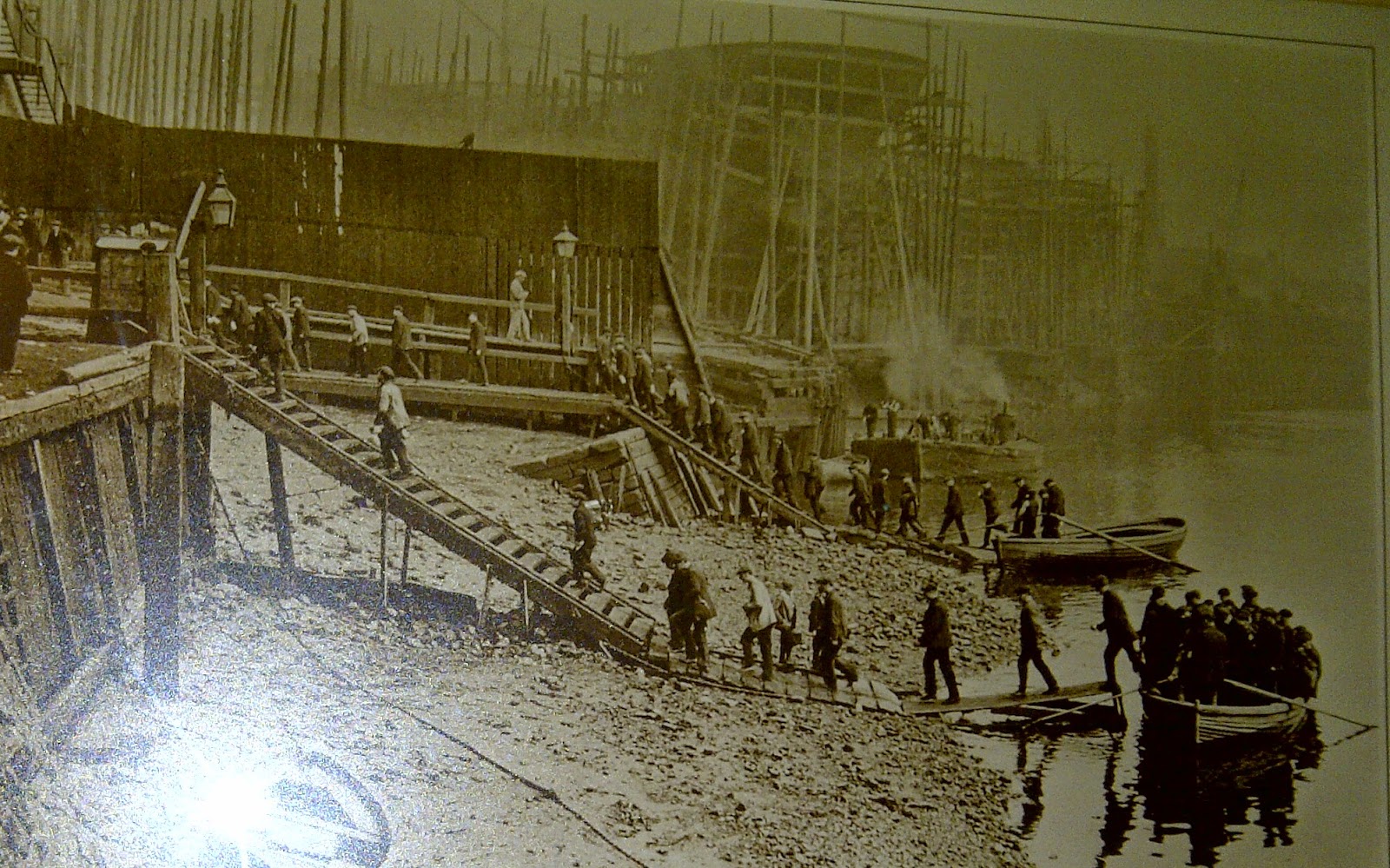
"HMS Black Prince" - The Thames Dreadnought
The first modern Dreadnought built on the Thames was in 1903
It gave its name to the Greenwich "Dreadnought seaman's" Hospital and Sylvia Pankhurst chose it as the name of her journal for the East London Federation
One trade unionist involved in the construction of the first Thames Dreadnought was Ernest "Ernie" W Cant, he recalled the successful campaign to stop wages being cut at the Thames Iron Works, in 1905, after the workers had completed the first "Dreadnought" battle ship "The Black Prince" (started in 1903 and completed late 1904) at Blackwall the other yard was at Canning Town. After its completion the Admiralty demanded that if the yards were to get more work, the workers pay had to be cut to that of those on the Tyneside shipbuilders. The campaign against wage cuts was led by Will Thorne and Jack Jones (SDF MP for Silvertown).
The Black Prince was launched on 8 November 1904 and sunk during the Battle of Jutland in May 1916 with the loss of her entire crew of 857.
The Thames Iron Works shipyard closed in 1911, but the works football team lived on however, when its players formed the basis for the new West Ham United team
Below
The Thames Shipyards in 1902 and then 1910
It gave its name to the Greenwich "Dreadnought seaman's" Hospital and Sylvia Pankhurst chose it as the name of her journal for the East London Federation
One trade unionist involved in the construction of the first Thames Dreadnought was Ernest "Ernie" W Cant, he recalled the successful campaign to stop wages being cut at the Thames Iron Works, in 1905, after the workers had completed the first "Dreadnought" battle ship "The Black Prince" (started in 1903 and completed late 1904) at Blackwall the other yard was at Canning Town. After its completion the Admiralty demanded that if the yards were to get more work, the workers pay had to be cut to that of those on the Tyneside shipbuilders. The campaign against wage cuts was led by Will Thorne and Jack Jones (SDF MP for Silvertown).
The Black Prince was launched on 8 November 1904 and sunk during the Battle of Jutland in May 1916 with the loss of her entire crew of 857.
The Thames Iron Works shipyard closed in 1911, but the works football team lived on however, when its players formed the basis for the new West Ham United team
Below
The Thames Shipyards in 1902 and then 1910
Labels:
Dreadnought,
SDF,
Thames Shipyards,
Will Thorne,
WW1
Saturday, December 08, 2012
Early Socialist Slide
Early socialist slide -
Liberty, Progress and Socialism slaying Capitalism.
Looks like Social Democratic Federation ? early 1900's ?
Liberty, Progress and Socialism slaying Capitalism.
Looks like Social Democratic Federation ? early 1900's ?
Labels:
1947,
ILP,
Labour Party,
SDF,
Social Democratic Federation
Tuesday, February 28, 2012
Independent Labour Party Executive Council 1899
Back row, left to right
Ramsay MacDonald, Joseph Burgess, James Parker, J. Penny, F. Littlewood,
Front row, left to right
Bruce Glasier, Kier Hardie, H. Russell Smart, Philip Snowden
NOTES:
Joseph Burgess was the editor of the Workingman's Times pro trade union
France Littlewood, France attended the founding conference of the ILP in Bradford in 1893, beginning an allegiance to the party which lasted thirty five years. He was appointed one of the auditors and in 1896 became national treasurer and a member of the party’s National Administrative Council (NAC).November 1891, the committee of the newly formed Colne Valley Labour Union (CVLU)
Labels:
George Garside,
ILP,
Independent Labour Party,
SDF
Friday, June 03, 2011
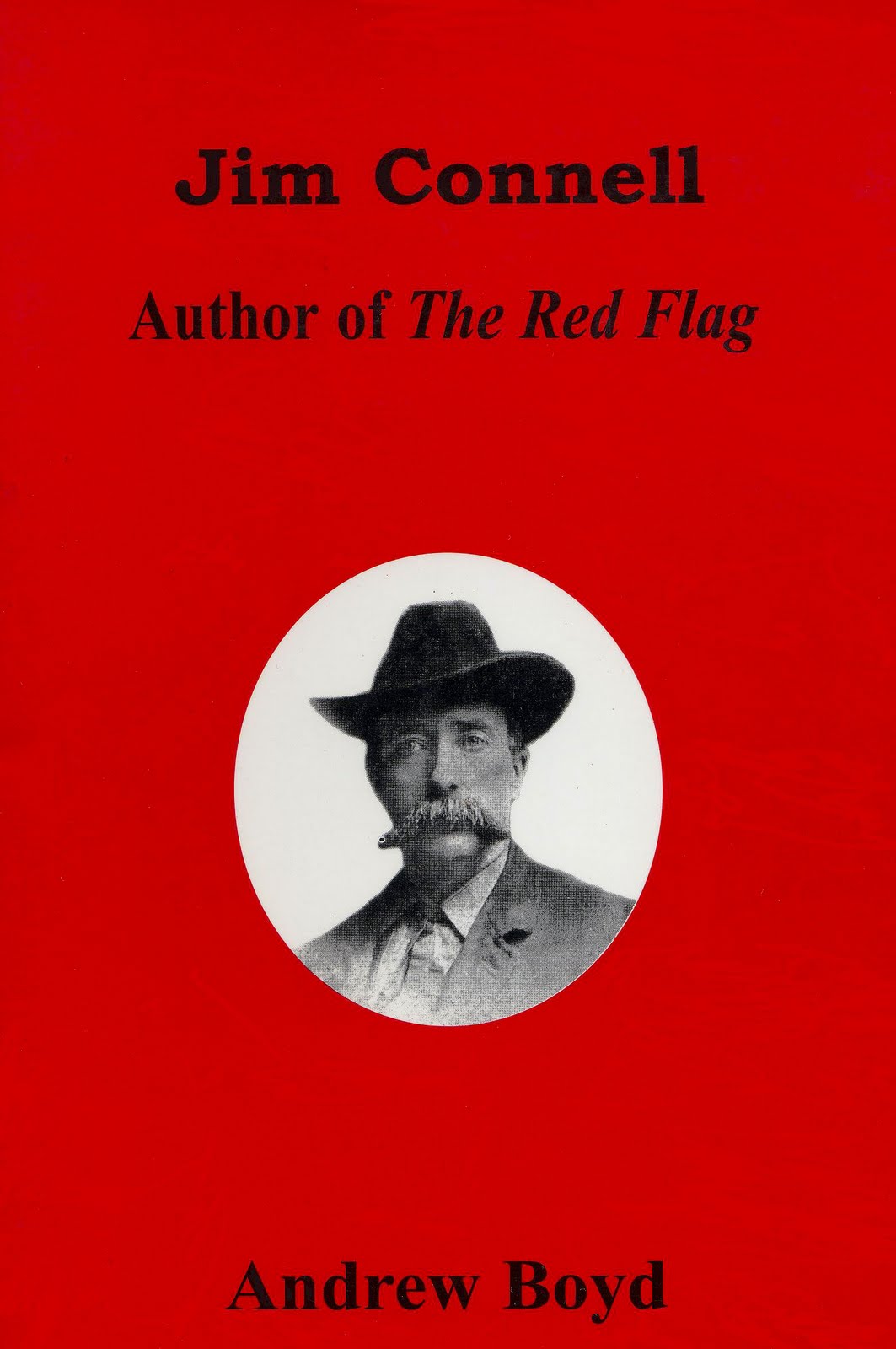
Jim Connell - The Man Who Wrote "The Red Flag"
The Rebel Poet Who Gave The Workers Their Battle Hymn
Daily Worker Friday 2 February 1962
Thirty Three years ago yesterday, Jim Connell, thet man who wrote " The Red Flag," died at the age of 76.
For over 70 years that song has been the battle hymn of the British Socialist movement.
Multitudes in each generation have sung it, but comparatively few have known anything about the author.
Jim Connell was an Irishman, born in 1852 in the village of Killskyre in Co. Meath.
During his boyhood days the terrible living conditions in Ireland under British rule awakened the class-consciousness of young Jim, and he joined the Irish Fenian/Brotherhood before he reached adult age.
Irish freedom
When Michael Davitt, one of the great fighters for Irish freedom, was released from a seven year. jail sentence and began organising the Irish Land League in 1879, Connell was then an exile in Britain, but he became a member of the British executive committee for the League.
In England Jim Connell soon realised that the fight for national freedom had its place in the inter national struggle for Socialism. and he joined the Social Democratic Federation long before the Labour Party was formed.
In 1890 he stood as a Parliamentary candidate for the S.D.F. in a three-cornered fight with Tory and Liberal in a North London constituency. He later became a member of the Independent Labour Party.
Charming wit
He was a man of many parts and once described himself as having been a " sheep farmer, dock labourer, navvy, railway man, draper, journalist, and ' a lawyer of sorts.' “ But he also had the attributes of an artist—he was an ardent student of Shakespeare and a lover of nature.
I first met him in 1924 with Tom Mann, who invited me to join them at a pub named The Golden Cross, which then stood in the Strand opposite Charing Cross Station.
I was then under 30 years of age and always remember the deep impression of that first meeting with Jim Connell. He was a hefty man over 6ft tall and very picturesque in his style of dress—a black sombrero hat, a large bright red tie and a long black cloak. He looked like an old Shakespearean actor. He had an enormous moustache and a rather high-pitched voice.
When he spoke with his rich Gaelic brogue there could be no doubt that he was an Irishman. He was a great talker with a charming wit, but he had a fighting spirit which blazed forth, whenever we talked of the class struggle.
I met him several times in the company of Tom Mann, Tom Quelch and Nat Watkins and always enjoyed his company. When Tom Mann was there it was great fun, because he had the same exultant nature as Jim.
they chaffed and bantered each other to the delight of our own group and often to the amusement of others within earshot.
At one period in his life he got his living as a poacher and later wrote a book entitled " The Confessions of a Poacher." Once when I was in his company he slapped me on the back with gusto and complimented me on my organising work among the unemployed and then added: " But why don't you advise the unemployed to become poachers? There's plenty of good food to be grabbed on the big estates of the Lords and Dukes of Britain."
Many poems
He wrote many poems and lyrics which are now unobtainable, but the one that still survives is " The Red Flag." It was first published by the S.D.F. paper Justice in 1889 the year of the famous strike of the London dockers for the " tanner-an-hour " wage.
No doubt this event prompted its publication. But I think the original inspiration of Connell for writing the song was the international protest against the execution in America, on November 11. 1887, of four militant trade unionists who were leading a strike movement for the eight hour day.
Chicago Martyrs
They became known as " The Chicago Martyrs." As they stood on the gallows they each pro claimed their faith in the ultimate victory for the working class. One said: " The time will come when our silence in the grave will be more eloquent than our speeches."
I believe that it was this tragic event in international working class history, and the challenging spirit of the Chicago Martyrs. which inspired Jim Connell to write the defiant verses of " The Red Flag."
Wal Hannington
Daily Worker Friday 2 February 1962
Why he wrote it
In The Call (B.S.P. weekly) of 'May 6, 1920, there was an article by Tim Connell entitled " How I Wrote ' The Red Flag.' " He mentioned a series of great struggles which " got me into the mood which enabled me to write ' The Red Flag.' " The first was the fight of the Irish Land League, which roused the democrats of all countries and in which he was secretary of the Poplar branch.
The second was the struggle of the Russian revolutionaries. He was in the company of one of their great figures, Stepnyak, on the night the latter was accidentally killed at a level crossing.
Stepnyak's book " Underground Russia " had had a deeper effect on him than any religious revival, Connell wrote. The third was- the hanging of the Chicago anarchists, and particularly the speech of Mrs.Parsons, the widow of one of them, which Connell heard. And the fourth was the great dockers' strike of 1889, which " aroused the whole of England."
So Wal Hannington, in his splendid article (February 9) has hit the nail squarely on the head. Connell said that he wrote the first two verses and the chorus during a 15-minute train journey between Charing Cross and New Cross, and finished the rest that night.
Then he sent it to Harry Quelch, Editor of Justice. It was printed in the Christmas number, published on a Thursday, and the following Sunday the song was sung in both Liverpool and Glasgow.
Connell was very emphatic that it should be sung to the air of " The White Cockade," not of the old German church hymn, " calculated to remind people of their sins and frighten them into repentance." known also as " Maryland."
ANDREW ROTHSTEIN. London, N.6.
Daily Worker 13 February 1962
MEN WHO SANG "RED FLAG" IN BARRACKS 1929
Highlander located in Maidstone Prison
STORY OF REVOLT
At least one of the three Sutherland Highlanders sentenced to five years' imprisonment, following a mutiny among the troops in Jamaica, according to news which has just reached the Daily Worker is in Maidstone Gaol, Kent.
The exact place where the others are imprisoned is not yet known, but here is an opportunity for London workers to strengthen the campaign for the immediate release of these men.
It will be remembered that these four men received this vicious sentence about eighteen months ago at a court martial following a mutiny and the singing of the "Red Flag " in the barracks by the soldiers.
The Capitalist Press made a great show of the affair about six weeks ago, pointing to it as an example of how stern measures had to he enforced in order to maintain discipline.
The whole scandalous affair of the brutal sentence and the way news concerning the case was being suppressed bv the Capitalist Press was exclusively exposed in the " Workers' Life last August. The whole affair first came to light following the publication, in a Communist pit paper in Fife, of a letter from a soldier in the Sutherland Highlanders.
His regiment was stationed in Jamaica, in the West Indies, and his
letter stated that scandalous conditions for the men prevailed. Deep resentment was growing among the soldiers against the bad conditions, and this came to a head in the revolt .
In his letter Private Clark described the events which led up to the revolt. An N.C.O. and two officers entered the barrack room to arrest two soldiers for making a noise after 10 o'clock. The men, it is said, demanded the remedying of certain grievances, and had the complete support of the two hundred men -in the barrack room, who commenced to singing the " Red Flag." Eventually the revolt was crushed, the four men taken to the guard room and. Later, court martialed.
Daily Worker first Edition
January 1st 1930
JIM CONNELL FACTS
Born 27th March 1852 - Kilskyre, Meath, Ireland (five miles from Kells)
Died 8 February 1929 - Lewisham Hospital, London, england
Emigrated to London in 1875
His occupations included, Dock labourer, navvy, railwayman, draper, journalist and sheep farmer
finally, Secretary of the workers Legal friendly Society based in Chancery Lane, Central London
Keen Countryman, poacher, he was taught by the local Police constable his poaching skills, Connell wrote a book "Confessions of a Poacher" which sold 80,000 copies also another book "The truth about the Game Laws"
Connell disregarded the game laws. in his opinion wild animals could not be anybody's private prporty"
"I broke ev'ry law the land robbers made
And mocked at the strength they put forth"
Connell had a favourite Lurcher called "Nellie" and he stated in Labour's Whos who Recreation as "poaching". He was caught poaching twice fined £1 Croydon (Mr Gladstones at Addington) and woolwich 13s 6d
According to a Times article in 1922 "in the authors own words the spirit of revolt against injustice in every country had become a religion"
Jim Connell wrote the Red Flag on a fifteen minute night journey from Charring Cross Station to New Cross Station, In South East London. in the Times article 22 January 1922 he states "The fortnight before Christmasof 1889"
Just prior to the train journey Connell had attended a lecture by Herbert Borrows
"As I sat down in the train for New Cross something urged me to write a song embodying the spirit of that lecture" (Times)
One of Jim Connell's favourite Public houses was the Golden Cross in the Strand
Branch secretary of Poplar Land League
Red Flag first produced in SDF journal "Justice" 1 December 1889
The "Maryland" or "Die Tannenbeaun" version was published by Adolph Smith of Headingley in 1895
The "White Cockade" "which could be heard in the mud cabins all over Ireland in the "sixties" and before" " a tune to which Robert Burns had written "John Hielan Man" Times article
He lived at 408 New Cross Road, Lewisham, later Battersea Rise and later still at 22a Standon Park,Lewisham
Jim Connell joined the Social Democratic Federation (SDF) in June 1881 and was later a member of the Independent Labour Party
1890 Jim Connell was Socialist candidate for Finchley East
Connell received the red Star Medal for composing the Red Flag by decree from V.I.Lenin in 1922
Cremated Golders Green Crematorium an ashes scattered in garden of Remembrance
The White Cockade V (Maryland) Die Tannenbaum
"The Red Flag" has fine words, yet few people sing it now because the tune is so dreary. In fact. Tim Connell, about whom Hannington wrote the interesting article on February 9, intended " The Red Flag " to be sung to the lively tune called "The White Cockade."
But in the 1880s the use of British folk tunes for workers' songs was wellnigh unheard of, so the defiant verses got hitched to the draggy German tune of " Tannenbaum."
Music fashions have changed now, thank God, and it's time "The Red Flag" text was divorced from its unsuitable German mate and reunited with the grand springing tune that Connell had chosen for it.
Then you'd hear- it really sung, by young as well as old. And .it would be a pleasure, and not merely a duty, to sing it.
A. L. LLOYD. London, S.E.10.
Maryland' version
For nearly 40 years I have been conducting " The Red Flag " to the " Maryland " tune.
When energetically and not too slowly sung it is an inspiring song.
Unfortunately the tune " Maryland " has reactionary associations in Central Europe, so to sing it there is an affront.
By all means let us try singing the words to the original tune for which they were written.
But do not let us deride the" Maryland " version as a piece of useless junk; it is still sung by hundreds of thousands of people in the working-class movement.
How can we get a new song? The only new progressive songs that have caught on in Britain since the First World War are the C.N.D. songs "The H-Bomb's Thunder," words by John Brunner to a Moody and Sankey hymn tune, and " The Family of Man ' by Fred Dallas.
A competition for a new" song could not succeed unless we controlled B.B.C. and I.T.V. and could plug it. New songs should certainly be tried out at mass meetings. Perhaps one of then will catch on.
ALAN BUSH. Radlett. Herts.
Jim Connell Author of the Red Flag
Poscript
By Andrew Boyd
In 1963 the Workers' Musical Association thought it time to settle the argument about either Maryland (Tannenbaum) or The White Cockade being the proper air to which The Red Flag should be sung.
The association produced a record of The Red Flag, sung by the Glasgow Socialist Choir and the Young Communist League Singers to the tune of Maryland on the one side and to the tune of The White Cockade on the other.
Reviewing the record, on 19 January 1963, Fred Dallas, music critic of the Daily Worker, decided there was 'no question' which tune the Labour Movement should choose. The answer was Maryland simply because it is so much better sung. The Maryland version is sung so as to give each word its proper weight and the diction of the massed Glasgow Socialist and Young Communist League Singers is so impeccable that the whole point of the song comes over.
But The White Cockade version is taken at a tremendous lick, with the words emerging like mouth music, a meaningless gabble which passes in one ear and out the other.
Fred Dallas also observed that as soon The Red Flag was sung in Glasgow and in Liverpool in December 1889 it was no longer Jim Connell's property. It belonged to the Labour movement which had created both Connell and the song. The movement had therefore the right to sing The Red Flag to whatever was judged to be the better tune.
NOTE
The Red Flag was played for the first time on the BBC in 1936 as part of the BBC radio "Songs that made history" series despite the opposition of the British Empire Union (Times 26 September 1936)
Labels:
ILP,
Irish,
Jim Connell,
SDF,
Social Democratic Federation,
The Red Flag
Subscribe to:
Posts (Atom)