Tuesday, August 12, 2008

Clarion Clubhouses

Manchester Clarion Clubhouses

“Comradeship and fresh air at a reasonable cost”

(article based extensively on an article by Denis Pye)

The Clarion movement was based around the Clarion newspaper established in 1891, one of its off shoots was a very successful cycling section formed in 1895. The slogan of the club was taken from William Morris's slogan “Fellowship is Life” and “Lack of Fellowship is death”.


One of the most successful areas for the Clarion movement was the industrial towns of North West of England.

Soon the Manchester Clarion Cycling Club began to organise regular summer camps for its members, initially at Tabley Brook near Knutsford in August 1895 and 1896

These Clarion camps were organised by
Charles "Charlie"D Reekie, Secretary of
Manchester Clarion Cycling Club.

Charlie Reekie was a Railway Clerk from Ancoats, Manchester.

The first Manchester Clarion camp at Tabley Brook was organised for three weeks in August 1895. The Clarion camp consisted of four bell tents, a square kitchen tent and a large marquee for dining and entertainment – all equipment for the Clarion camp (including Gorton ILP crockery) was transported in a horse drawn caravan borrowed from a farmer and Clarion supporter from Malpas, Mr William Ranstead

(The same van that was used by the first Clarion women’s propaganda van tour).

The first Manchester Clarion camp of 1895 was a huge success and was visited by over 2,200 cyclists of whom 460 camped.

After the success of this initial camp Charlie Reekie suggested other Clarion camps in other parts of the country under the slogan “Comradeship and fresh air at a reasonable cost” he also wrote a short poem

“Where thrushes sing and busy bee hums,
Far from the stinking, stifling slums,
We’ll pitch our tents by a troutlet stream,

Sink all sorrow, nor think of the morrow,
But look on life as a happy dream”

With the success of the Clarion camp, Manchester Clarion's began to examine the possibility of a Clarion Clubhouse in the country, an old “old farmhouse” was already mentioned being discussed by Manchester Clarion cyclists. The Clarion Scout Journal in November 1895 reported that the Burnley Clarion cycling club had already established a a Clubhouse (photo left) and that the Manchester Clarion Cycling Club were keen to get one by next Spring.

However by August 1896 the Clarion’s were once again camping at Tabley Brook this time with fourteen bell tents, two marques and Clarion cyclist came from as far away as Birmingham and London. Kier Hardie the great Labour leader even put in an appearance at the Clarion camp, staying the night and even help preparing the porridge in the morning (probably in the rain as Charlie Reekie once again wrote the following verse

“The rugs are wet and the beds are damp,
Conducive to ague, rheumatic and cramp’
We’re praying for sunshine, but the weather gets wuss,

Causing the campers to quietly kuss.”

Charlie Reekies dream for a Clarion clubhouse was modelled on guest houses in William Morris’s “News from Nowhere”.

They would be “clean, airy, well appointed rooms, furnished with fumed oak furniture, tapestry hangings and allegorical pictures” The house would be “ Surrounded by grounds and with a first floor balconies for al fresco meals (with) fruit orchard and playing fields on every side; the whole alive fair women and brave men; while up in the sky floated a captive balloon to guide comrades from miles around towards the pleasant by lanes approaching the spot – the ideal spot”.

The Rev T Arthur Leonard of Colne had already established a o-operative Holiday Association Guest House in Ambleside in 1893.

One local Clarion had even visited the cabin of Thoreau's Walden in Massachusetts, Thoreau lived in the woods of Massachusetts for two years, two months, and two days and wrote a book of his experience "Life in the Woods".

BUCKLOW HILL 1897-1902

“The first socialist guest house”

By February 1897 a plan was in progress for the Manchester Clarion Cycluing Club to take a cottage half a days cycling from Manchester, Wigan, Bolton, Rochdale, Oldham and Liverpool (all flourishing Clarion cycling clubs)

In June 1897 the Clarion proclaimed that Bucklow Hill (four miles South of Altrincham on the A556) would be the “first experimental co-operative cottage of the Clarion clubs” it also noted that apart from the cottage their was a field for camping and football.

Bucklow Hill Clarion Clubhouse (the house being known previously as Acropolis) was officially opened on the 22nd June 1897 and was deliberately designed to offer socialist alternative to celebrations and holiday to mark Queen Victoria’s 60th anniversary as monarch.

The Clarion cyclists met at Trafford Bar at 10am on the 22nd June 1897 in a great ride out to the opening at Bucklow Hill.

Robert Blatchford “Nanquam” the editor of the Clarion was to perform the opening with a specially cast diamond jubilee pig iron key, but he was not available on the day and as a result the Clarion clubhouse at Bucklow Hill was opened by Mr J. Pitt-Hardacre actor-manager of the Comedy Theatre, Manchester
and keen Clarion cyclist.

Some 250 were present for dinner (lunch and even more for tea). The clubhouse could accommodate up to sixty people overnight and up to 150 for meals.

The Clarion newspaper columnist Haydon Perry wrote an article stating that he found people on the balcony, and in garden deck chairs under Chinese umbrellas, reading and smoking. Tents had been pitched in the adjoining field and campers used spring water for washing. There was ample rooms for stabling bicycles, a large kitchen and dinning room, an office and a reading room. Up stairs a general purpose room opened on to the balcony , which offered a view of the road to Manchester ],. The dormitories were named after flowers.

The steward and stewardess of the Clubhouse were Mr and Mrs Bennett (Manchester Clarion cyclists)

The Secretary of the Bolton Clarion cycling club stated the new clarion clubhouse was “Centre of a cycling paradise, away from the Smokey towns” popular rides included rides to Arley Hall and Rostherne Mere.

The Clarion clubhouse was very popular with cyclists and non cyclists who came for the evening concerts and walked or cycled during the the day.

The funding for the project was to come from the proceeds of selling 2,000 five shilling shares in the Clarion cycling Clubhouses company limited, a company drawn up by Dr Richard Pankhurst (father of Sylvia Pankhurst).

At the first meeting of the shareholders in October 1897 at the Royal Oak tavern, Quay street, Deansgate, Manchester, some 150 people attended. However the good attendance did not materialise into share ownership and only some 120 out of 500 shares had been taken.

The Clarion Cycling Club spent its winter months raising money to maintain its new property, to this end they were helped by the Manchester Clarion choir who also organised concerts to pay for the clubhouse.

The Bucklow Hill cottage was acquired on a five year lease from the local Earl Egerton of Tatton, who only later found out he had mistakenly let one of his establishments to the hated socialists., unsurprisingly the lease was not renewed by Earl Egerton in June 1902.

HANDFORTH 1903-1935

After its untimely eviction from Bucklow Hill, Manchester Clarions scoured the countryside for a replacement Clarion Clubhouse and they found an ideal establishment eight miles from Bucklow hill, in the form of a dilapidated, old, empty farmhouse. It was located on the outward road between Cheadle and Handforth, about half a mile off the main Manchester-Wilmslow road.


It was flanked by two orchards and was secluded enough to minimise the possibility of causing annoyance to local people.

Handworth Clarion Clubhouse was officially opened in September 1903

Rambling farmhouse had a large kitchen with oak beams and panelling, which was as furnished with a comfortable sitting room. Here the presiding genius was Edward Fay, the much loved “Bounder” who had died in 1896 at the age of 43 and whose picture adorned the wall. There was a card room as well as a library and reading room. Four dormitories with a total of fifty beds, and tents available to sleep at least a dozen, failing that you could also sleep in the hayloft.

Outside, a lawn fringed with a well kept garden could be enjoyed from a number of wooden benches. The kitchen garden was the “pride of the steward” One of two orchards was used as an open air theatre

or auditorium (anything from Shakespeare to Shaw). Nearby was a large playing field with three tennis courts and space for cricket and football and the annual old English sports day held in July and included obstacle races, high jump, skipping, and potato gathering for the ladies.

Handforth played a pivotal role in development of the Clarion's and early socialist ideas in the North West.

Colin Coates (a keen Clarion cyclstated “I fear we were guilty of attempting to make the most of two worlds; the Clarion Cycling Club with the claims and charms of the road, and the benefits which the House afforded in the way of concerts, games, plays etc. there were amongst the members at that time many who were able and willing to draw from their store of talents; singers, players, reciters could always be tapped to provide good entertainment. Weather permitting, concerts arranged in the orchard. On the stage beneath the pear trees the artists did their stuff”.

The Clubhouse was surely one of the greatest treasurers of the Clarion movement and the leisure and enjoyment it gave to thousands of socialists toiling in Northern industrial towns must have been immense. Everything revolved around the Clubhouse and the saying “Clubhouse for tea” was a very popular slogan amongst the North west Clarion Cyclists.

It may have been a Utopian experiment but the mass unemployment of the 1930's forced the Handforth Clarion Clubhouse to close in the early 1930's

VALLEY HOUSE 1936-1951

In 1938 the Manchester Clarion Scouts were once again in search of a Clubhouse this time they found it at Valley House, Oversley Ford on the banks of the river Bollin near Styal, just two miles from Handforth.

The prominent gold painted clarion sign from the old clubhouse at Handforth was taken to the new premises and a fixed to the outside wall as previously do ne at Handforth.

The official opening was conducted by Hubert Humphries a Birmingham Councillor (later Mayor of Birmingham) on the 24th May 1936. Over 600 we
re present at opening and Sang the red flag

Those seeing it for the first time must have been impressed with their new home. The site was quiet and secluded, surrounded as it was by tall trees. The house was fronted by extensive gardens, while alongside the River Bollin was a large natural field with space for cricket or football with tennis courts and putting green.

While the Clubhouse was always in need of financial support money was raised after war to pay of its debts however the local Public Health Department demanded improvements, which would cost a further £2,000 and the Clarions were forced to sell the Clubhouse in 1951


Of the Clarion Clubhouses that were opened by 1950 only a handful remained


Clarion Club house - Sheffield Dore Moor (Left)

Their was previously a Clarion hut at Sheffield, Cordwell Valley, probably on the land of Edward Carpenter, and was used by Heeley Clarion Fellowship , It was transfered to the Dore Moor land in 1920, when built by local Clarion's.

The Sheffield Dore Moor Clarion Club House was not only used by the club house shareholders, [who could stay there overnight,] but also by the Clarion Cycling Club , and Clarion Ramblers . At the Club House there were the Clarion Entertainers, a Clarion Football team, Clarion Cricket team, there was a putting green , a bowling green, childrens playground,and a wonderful view of Sheffield from the club house verander at the back. The general public could buy their cups of tea and sandwiches in the cafe, or could even bring their own tea and just get hot water during the war years.


Ribble Valley near Ribchester opened in 1913 (right)

Yorkshire (Menston) Clubhouse opened in 1902 (Still open but lost control ?)( below Left)


(Halewood Clarion Clubhouse Left of which little is known ???)


The only Clarion Clubhouse open to day, under progressive management is the excellent clubhouse at Pendle.

www.clarionhouse.org.uk

END


Britain's Daily Socialist Paper suffered from a fire at its premises in East London on the morning of 28th July 2008
However, not one days production was lost, a record former Daily Worker editor William Rust would be proud of

Monday, July 28, 2008


BRASSED OFF

Having watched Bob Crow, General Secretary of the RMT union lead his delegation down, Tolpuddle High Street in 2008, with the RMT Easington Colliery Band.

I thought about posting a brief article on Brass Bands and the Labour Movement.


While many mining collieries had their own bands, many run and organised by the miners union their is few other examples of trade unions establishing Bras
s Bands, the only other examples I can find is the Doncaster National Union of Railwaymen (NUR) Brass Band which was established around circa 1938.

A Langham Labour League band from 1871 (this was likely to have been an agricultural workers union band). The Co-operative
movement also had numerous Brass Bands, many of them successful.

The Gas Workers Union in the late 1880's also
seem to have helped establish a number of bands and today UNISON sponsors the Kinneil Brass band in Scotland, founded by the miners of Kinneil Pit and the workers of Wilson's Kinneil Iron Works in their home town of Bo'ness, West Lothian in 1858.


The Milnsbridge Socialist Brass Band (Huddersfield) was active in the early 1930's and surely the Independent Labour Party (ILP) or the Clarion's also attempted to establish Brass Bands. Preston Clarion had a band circa 1911


I have seen reference to a Transport & General Workers Union Brass Band ? but not been able to confirm. Photo right is of a special Silver Jubilee TGWU band from 1947.
I have seen reference to a Post Office Engineering Union band from Stockport circa early 1970's

Their was a Liverpool Socialist brass band


Ireland now has only one trade union Brass Band (CWU), after the disbandment of the world famous Irish Transport & General Worker Union (ITGWU) Brass Band (lat
er known as SIPTU Brass Band) around circa 2005.

HISTORY OF THE IRISH TRANSPORT & GENERAL WORKERS UNION BRASS BAND
By Eileen King "ITGWU Liberty Magazine" June 1984


The Irish Transport & General Workers’ Union Band (ITGWU) was formed in 1919 (picture above). Senator Thomas Foran, General President of the Union, decided that a Brass and Reed Band would be of great assistance in extending Union organisation in Dublin. He already had experience of two previous bands which had been intimately connected with the young Union. One was a fife and drum band, affectionately referred to as “The Suffering Ducks”, and the other a pipe band with which Tom Kennedy (later a General Officer of the Union) was closely associated.

The Dublin dockers were interested in Tom Foran’s idea, and a committee of Dublin No. 1 Branch members was set up to raise the necessary funds to equip, clothe and train a band. The collection to raise the money was undertaken during the latter part of 1918. An interesting point about this collection, which ranged mostly over the docks and local employments, including carriers was that the carriers negotiated an increase of 7/6d per week in October, 1918 and, led by the late Jack Clarke (a member of the fund raising committee) and his eight fellow workers in Suttons, a large number of the carters subscribed their first week’s increase — 7/6d to the band fund.

Financial help came from Union funds too and the organisation of a series of “Housey-Housey” games was — according to a man who was active in the project - another source of revenue.

Early in 1919 the Band was formed, instruments purchased and rehearsals begun. The first uniforms of the band were made by the Abbey Street Co-op and designed and paid for by William O’Brien who was then Acting General Secretary of the Union.

The first public engagement undertaken by the Band was in May, 1919, when it participated in the May Procession at the church of the Oblate Fathers in Inchicore.

There were veterans who remembered how the Band practised in the drill hall of the old Citizen Army ... of the raid on Liberty Hall in 1920 by the Black and Tans who smashed up most of the instruments, and of the period in 1924 when it seemed doubtful if the Band would be permitted to survive. But survive it did and played on to become the only band to win the Royal Dublin Society Band Contest two years in succession.

During the Anglo-Irish war the Band was prominent, participating in many parades and exercises. They were frequently in trouble because of their activities, and were often stopped by the Black and Tans and ordered off parade. An amusing story is told of a parade they had in Finglas. A contingent of Tans stopped the Band and the officer in charge instructed them to cease playing Irish marches. The Band Sergeant agreed and instructed the Band to play the “Wearing of the Green.” The officer applauded and remarked ... “Isn’t that much better than your b.... Irish marches?”.

In 1932 the Band went to Belfast to support William McMullen (later a General President) who was contesting the Stormont election. On leaving Belfast they played the Irish National Anthem at the railway station, and as a result a large number of them were arrested. It was only with great difficulty that William McMullen succeeded iri getting them released the following day. A ban was then imposed on the Band’s re-entry to the Six Counties, but it was lifted in 1948 to allow it to attend the monster 1798 Commemoration in Belfast that year. Needless to say, at the railway station on leaving Belfast, history repeated itself!.

It is worthy of record that in those early years, when the Irish Army Military Band was first formed, twenty-one members of the ITGWU Band were accepted as key instrumentalists and went over en bloc.

Since its formation in 1919, up to 1936, the Band was administered by a Committee from the Dublin No. 1 Branch. Since 1937, it has been administered by the Dublin District Council of the Union.

It was in 1937 also that Adolf Gebler was appointed as Musical Director. He held the degree of Pedagoge de Musicke from a German Conservatoire of Music, and from that year until 1957, when he left to take up an appointment in San Francisco, the Band settled down to a really excellent and fruitful period. It attained a very high standard which won it many collective and individual prizes.

Up to August 9, 1954, the official title of the Union Band was The Irish Transport & General Workers’ Union Prize Brass & Reed Band. Since then the title has be-come The Irish Transport & General Workers Band World Prize Brass and Reed Band. This came about as a result of an invitation to the Band to represent Ireland at the Wereld Muzierkconcours (World Musical Competition and Olympiad) 1954, to be held in Kerkrade, Holland, in August of that year. (This contest is held every four years.)

The journey to Holland wasn’t without its troubles. The Band and officials were scheduled to arrive in Kerkrade at 9.45 p.m. but didn’t arrive until the early hours of the following morning because, first of all, they got lost at Rotterdam and, secondly, they were held up for an hour and as half in a train break-down due to an electrical storm.

When the party eventually arrived at Kerkrade it was both too late and too early to allocate the individual members to their respective abodes for the duration of their stay. They had been given up for lost and the reception committee had gone home. However, the local police very kindly opened wide the station doors and took them “into custody”. Some of the party (including the Musical Director) were so tired and worn out that they slept in the cells! However, by 6.30 a.m. everything was sorted out and the party accommodated.

In spite of their misadventures, the Band went on to win 1st Prize in the “Excellence Section”; 1st Prize in the “Contest of Honour”, and 2nd Prize in the marching competition. This achievement in Holland was a triumph not only for the Band’s Musical Director, Adolf Gebler, but to the hard work and enthusiasm of the bandsmen over a very long period.

A learners” class was established around 1956 to provide the way and the means of ready-made replacements for key instrumentalists who, perhaps, through force of circumstances or; other reasons might sever their connection with the Band back again to Kerkrade in 1958 — this time with new Musical Director, Joe Murphy who had replaced Adolf Gebler where the Band added to its laurels by winning two second prizes.

In 1962, John Carroll (now General President of the Union) became Musical Director. He had been a member of the Band since he was 14 years of age, and chairman from the age of 16. Another milestone — the Band had been an all-male one since its formation, but in 1962 John Carroll changed all that and took on two lady members.

In 1969, Michael Rogers became Assistant to John Carroll, and Junior Band Coach. He was also responsible for establishing the children’s recorder band, which is still flourishing.

In 1970, what was called the Egerlander Band was formed. It comprised 12 members from the Band proper who, in colourful Bavarian-type costumes, played tuneful and rousing music in the “beer-garden” genre. This Band was very popular in the 1970’s, playing mostly for charities. It seems to have gone to ground in recent years, which is a great pity.

The list of achievements by the ITGWU World Prize Brass & Reed Band is quite formidable and space does not allow me to list them specifically. Suffice it to say, however, that the Band excelled itself down through the years by winning many competitions and championships. In addition, many of the Bandsmen won individual gold and silver medals in solo competitions. Three more visits were made to Kerkrade — 1962/1966/1970, with John Carroll as Musical Director, and on each occasion the Band came back with prizes, both in the concert section and in the marching competition.

Due to his many commitments, John Carroll left the Band about five years ago, and was replaced by Jimmy Cavanagh as Musical Director.

The standard of musicianship of the Union Band has long been acknowledged as top class, and the honours which have come its way in competition at local, national and international level bear testimony to this.

From its foundation, the Band has been a regular participant in labour, trade union and national parades and ceremonies. Ever since then the Band has continued its labour and trade union activities and has visited most centres of the country in which the union has branches on many occasions down the years in connection with commemorative ceremonies, industrial parades and disputes and other major industrial events.

The bandsmen always have been drawn from the ranks of the workers; some of the boys from the Artane Band have graduated to the uniform of the Union’s Band, but throughout its long history it has been an amateur organisation of working people, kept alive through the enthusiasm of its members and the interest of Union personnel.

The ITGWU (SIPTU) Brass band closed circa 2005


Thanks to Andy Newman for Tolpuddle/RMT photo

Saturday, July 26, 2008

Hayes Cottage Hospital Occupation office based at the hospital.

Steve Clare taking credit for his and 20 other supporters (including an 80 year old) being thrown out of the District Health Authority meeting held at Harefield Hospital.

The Police man handled campaigners down the stairs, even to disgust of local Tory Councillor Elsie Boff.

This event was a turning point in the campaign and soon after the management were forced to drop plans to close the hospital.

the hospital was occupied on the 25th October 1983

Wednesday, July 02, 2008


LAND NATIONALISATION SOCIETY

The Pioneer Yellow Lecture Van of the Land Nationalisation Society visited Southall in July 1905, a good attendance was present for the lecture on the objective of the Society.

The Society was founded by Alfred Russell Wallace in March 1881, its journal was the "Land and Labour".

Alfred Wallace is best known as the codiscoverer, with Charles Darwin, of evolution by natural selection.

Alfred Russell Wallace was born on 23rd January 1823 at Usk, Wales and died on 7th November 1913 at the Old Orchard, Broadstone, Wimborne, Dorset. (picture below)

Propositions of this Society in 1882 were agreed as-

1.Unrestricted private property in land is inherently wrong, and leads to grievous and wide-spread evils.

2. In order that the land of the country may be free for the enjoyment of all its citizens to the fullest extent compatible with the well-being of the community, the following principles should be embodied in law:--The land alone in its inherent value, as dependent on natural conditions, means of communication, nearness to markets, is to become the property of the State; the houses, buildings, private roads, improvements, the property of the owner, and constitute his tenant-right. All land whatever must be held direct from the State, and solely for the personal use and enjoyment of the occupier; complete freedom in the choice of a home, and ample space whereon to build a dwelling-house, would be the greatest boon to the community, and are essential to the wealth and happiness of its individual members


3. In order that the community may reap the full benefit of the proposed system of land tenure as soon as possible, it is essential that the entire interest in the land of the country (as distinguished from tenant-right) should pass to the State by means of a general law, securing to all existing landowners and their heirs revenues equal to the annual value of the land apart from the tenant right."

William Gladstone (Speech at West Calder.)

"In my opinion, if it is known to be for the welfare of the community at large, the Legislature is perfectly entitled to buy out the landed proprietors. . . . Those persons who possess large portions of the earth's space are not altogether in the same position as the possessors of mere personalty.

Personalty does not impose limitations on the action and the industry of man and the well-being of the community as possession of land does, and therefore, I freely own that compulsory expropriation is admissible, and even sound in principle." -


Marx, Lenin and Adam Smith on land

Theories of Surplus Value
, Marx reveals the “essence of different theories of rent”: the theory of the monopoly price of agricultural produce and the theory of differential rent. He shows what is true in both those theories, insofar as absolute rent contains an element of monopoly. Concerning Adam Smith’s theory: “it is quite true” that rent is monopoly price, insofar as the private ownership of land prevents the levelling of profit. by fixing profit at a level higher than the average.Lenin


Tuesday, July 01, 2008


FIRST TRADE UNION MARCH IN UXBRIDGE 1900

At a mass rally of United Builders Labourers Union held in Uxbridge on Saturday 10th Novemeber 1900. A march took place at six o clock, the procession headed by the Uxbridge & Hillingdon prize band,
included 14 or 15 branches of the union, "as each contingent brought a beautiful banner there was considerable public evoked in the gathering."


With the procession
formed and "the men and their banners flying they marched through the High Street, up St Andrews Road, The Greenway and Waterloo Road, to the Lynch and through New Windsor Street to the rally at the Drill Hall, followed by a large crowd of men, women and children, the members of theunion being distinguished by a ribbon or sash worn round the shoulders".

The most "prominent and most beautiful amongst them (banners) all being that of from West Drayton which seemed to be quite new and bore the following"

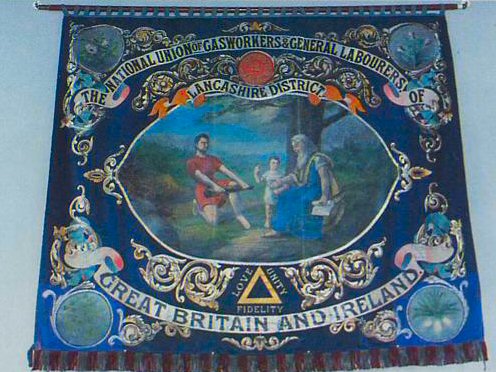
National Union of Gas Workers and General Labourers of Great Britain and Ireland , West Drayton, branch no 23


The banner had actually been unfurled on 27th September 1890 at West Drayton during a speech addressed by Will Thorne the union's General Secretary and Eleanor Marx (daughter of Karl Marx). see report below

Mr John Brown, the local branch secretary of the union said that some time ago according to the resolution of the branch he was instructed to wait upon Mr E. Humbert, and ask him if he would unfurl the banner that afternoon.

That gentleman said he was very sorry but he had an engagement which necessitated his refusing the request. At the same time he assured Mr Brown that anything he could do for them on a future occasion he would do with pleasure and wished them success (applause)

That being the case it devolved upon Mr Brown to unfurl the banner himself but he could not help feeling that such a pleasing duty was not deserve by him. There were men in the branch who had done a great deal more for the cause than he had and he was sure they would all have liked one branch officers to have undertaken the duty.

Before unfurling the banner he might say that they had their own band there that afternoon and hoped they would do credit to West Drayton branch (applause)

Mr Brown then proceeded to unfurl the banner and upon being hoisted it was greeted with loud cheers

On one side of it was represented an employer and a labourer (the later baring a strong resemblance to one of the members of the branch) shaking hands, while on the other side was a brickfield in the district. The recognition of the portraits caused another cheer from the bystanders.

A procession was then formed and headed by the band, proceeded through Yiewsley and back to Drayton Green.

The banner it is understood was made by Mr William Ellen of 257 Hackney Road, London.

(picture above is of a similar banner, the last records of the West Drayton banner are in 1908)

NOTE
Other (early) trade union banners


Southall ASLEF banner
Southall NUR banner (Amalgamated Society of Railway Servants) circa 1905
Willesden
Amalgamated Society of Railway Servants banner
Paddington
Amalgamated Society of Railway Servants banner
Brentwood Lighterman 1895
Acton Communist Party "New Dawn"


National Association of Operative Plasterers, Southall branch established July 1905

Southall Trades & Labour Council meeting posite the King of Prussia public House in March 1905, Mr Horace E Lucia Chairman, speakers at March 1905 meeting. Mr W. Smith G U Carpenter & Joiners Union District delegate; Mr Lovatt District Secretary OBS (Bricklayers Union); Mr W. Randall A S Carpenter & Joiners Delegate; Mr W Wall UBLU (builders Labourers union) Fulham Board of Guardians

Southall Carmen's Union established November 1905

Richard Bell MP spoke to
Southall Amalgamated Society of Railway Servants branch April 7th 1907

(picture right Rickmandsworth ASRS 1912 march and rally Neasden banner front)


Thursday, June 19, 2008

LABOUR CANDIDATES HAYES WEST MIDDX 1925


LABOUR CANDIDATES 1925
HAYES AND WEST MIDDLESEX 4th APRIL 1924

Hayes (East Ward)

Douglas Page (Elected)

(Chair of Hayes Trades & Labour Council, Horticultural Society, Sec Workers Union)

William Sutcliffe (Elected)
(Employed at NUR head Office)


Hayes (South Ward)

L Fitzgerald (Elected)


J.C.C. Hayden (Sec of Hayes Municipal & General Workers Union branch, Ex Servicemen's Assoc)


Hayes (West Ward)

Robert William Gunton, 1 Westgate Villas, Park Road, (Civil Servant)

Horace Sydney
Greenhead

Board of Guardians

Mrs I. M. Fowler (Guardian for six years)
Mrs Anna Begitta Greenhead (Secretary of the Women’s Section)

It was reported that the Municipal Reform (Tories) had had a majority on the council for the last twelve months (1924-1925) In 1925 they changed their name to the Residents Association.
1925 the Labour, anti Labour councillors were equal. However in a special additional election November 1925 Labour secured a one seat majority on Hayes Urban District Council a position it held until another blip around 1929-1930

At this election in 1925
Labour secured the election of Sutcliffe, Page an
d Fitzgerald

As the election resulted in equal numbers of Labour and non Labour it was agreed that Councillor Leach and Councillor Ellis take the chair for six months each. This novel agreement was agreed


EXTRA ELECTION HAYES UDC 28th NOVEMBER 1925

William John Smith (South Ward) Elected 13 Third Avenue, Hayes (Organ Builder)
Robert William Gunton (East Ward) Elected
Albert Edward Knight (West Ward) not Elected The Nursery, Pistils Lane (Insurance Agent)

With the election of two extra Labour Councillors Smith and Gunton, Labour once again secured a majority on the council by 8-7

East Ward Labour 530 RA 232 52% turnout
South Ward Labour 456 RA 367 66% turnout
West Ward Labour 262 RA 345 53% turnout


YIEWSLEY LABOUR CANDIDATES APRIL 1925
A. Hunt

Samuel Thorne
Mrs Read

UXBRIDGE LABOUR CANDIDATES APRIL 1925
John W. Brooks
Joseph W. M. Hart
G.A. Kingsford


Board of Guardians Mrs Sarah Ann Dubberley - Elected unopposed

HARROW LABOUR CANDIDATES APRIL 1925

G.A. Jordan, 5 Roxborough Road (topped the poll)
Sarah Rebecca Ludbrook, 23 (or 28) Sumner Road
B.W. Handley, 82 Roxeth Hill
F.W. Perkins, 4 Gayton Road

WEALDSTONE LABOUR CANDIDATES APRIL 1925
Mrs A Belshaw, 32 Claremount Road, Wealdstone (Elected)
Sidney Bleaney, 58 Graham Road
Henry George Gange,19 Peel Road

Gilbert Postlethwaite, 16 Spencer Road
NOTES

Mr Horace Greenhead stated during the 1925 council elections that
"A return of all Labour candidates and a council similar to that which held office in 1921 was the expressed desire, (he considered this)..."the finest council they had ever had in Hayes"

Robert William Gunton of Park Road, Hayes stated during the same election that

"There was more solid progress when the Labour Council prevailed than had been obtained in the last twelve months"

Robert William Gunton was
"convinced that every branch of the Council's work it was necessary to illuminate private contractors as far as possible........Mr Isreal Ellis (Municipal Reform) had said he was out to smash the Labour movement but it simply could not be done........Working people ought to be proud of the work of the Council in cleaning away slums, demolishing them, so that no reactionary Council could open them again.....The decline of the death rate (in Hayes) since the Council houses had been errected"


Hayes ILP (Independent Labour Party doubled its membership during 1925, active in the ILP were Douglas Page, and Robert William Gunton (speakers includes Seymour Cocks from Chiswick ILP)

East Ward was seen as a Labour stronghold

George Albert Manley was Chair of Hayes Labour Party

HAYES LABOUR LEAGUE OF YOUTH
The national Labour Party, Labour League of Youth was formed in 1924, Hayes Labour League of Youth was established in 1924 (or before) it established a cycling, rambling and swimming section in 1925

The Hayes Labour League of Youth first cycling outing was in May 1925 was from Hayes Cinema to Ruislip.

Other League outings included a trip in July 1925 to Virgina Water via Staines, Egham and Thorpe, where they meet the Rambling section who arrived by "Charabanc".

The swimming section of the Hayes Labour League of Youth was offered the services of Mr J. Harley a "well known" Surrey athlete, this attracted 40 to the bathhouse.

The Leagues first Concert was held at the Brotherhood Hall in January 1925 and developed a Hayes Young Pierrot Troupe of entertainers

Hayes Labour League of Youth meet with Southall Labour League of Youth and Southall Socialist Sunday School at a joint meeting in September 1925 at the White Hart rooms, and on Mr Green’s meadow West End (Northolt) Hayes Labour League of Youth pierrots gave a performance, as did Hayes young gymnastics. Mr Gardner was present. Mr Frank Hall stated “need for Labour organisation in West End and Northolt either ILP or Labour party as best suited to the district”

Hammersmith ILP Cycling Section
INDEPENDENT LABOUR PARTY
Uxbridge Independent Labour Party was founded by Councillor Leonard W. Spencer (killed 1st September 1915, during WW1) meeting initially in Rockingham Hall and in the 1920’s its branch secretary was Ernest A Cave.
The Uxbridge ILP protested at the arrest and prosecution of the 12 Communist Party leaders for alleged seditious conspiracy and Harrow Labour Party women’s section took a collection for the "Communist defence Fund" its secretary was Mrs Smith, Mrs Reid Chair and Mrs Lee Treasurer. The branch also condemned the failure to prosecute the attack “outrage” by four fascists on the Daily Herald

Ruislip Independent Labour Party (ILP) a Mr H. Hirst was active as was Mr Collins of Richmond ILP. Mr Ernest E Hunter, Divisional chairman ILP and National Advisory Committee representative organised a Ruislip ILP day school in September 1925
Mr J.S Collins, Chair West London Federation of the Independent Labour Party, Mr F. Seymour Cocks, Mr H Stewart Ryde, ILP Regional representative and finally Mrs Cook, Mrs Oresten, Mr Hagg and Mr Simpson of the Central London Independent Labour Party (ILP) Players performed Barrie's "The twelve pound look"
Harrow Independent labour Party was established at the turn of the last centaury circa 1900 with Ramsey MacDonald as one of its members
Hammersmith Independent Labour Party (ILP) Cycling Section also active in 1925
FIRST LABOUR COUNCILLORS
Henry Palmer: Hayes UDC 1911
Percy Langton: Hayes UDC 1912
Leonard Spencer: Uxbridge UDC 1910
E.R. Westcott: Uxbridge UDC 1910
Horace Lucia: Southall UDC 1905 (40 Waltham Road,Southall)
J. Perkins Southall UDC 1905 (Endesleigh Road, Southall)
G.A. Jordan: Harrow UDC 1919
A.H. Bartle: Harrow UDC 1919
LENIN AND TROTSKY

Mr H. Hirst spoke at a meeting of the Ruislip & Eastcote Labour Party in March 1925 about the Russian revolution
“Russia went through a revolution and if their was a country that needed a revolution it was Russia….Lenin the lecturer said was an able man with a strong sense of humour and a ready grasp of practical politics. He practically carried out the whole of the work of an opposition in Russia. Of his successor Trotsky the lecturer was not so enthusiastic and of Zinovieff of the red letter fame he had little favourable to say “

WOMEN’S SECTION OF THE LABOUR PARTY
At Wealdstone, Mrs A. Belshaw (Social Worker) 32 Claremount Road, Wealdstone, was elected as a Labour candidate, topping the poll at Wealdstone in the April 1925 Council elections. Belshaw was the first woman to be elected to Wealdstone Council (and therefore probably the first women councillor elected in Harrow)


In August 1925 Mrs Sarah Rebecca Ludbrook Chairman of the Roxeth Labour Party Women’s Section unveiled the new banner of the Roxeth Labour Party Women's group "This handsome emblem designed and embroided by the members themselves and greatly admired by visitors" at the Harrow Labour Party Fete August Bank holiday 1925. Mr G.A. Jordan was also present
Freda Laski, lectured on Birth Control to a packed meeting of Wealdstone Labour Party Women's section at the Co-Operative Hall, Wealdstone in October 1925


Labour Candidates in Middlesex elections (These need checking)
W. G. Sillitoe (West Ward Southall)
W. Garrod (or Garson) (East Ward Southall) Labour win
W.H. Knowles (Hillingdon)
W.L. Carr (Hayes/Northwood/Ickenham/Harefield/Northolt) ??
Capt Fawcett (Feltham) Labour

MUNICIPAL REFORM AND RESIDENT ASSOCIATION
Municipal Reform, was primarily Tory front active in it was Mr C.E. Dobson Secretary, Dr W.D Hopkins, A. Simpson, A.H. Boot, I. Ellis, W.S. Barnes, F.F. Osgood, J.H. Gardner, E.J.Bell, W.W Westacott

RESIDENT ASSOCIATION

Mr C.E. Dobson Honorary sectary; Dr W.D. Hopkins Treasurer; J.R. Scott President; Boot, Leach, Barnes, Gardner, Russell, Holland, Major Shuter, Mrs Haldane, Mrs Hawkins, Mrs Perry. In the 1925 additional seats election they supported George Fulford, John Robert Scott and Arthur .L.F. Cook and Mrs Pickering for the guardians


"It was quite conceivable that if those who had taken an active intrest in affairs of the Parish withdrew, that before many years were over they would see a state of affairs such as had been witnessed in Poplar and West Ham statement founding meeting of Hayes residents association November 1925 (I believe C.E. Hopkins or Ellis)
The Junior Branch of the Primrose League (Tory- anti socialist) established Hayes April 1924 meeting in the new hall claiming 361 members in 1925

Hayes Liberal Association established March 1904
Harrow League of Young Liberals Mr S.V. Kirkpatrick Chairman
Uxbridge Esperanto group circa 1922 Frederick Bradbury 1 Ickenham close, Ruislip
Socialist Party of Great Britain local activist Joe Cohen 15, Eastholme, Hayes, West Middlesex in the early 1920’s