Saturday, December 17, 2011

Occupy St Paul's Cathedral Circa 1887 - #OccupyLSX 2011


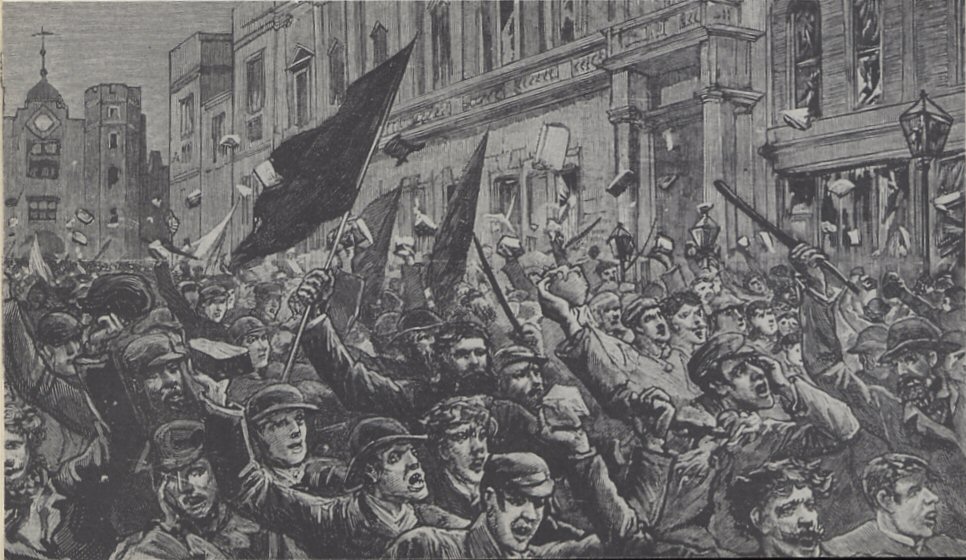
Occupation's and demonstrations in support of the unemployed have been waged on streets outside and even inside St Paul's Cathedral on numerous occasions.


In 1886 and 1887 the Social Democratic Federation (SDF) conducted a broad campaign of agitation among London's unemployed. The church parades were a form of this agitation, practised in early 1887. It was an attempt to address the unemployed from the pulpit. One parade, on 27 February 1887, took place in front of St Paul's Cathedral. During the sermon, parade participants proclaimed socialist slogans.

After the service the Social Democratic Federation held three meetings in the streets, the speakers including John Burns, George Bateman and Fielding.

Some refer to the events of 2th February 1887 as an "occupation" lead by John Burns later MP for Battersea (1892-1918)

--------------------------

Christian Socialism lecture by Rev Stuart Headlam in West Middlesex (probably Uxbridge)

"some years ago when the socialists marched in a body to St Paul's cathedral the old archdeacon of London was the preacher the men paraded the streets with banners and he stood on the steps of St Paul's and watched the procession arriving and was struck with the words on nearly all the banners being the sayings of Jesus Christ or his apostles and the chairman of the meeting (Rev Thomas Hancock) preached and published a sermon which he hoped all had read or would read, entitled "The banner of Christ in the hands of the Socialists" (published 1887) But the old Archdeacon told the congregation that we should never get rid altogether of poverty for Christ had said "the poor ye shall have with you" But Jesus did not say that, He simply said noting the persistence of poverty, "The poor, ye have with you" a very different thing to his saying "Ye shall always have them "


Christian Socialism lecture by Rev Stuart Headlam in West Middlesex (probably Uxbridge)


Buckinghamshire December 2nd 1890


The Banner of Christ in the Hands of the Socialists

from a sermon by Thomas Hancock

[The years 1886 and 1887 saw widespread unemployment and suffering among the working people of London, as well as in the North, and many of them adopted the tactic of marching into fashionable churches to dramatize their plight, armed with banners proclaiming appropriate Scriptural texts. Stewart Headlam responded to the predictable squeals of the pious by saying "It is no worse for a disinherited brother to come to church to 'show his rags' than for a middle class dame to attend for the purpose of displaying the sweetest new thing in Parisian bonnets; but where can the hungry worker make his mute appeal more appropriately than before the altar of Him who bade the hungry thousands sit down upon the green grass and made them eat until all were filled?" The following are excerpts from a sermon Thomas Hancock on the same subject. - - Ted M.]
* * * * * * *

The non-church-going masses have taken to churchgoing. We have seen what journalists of Mammon and Caste call an invasion of the 'Churches by poor Socialists.' We have seen nothing else like it in our generation. 'This is the Lord's doing; and it is marvelous in our eyes' . . .

If some old Athenian philosopher had risen from the dead . . . had come into the streets of London on Sunday and watched the great multitude surging into St. Paul's Cathedral, they would naturally have asked, 'whose disciples are all these men? What leader so they follow? From whom do they derive the axioms and rules which are moving them?'

Have you, my brethren, looked at the banners of this 'mob'? Have you observed 'whose image and superscription' they bear? It is not Caesar's, not Victoria's, not Gladstone's, not Schnadhorst's. not Hyndman's.

You see that they carry banners with mottoes upon them. Who is the author of these texts which express the social faith of this huge multitude? From what teachers have they borrowed the dogmas which they call upon all the city to read and to respect, and to obey? On whose authority are these innumerable crowds of the poor and rough doing this unwonted thing? They, or a great many of them, call themselves 'Socialists.' Let us read what is on their banners; let us discover who is the ultimate dogmatist of this multitudinous sect.

Christians, as you watch the mighty multitude pass by, you will soon be shaken out of your hasty a priori conjectures. Do you expect to read upon their banners wild words of their own invention? Do you expect extracts from Babeuf or from Proudhon, or even from Ferdinand Lasalle or Karl Marx? Are not the 'Socialists' their disciples? Ought not the mottoes by which they declare before the world their convictions, their demands, their faith, to be extracted from Das Capital or from the Arbeiterprogramm? Oh, come, all ye faithful! Look again and again at these inscriptions. Recognize, while you have time, what they are: see, clergy and laity, out of whose mouth the cries of the 'mob' have come. They are the words of your Master. They are the laws of the Eternal Father. They are the lessons which He taught us by His Son. They are the new commandments which you and I were pledged at our Baptism to keep. 'Feed My lambs!' 'My house is a house of prayer, but ye (capitalists and landlords) have made it a den of thieves!' 'I was an hungered and ye gave Me no meat; naked and ye clothed Me not." It is a small matter to what sect or party this great 'multitude' fancies it belongs, or by what denomination it pleases to call itself. You can see to whom they have felt obliged to go in order to find the fullest expression of their faith. 'In the name of our God,' said the crowds of the London poor, as well as the Hebrew psalmist, 'we will set up our banners.' We have not seen in our generation any other such warning, any other such an acknowledgment, that Jesus Christ the Crucified is He whom the Father has exalted to be the Head of Humanity, to lift up an ensign for the peoples, to be the one and only all-sufficient mediator, representative, spokesman, and avenger of 'all that are desolate and oppressed.'

- -quoted in Gilbert Clive Binyon, The Christian Socialist Movement in England, 1931


METROPOLIS—CHURCH PARADE OF SOCIALISTS AT ST. PAUL'S CATHEDRAL.

House of Commons Debate 28 February 1887 vol 311 c725
MR. DIXON-HARTLAND (Middlesex, Uxbridge)

I beg to ask the Secretary of State for the Home Department, Whether the accounts of the proceedings in St. Paul's Cathedral yesterday have been brought under his notice; and, if so, whether he will give such orders to the police, as will, in future, prevent the recurrence of such disgraceful scenes?

THE SECRETARY OF STATE (Mr. MATTHEWS) (Birmingham, E.)

I have seen the newspaper accounts of what took place in St. Paul's yesterday. Those accounts appear to me to be considerably exaggerated. From an interview I have had to-day with one of the officers of the City Police, who are not under my jurisdiction, I have no doubt that in future they will act vigorously in order to prevent any recurrence of the disturbance.

.

Uxbridge Liberal & Radical Association Established 1888


On Wednesday 11th January 1888 a meeting took place at Montague Hall for the purpose of establishing a new Liberal & Radical Association for Uxbridge and district.

Mr J. P Rickman the late Liberal candidate for the Uxbridge Division at the general election of 1885 occupied the chair. Those present included Rev J. Adams, Rev R Sewell, Mr W. Rayner and about 80 supporters.

The Chairman stated that "in the past two years politics had nearly gone to sleep in this neighbourhood. an effort had recently been made for a change, and that effort would now take the shape of the formation of a Liberal & Radical club.

Liberal clubs had been formed in a good many parts of the division, and had been attended with success, this being specially the case on the South or Thames Valley side, The Staines Club being the largest. He thought the it was quite time the example set in the Southern portion of the division should be followed in the North,. Premises would shortly be secured and he had no doubt that the efforts would prove successful and that the movement would extend throughout the district , Uxbride being the centre

A committee of 21 was to be established and will hold office for twelve months

The following officers were appointed

President: Mr J.P Rickman
Secretary: J.J. Hoare
Asst secretary: Mr Woods
Treasurer: Rev J. Adams


13 members were elected vice presidents, The rules were agreed

National journal "Liberal & Radical Journal"

Buckinghamshire Advertiser 14th January 1888

-----------------------------


The first annual meeting of the Liberal Council for the Uxbridge Division was held on Wednesday 27th June 1888 at the Uxbridge Town Hall about 60 members attended. With the exception of Hampton all polling districts were well represented.

The chair was taken by Mr J. M Moorsom QC

Secretaries Mr J Gundry and Mr J.J. Hoare

The President said they had assembled as a Council for the first time in their history, he refereed to recent victories in Southampton, Ayr and likely victory in Isle of Thanet

"He was not one of those who were very anxious for the liberals to be hurried into power again, He had always thought that after a great disaster, such as happened to them in 1886, they required some lengthened period to recover themselves. The state of the Liberal party had required purification"

In 1885 the Liberal candidate had been Mr Rickman

Mr Dean stated "Mr Rickman (cheers) might not be unwilling to become liberal candidate again, more especially as he withdrawn himself from that unfortunate heresy with which he was afflicted in 1886 when he associated with that detestable party, the Dissentient Liberals, however, he had since been accepted as the candidate for the Peckham division

Mr Hoare reported on Liberal activities in the north and Mr F. Morford in the South of the Division

Arthur King Staines
Mr Callam Staines
Mr A Dean Bedfont
Mr F Finch Uxbridge
John Wilkins Uxbridge

Mr CuthmCuthbert
mr F. A Wallroth

Buckinghamshire Advertiser 30th June 1888


------------------------------------------------------------------------------------------------

James Marshall the President of the new Liberal & Radical Association which has been formed here

Mr James Marshall of the Corn Mills, Heston, Hounslow is a man of whom the liberal party should be proud, and not only proud, but should make good use of him. He was born in Heston in 1838 and in the prime of life, very active and a hard worker in every cause he knows will do good to his fellow man. Mr Marshall is locally reported by every section of the community for his genial kindness as a neighbour, and for his industrious efforts for the public welfare.

he is a member of the local Board of his district since its formation in 1875 and is chairman of the works committee. he has been a member of the Board of Guardians since 1862 and although his Tory opponents have tried to oust him, he has at each contest been returned by an increasing majority. Mr Marshall is a member of the Society of Friends (Quakers) and one of the leaders of the temperance Party

Buckinghamshire Advertiser 19th May 1888

Note:
Staines also had a Conservative working Mens Club In May 1888
Conservative MP Dixon-Hartland Uxbridge Division referred to the Staines Conservative Working Mens Club established being established by the efforts of Frank Ashby (note Staines Brewery owner ?) according to Dixon- Hartland "It had a small beginning but had become a great power for work on behalf of the Conservative cause"


Sidney Job Pocock
Liberal Candidate 1906 and 1910

The name was agreed as Uxbridge Liberal & Radical Club and Association


Born 13 September 1854 Died 1931
at Broome Manor, Swindon, Wiltshire
Eighth son of Abraham and LydiaPocock
Tenant farmer from West Of England
Moved to London 1875 "Without a shilling"

Set up business with Mr F.H.Freeth wholesale milk contractor dairy farmer, which prospered into a major company and became chairman of Freeth & Pocock Ltd. later Director of Dairy Outfit Company Limited.

1894 elected Governor Metropolitan Dairyman's Benevolent Institution

Pocock had written widely on agriculture

1892 married Annie Cozens of Brockley (died 1900 during child birth) later married Kate Ethel

Visited Canada three time

Pocock was a non-conformist preacher and regular speaker at Brotherhood (Religious) meetings

Lived at Charlton Court near Shepperton (from last year)1904 and later at Surbiton Hall, Kingston

At the1906 General election Pocock came within200 votes of defeating long standingConservative and founder of the Primrose League Dixon-Hartland in Uxbeidge parliamentary election
F.D. Dixon-Hartland Con 6,429 50.6%
Sidney J Pocock Lib 6,284 49.4%


In 1912 he was knighted

He lost two sons killed in World War I (Sidney Norman Pocock- Corporal in Royal engineers killed February 1915 and Beric Edmund Pocock Lieutenant - London Rifle Brigade May 1916)


At an Liberal meeting on March 19th 1904 at Salem Baptist Church school room.

Christopher Roundell (?) stated they were fighting against money and power and besides the ordinary opposition there were those underground influences which were always in operation when they could not fix, the influence exerted by the Tory squire and Tory Parson.


In 1905 Women’s Association of Liberals in Uxbridge had four branches (Teddington being the largest)

"Liberalism had been dead and dormant in the division for 20 years" and it was 12 years since they last fought

Pocock was described as "an extremely popular candidate with a bluff and hearty manner winning the admiration of friends and opponents alike"


Thursday, December 15, 2011

1888 Jack The Ripper in Uxbridge ?


Jack The Ripper in Uxbridge ?

The local Advertiser newspaper reported

"A scare in High Street, Uxbridge" on 19th October 1888
On Saturday evening last, about eight o'clock, no small amount of interest was awakened among the people in the High Street Uxbridge by a report of a mysterious nature with which the now notorious and dreaded name of "Jack the Ripper was associated.

Buckinghamshire Advertiser, Uxbridge & Watford Journal
26th October 1888

Note


London was in a state of near hysteria over the horrific murderous activities of "Jack the Ripper" a situation exacerbated by the newspaper coverage, and incidents like that reported above.

What is less well now is that in the same streets as these atrocities against women were occurring working class women like the famous match girls at Bryant & May (at Bow) were fighting a heroic battle for a living wage and trade union rights.

It has been argued that some of the newspaper coverage of "Jack the Rippers" activities were a deliberate attempt to frighten women off the streets and away from political activity.

Certainly at this period in history the East End was the cauldron
of a huge upsurge in working class militancy and even a possible revolution. A situation fanned by the alleged links between "Jack the Ripper" and the Royal Family and/or the ruling classes.

Southall Industrial Co-Opeartive Society


On Wednesday 17th August 1890 a public meeting was held at St John's School, Southall to discuss the formation of a Co-Operative store in Southall. Mr T. E. Harland occupied the Chair and amongst those present were Mr A. Romney, B. G. Hanson, G.Harper, A. Upton, W. Tebbutt, J. Wilson, C. Mead, W.F. Sanger and J. Shirley.

The Chairman spoke briefly on the advantages of the Society and introduced Mr Cooper from the Guild of Co-operators.

Mr Cooper gave an exhaustive resume of the working of the stores generally and as an investment for the working man it was unique. All goods were sold at a fair rate and the profits distributed among the shareholders.

At the end of the meeting, it was resolved to establish a store in Southall on the principles laid down by the delegate.

Buckinghamshire Advertiser
20 August 1890

Wednesday, December 14, 2011

Hillingdon's First Black Public Speaker 1890

Hillingdon's First Black Public Speaker 1890

I believe that the African preacher described in the 1890 news item below was the first Black speaker in Hillingdon. A Coloured Peacher

A native of Africa will preach at the Uxbridge Wesleyan Chapel Sunday 29th March 1890 and at Iver, Buckinghamshire Mission hall in the afternoon and evening.


NOTE:

Their was no name associated with this news item. Above is a picture of the famous Nigerian Methodist preacher Thomas Birch Freeman ( 1809-1890) born in Twyford to an african free slave and English mother

After an education in England he became involved in the Methodist MovementHe had been ordained in Islington Chapel, London, on October 10, 1837

Freeman was sent to the Gold Coast as a Minister in 1838, Freeman built the first Methodist Church at Cape Coast, opened on June 10, 1838

In 1850 The British Governor Winniett took Freeman to Accra as his honorary secretary when he took possession of the Danish settlements on the Gold Coast which the British government had bought. The two men entered the Danish settlement of Christiansborg together and received the keys of Christiansborg Castle from the Danish authorities.


Freeman also set up an Agricultural Society in the Gold Coast (now Nigeria)


NOTE
Chaplin of Brunel University, Reverend Theo Samuel in the 1970s/80's - Black Socialist Preacher and active in the Association of Black Clergy

Uxbridge - Christain Socialist Fellowship 1911

A public meeting of the Christain Socialist Fellowship, Uxbridge Branch took place in February 1911 at the Primitive Methodist School Room, Lawn Road.

The Speaker was J. C. Fuller Socialist prime minister in the Hanwell & Ealing (debating) Parliament his subject was "The work of a Socialist Parliament".

He stated that The Socialist movement had made great progress during the last few years, ten years ago they were a band of gorillas, but they had now developed into a Party.

The Hanwell and District parliament was one of the oldest and strongest institutions of its kind in London and it started with only four or five socialists and now had over sixty
.


Advertiser 11 February 1911

ILP Speakers 1908
J. C. Fuller, , 8, Leighton Road. West Ealing
later Ealing Alderman

Note

Buckinghamshire Advertiser and Uxbridge, Harrow & Watford Journal 23 March 1890

A Coloured preacher - A native of Africa will preach at the Uxbridge Wesleyan Chapel Sunday 24th March 1890 and at Iver Mission hall in the afternoon and evening

Clarion Movement Drama Clubs

Clarion call to Drama.
Martin W. Collins
People's Theatre Archives.
May 2002

Introduction.
In 1911 the Newcastle upon Tyne branch of the British Socialist Party was having problems with their cash flow. They had rooms in Leazes Park Rd. Newcastle, in a wedge shaped building that is now a Joke Shop and Theatrical Costumers. Funds were hard to come by and they had been reduced to running dances in the Leazes rooms, for both socialists and non-socialists, to make ends meet. This was regarded by some as sacrilege and so a higher, more socially uplifting, way to raise money was sort. Wilf Armstrong, a staunch socialist and a reciter of some local repute, took up the challenge by posting a notice asking for any members who were interested in the Drama as a possible way to solve the financial problem. A number of people took up his idea and began to run with it. So, on Friday 17th march a Clarion Drama Club was formed. (Veitch 1950, Goulding 1991, The Clarion 1911)

It is my intention here in to give an account of the progress of the Clarion Drama Clubs/Societies with reference to the growth of the Newcastle upon Tyne Club whose members had a strong influence upon the National Clarion Players. Groups tended to be a little cavalier about the use of the terms "Drama Club" and "Drama Society" therefore, throughout this work the two words are essentially interchangeable.

The Clarion Movement.
One of the strands of socialism that was thriving in Newcastle, and who shared the Leazes Park Rooms, were sections of the Clarion movement. The main and most persistent strand of this movement are the Clarion Cycle Clubs (many of which, including one in Sunderland, still exist), however there were a range of other sports and arts clubs working under the Clarion banner. The Clarion movement began with the publication in 1891 by Robert Blatchford in Manchester of "The Clarion", a socialist weekly newspaper. "The Clarion" always carried a strong line for the Theatre. An extensive column called "STAGE LAND" produced by "Dangle" was part of the papers content well into the 1920s. It gave a range of reviews and gossip about theatre from around the country. Blatchford believed that socialism need not be drab. He believed that the socialist movement took itself to seriously regarding the austere Puritanism of Keir Hardy as lacking colour. Indeed Blatchford and Hardy had a long standing animosity between them. As Paynn (1976) put it, Blatchford believed that by offering a friendly atmosphere in the Clarion Clubs a wider appeal could be won for socialism. From this developed the Cycle clubs already mentions along with Swimming Clubs, Vocal Unions, Glee Clubs, Drama Clubs, Missionary Vans, handicrafts, holiday camps and Cinderella Clubs to entertain slum children. Regular reports of these groups would appear in "The Clarion." It therefore seemed obvious that the new drama club in Newcastle should be a Clarion Drama Club.

Clarion Drama Clubs/Societies and Clarion Players.
So it was that on July 11th 1911 the Clarion Drama Club of Newcastle upon Tyne mounted their first production, a double bill of two short plays. These reflected the Clubs socialist position in that they chose an adaptation of a section of Victor Hugo's "Les Miserables" by Norman McKinnell called "The Bishops Candlesticks" and a play by Gertrude Jennings called "Pot Luck." At around the same time Liverpool was also setting up its Clarion Drama Club (The Clarion 1911b). Reports of Clarion Drama Clubs began appearing in "The Clarion" on the 4th. May 1910 with mentions of groups in North and South London, Glasgow and Stockport.

The first Clarion Club to dabble with the drama as a mean of propaganda was set up in 1899 by members of the Manchester Club House. However, Birmingham claimed to be the first, in 1903, to form a Clarion Dramatic Society as an offshoot of its Cinderella Club. In 1910 the Clarion Players Union was formed (Pye 1995) by the ten clubs that then existed across the country. However, in the 1912 National Clarion Cycle Clubs year book (These Year Books acted as the Year Book for the wider clarion movement and the meets an outlet for their talents.) published for their 18th meet at Buxton, the groups report section on the Clarion Players stated:

Clarion Players; These are flowers in the bud, so to speak. Many amateurs and professionals have expressed themselves willing to help in such a scheme. But an organiser is wanted. Who will volunteer? Splendid scope for propaganda. (NCCC 1912)

In 1913 The Newcastle Clarion Drama Society performed a number of plays at the National Clarion Cycle Clubs annual meet at York. This included its fiftieth performance of Shaw's "Major Barbara". The Programme and Year Book accompanying this meeting lists Clarion "Players" in Hyde, West Leeds, Stockport and of course Newcastle upon Tyne. The reports section is introduced with the following paragraph

Clarion Players; Have developed considerably during the last three years, and are ready to present the drama – from Shakespeare to G.B.S. – without any qualms of conscience. (NCCC 1913)

In the 1913 year book the entry for the Newcastle club, after a list of the shows undertaken since its inception in 1911 there is a hope expressed that their example would inspire others to tread the boards as had the Newcastle Clarion Drama Club. The entry ended with "The propaganda value of plays such as the above are very great indeed, as a great number of people reached to whom lectures and other methods of propaganda would not appeal." (NCCC 1913)

In his book "The People's" (1950) Norman Veitch describes the efforts of the "National organisation of Clarion Drama Clubs" to form a library of plays suitable for Clarion Clubs, but more importantly that deal with Labour and Socialist subjects. The library was to be funded by clubs giving ten percent of their takings to this central library. To this end the Newcastle Club's (and by inference other clubs around the country) 1913 season consisted of a range of one act plays from both established writers such as Shaw and new writers. This project allowed the clubs to acquire a number of plays of their own which were "under the control of the National Executive." Although a number of plays were produced under this scheme two were particularly popular, "Recognition of the Union" by Landon Ronald and "Ashes" by W. J. Priestley. Indeed Ashes was so popular that it sold out. The scheme was working well until world war one intervened.

By 1914 Norman Veitch, one of the founders of the Newcastle Clarion Drama Club, was National secretary of the Clarion Players Union. He laid out the ideals of the Union in the Newcastle section of the 1914 NCCC annual meet Programme and Year book (held at Shrewsbury) as follows:

"We realise that most good art is good propaganda, so that in an indirect manner we express, through the drama, the living truths of socialism to people who otherwise are never touched by the ordinary methods of street-comer meetings and manifestos."

The NCCC 1914 Year Book and Programme listed seventeen clubs from around the country listed in table 1. The National Clarion Drama Societies (Players) were involved in the Meets of 1915 and 1916, however by this time World War I was taking its toll and no meets were held until 1919 when regular Meets were re-established. The National Clarion Drama Societies made use of these Meets to hold there own annual conferences along with entertaining those gathered. The final performance at these meets was at the 1927 York Meet when Newcastle Clarion Drama Society gave a performance. Unfortunately, no record of exactly what was performed seems to have survived.


Table 1. Clarion Drama Clubs in 1914
Club/Society Year founded
Birmingham1903
Nelson 1908
Glasgow 1909
Horsforth 1909
Stockport 1910
North London 1910
Hyde 1911
Liverpool 1911
Newcastle upon Tyne 1911
Accrington 1912
West Leeds Socialist 1912
Willesden Clarion (Black & White) Minstrels 1913
Nottingham 1913
Bristol 1913
Litherland (Liverpool) 1913
Handsworth 1914
West Ham 1914
NCCC Year book & Meet Programme 1914

In the press release that announced the formation of the Newcastle upon Tyne Clarion Drama Club (Clarion 1911a) members of the Clarion Drama Clubs in other parts of the country were invited to visit. In 1921 the Newcastle Clarion Drama Society had Mr. Herbert Humphreys on loan from the Birmingham Clarion Dram Club for their production of Bernard Shaw's Man & Superman in April 1921. In his book, the People's, (1950) Norman Vietch discusses his friendship with Humphreys, a future Mayor of Birmingham, forged during Clarion Easter Meets and continued by post. Humphreys was also instrumental in introducing George Bernard Shaw to the Newcastle Association, a relationship that lead to the Clarion/People's Theatre performing a number of Northern and National premiers of his plays.

Throughout the 1920s Clarion Movement in general was changing. Performers were realising that there was more to the Theatre than just socialist propaganda and these "entertainment" for the sake of entertainment were just as fulfilling as the hard core socialist repertoire. In Newcastle the Association had already begun to use "The People's Theatre" above the Clarion name. This was thought to provide a wider embrace than just the Clarion name. There was also increased bickering between "The People's/Clarion Theatre" and the Socialist society, even though the Drama Club had bailed the Socialists out of numerous financial holes, so allowing it to continue.

In 1929 the Newcastle upon Tyne People's Theatre incorporating the Clarion Drama Association acquired its own premises. When it moved to its new theatre "The People's Theatre" left its Clarion banner behind it at the Royal Arcade. All around the country Clarion Drama Clubs were either converting or disbanding.

Conclusion.
The Clarion Drama Movement was not the only attempt to promote Socialism through the medium of the Drama. In 1906 the Northern Weekly newspaper reported the formation of the first "Daisy Amateur Dramatic Society" in Manchester with the object of producing two plays, "The Unemployed" and "An out-of-works reply" written by two of the papers contributors. In 1936 the "British Workers Sports Association" formed a coral & Dramatic section stating:

It was realised that in the formation of the Choral and Dramatic Societies there were immense possibilities of linking the recreational activities with the propaganda work of the Labour movement. (1937)
Words that echo those published in the NCCC 1913 Year Book about the Clarion Drama Clubs.

The legacy of the Clarion Drama Movement is diverse. In Newcastle upon Tyne this legacy is highly apparent in the fact of the People's Theatre, a wholly amateur theatre company which has provided a wide repertoire of plays, including world premières from the likes of Shaw and O'Casey, to the people of Newcastle. In other places it may be a few unattributed photographs in the Local History Library. But for the twenty five years of its existence at the beginning of the twentieth century the Clarion Drama Movement helped to both entertain and educate the working people of Great Britain.
30th. May 2002.

References.
British Workers Sports Association (1937) Leaflet.
Goulding C. (1991) The Story of the People's: Newcastle upon Tyne City Libraries & Arts.
National Clarion Cycling Club (NCCC) Annual Meet, Buxton 1912: programme and Year Book (1912) The Utopia Press, London.
National Clarion Cycling Club (NCCC) Annual Meet, York 1913: programme and Year Book (1913) The Utopia Press, London.
National Clarion Cycling Club (NCCC) Annual Meet, York 1914: programme and Year Book (1914) The Utopia Press, London.
National Clarion Cycling Club (NCCC) Annual Meet, York 1927: programme (1927) The Utopia Press, London.
Northern Weekly (1906) 10th. March.
Prynn D (1976) The Clarion Clubs, Rambling and Holiday Associations in Britain since 1890s': Journal of Contemporary History 11(2&3) 65.
Pye D. (1995) Fellowship is Life: The National Clarion Cycling Club 1895-1995.
The Clarion (1911a) March 31st. p12
The Clarion (1911b) April 21st. p3
Veitch N. (1950) The People's; being a history of the People's Theatre, Newcastle upon Tyne, 1911 – 1939: Northumberland Press Ltd.


There are many glaring gaps in our knowledge of the Clarion Drama Clubs/Societies. I would therefore like to hear from anyone who can help fill in the gaps. Questions such as where the minuets of the Annual General Meetings have gone? What exactly were the programmes of productions given at the NCCC meets? What the Clubs other than the one in Newcastle doing and where are their records now? If you can help with any of this please contact me and tell me all about it.


My e-mail address is:

martin(at)sandmartyn.freeserve.co.uk

Pictures, words anything to fill the gap would be most welcome.
Martin Collins
People's Theatre Archive.

Tuesday, December 13, 2011

Kennington ILP 1908

click on picture to enlarge


Kennington Independent Labour Party Branch
Tram Electrification
Demonstration
Monday 1st June 1908

Corner of Devonshire Road and Wandsworth Road

Speakers

E.O. Joyce
Councillor C. Iremonger (Lambeth)
Councillor Frank Smith (London County Council)
Councillor T. W Simmons (Battersea)
G. J. Simkins
H. Bradshaw
W. Bishop

Kennington ILP Secretary C. Perry, 1 Lansdowne Gardens


Councillor C. Iremonger 19, Kenchester Street, South Lambeth Road, S.W.
Councillor T.W. Simmons 16 Wroughton Road

ILP (Independent Labour Party) Branches South London 1908

Balham
Battersea
Brixton
Camberwell
Clapham
Dulwich
Kennington
North Lambeth
Southwark
Streatham
Tooting
Wandsworth

Monday, December 12, 2011

Labour 1945


Click on photos to enlarge

Note

Labour party membership for 1945 (above) similar to 1938 but in yellow and year

Monday, November 14, 2011

Willesden - Spanish Civil War Heroes

Willesden welcomes back its heroes

March 1939

Charlie Pottins


Brent Trades Union Council in north-west London has invited Dave Chapple, from Bridgwater, to come and speak to us about Kilburn-born Howard Andrews, who died aged 101 in Taunton in May this year. A lifelong trade unionist and socialist, Howard - known to friends as 'Andy' - was one of the first to go from Willesden area (now part of Brent) to help the fight against fascism in Spain. He served in a frontline medical unit.

Hearing that Dave was interviewing and writing about Andy, someone anonymously sent him a photocopy of a little programme produced for the event which Willesden Borough Labour Party, Trades Council, and Spanish Aid Committee held in Pound Lane School on Saturday, March 18, 1939. to welcome home local members of the British Battalion in the International Brigade.

Howard is listed as Keith Andrews - he had used his brother's name - and there were also George Cornwallis, John Ducksbury, Morgan Havard, Harold Horne, Charlie Hunt, J.Russel, Alec Unthank, Danny Doyle and A.Moulton - who was to reply on the Brigaders' behalf to the welcome from deputy mayor Alderrman WH Ryde, in the chair.

The Hendon Left Singers were to perform, and also billed were MP Sydney Silverman, nurse Lillian Urmston, and Maurice Orbach, then a London County Councillor, later MP for Willesden East.

The event was to finish with the Spanish national anthem and the Internationale.

The programme also had a roll of honour, remembering Ben Murray, trade unionist, killed on the Aragon front; Sam Pearson, a Cambridge graduate, mentioned in despatches, who fell on the Ebro; John Unthank, killed in the battle of Jarama; John Stevens, a young trade unionist captured by Moorish troops at Jarama and shot; and Robert Blair, also mentioned in dispatches, whose fate was not known since he had been cut off behind enemy lines on the Aragon front.

Those were desperate times, and they were courageous men, and whatever we might think of the kind of political leadership to whose banner they were tied, we can only hope that a fraction of their spirit lives on, especially in these days of economic crisis and fascism again rearing its head.


END


NOTE


Robert "Bob" Cooper Blair killed April 1938 Gandesa

James Jones communist party member from Harrow (and Aberaman) Killed Ebro July 1938

William Francis Durston Wembley killed September 1938 Sierra Caballs

Sam Pearson (probably Henry C H Pearson Communist Party member and Cambridge student killed July 1938 Ebro)

John Unthank Middlesborough communist party member killed Jarama February 1937

John Stevens, an engineer and communist party member killed Jarama February 1937 shot while prisoner

Ben Murray

W.H.McCullough, Workers’ Republic May 1938
By the death of Ben Murray, killed in Spain in defence of Democracy, the Communist Party of Ireland and the working class of Belfast, have lost one if its best fighters. 

Ben, a native of Armagh, came to our Movement in 1934. Prior to that he had been for a number of years in Canada and had soldiered in a crack Canadian Cavalry Regiment during the Great War. He was a gifted speaker and was always sure of an attentive audience when speaking at Custom House steps or elsewhere in Belfast on behalf of the Communist Party of the unemployed. 

As a salesman of Party literature, Ben had no rival. He readily recognised that this form of propaganda was easily the most effective and his enthusiasm for this type of work was simply terrific. He did not simply talk about it but spent hours and days going from door to door on the Shankill and Falls Roads, canvassing and selling the 'Irish Workers Voice', the 'Daily Worker'. and other Left papers. The results he obtained were a sure indication of the enthusiasm he put into his work as, where previously comrades on this class of work thought they were doing well when they sold a few dozen copes, Ben was selling in numbers of 20 dozen. 

Unfortunately the program of 1935 interfered with this class of work and Ben began to get restless at the restricted activity and he asked permission of the Party in Belfast, to go to England. He was a big loss to our Party but a very big gain to the British Party as his work there on behalf of the Daily Worker proved. 

I had not known that Ben had gone to Spain until one day I read in the Daily Worker of three members of the International brigade planting a flag in 'no man's' land to commemorate the anniversary of the Spanish Republic and one of them was Ben Murray.
Ben is dead and I believe that he would not have wished to die any other way. He once informed me in private conversation that his life did not really commence until he joined the Communist Party and that he had an interest now that was worth living and dying for.


ADDITION
James Jones communist party member from Harrow (and Aberaman) Killed Ebro July 1938

William Francis Durston - Wembley killed September 1938 Ebro

The Storming of the Savoy - 14th September 1940


When Max Levitas Stormed the Savoy

November 3, 2011
by Matthew Sweet

On the day of publication of Matthew Sweet’s The West End Front, we present this extract from his account of when East End Communists occupied the Savoy Hotel in 1940.

There were forty of them. There were eighty. There were a hundred. They marched. They sauntered. They were angry. They were bewildered. They came with two dogs and they came with none. Theirs was a daring act that saved thousands of lives. Or it was a pretty piece of propaganda, gift-wrapped for the Führer. What happened beneath the Savoy Hotel on 14th September 1940, the eighth night of the Blitz, depended on the position of the observer: whether she or he was Red or anti-Red; East Ender or West Ender; dreaming of revolution or restoration. That Saturday night, when those forty or eighty or a hundred arrived at the doors of the hotel – with their dogs, or dogless – a small army of journalists was on the premises for a briefing by the Ministry of Information. Few, however, wrote about their uninvited fellow guests until the war was safely over. The government also maintained a public silence on the story, despite the urgent Cabinet discussion held the following Monday morning – a discussion with sinister undertones. But old comrades, years later, made that West End outing into a famous victory, a second Battle of Cable Street. It worked its way into plays and novels, into the mythology of the British Left. And though no horses charged and no batons swung, the Savoy Hotel invasion was the most serious political demonstration of the war – and dramatic evidence that conflict with Germany did not bring the class war to an end.

Max Levitas has spent most of his long life on the front line of that conflict. He was part of the famous human barricade that halted the Blackshirts’ progress through the East End in October 1936. He stood his ground at Brady Mansions during a twenty-one-week rent strike – brought to an end only by the government’s decision to freeze rents for the duration of the war. He was one of the dozen Communist councillors elected to the Borough of Stepney in 1945, during that giddy moment when the electorate could still see the avuncular side of Joe Stalin. He was there in 1991 when the Communist Party of Great Britain voted for dissolution and secured victory in the long war of attrition against itself. He was there, too, on that Blitz- struck Saturday night in 1940, shouldering the red banner of the Stepney Young Communist League as his group of demon- strators marched from the Embankment towards the silvered canopy of the Savoy. They marched for better air-raid shelters in the East End. They marched against the myth that the Luftwaffe had brought equality of suffering to Britain. And they received their marching orders from a series of urgent editorials in the Communist newspaper, the Daily Worker: ‘If you live in the Savoy Hotel you are called by telephone when the sirens sound and then tucked into bed by servants in a luxury bomb-proof shelter,’ the newspaper asserted. ‘But if you live in Paradise Court you may find yourself without a refuge of any kind.’ And above these words, in thick bold print: ‘The people must act.’

Max Levitas nods in agreement when I read the article back to him. ‘The surface shelters protected you from shrapnel, from flak, but not much else,’ he reflects. ‘If a bomb fell on one of those it would collapse and kill everybody in it. The Communist Party argued for deep shelters. But the National Government wouldn’t listen. They wouldn’t even open the Underground. It was easy to ignore that message if you were sitting in the basement of a very nice hotel. So we decided to march on one.’ I ask him why they chose the Savoy. Max Levitas smiles a tolerant smile. ‘It was the nearest.’

I meet Max Levitas at the Idea Store, that gleaming cultural institution planted in the East End to compensate locals for the assimilation of their much-loved public library into the Whitechapel Art Gallery. He is a small, cloth-capped nonagenarian, wrapped tightly in a raincoat and muffler. Standing on the studded purple rubber floor of the foyer, he looks like a preserved fragment of the old Stepney. It is a chilling morning in February, and he can spare me an hour before he goes for his Turkish bath – a weekly ritual since the 1920s, when his father took him to the long-vanished Schewik steam rooms on Brick Lane. We catch the lift to the top-floor café, secure two cups of tea and a table with a view of the bristling City skyline, and he tells the story of his association with the area: how his parents fled the Lithuanian pogroms in 1912 and made landfall in Dublin, where Max was born three years later; how his father took the family first to Glasgow, and finally to Stepney, where work could be found among a supportive community of Jewish exiles. History radicalised those members of the Levitas clan it did not destroy: Max’s Aunt Sara and her family were burned to death in the synagogue of the Lithuanian shtetl of Akmian; Max’s father became a leading member of the distinctly Semitic, distinctly Red-tinged International Tailors and Pressers’ Union; Max’s elder brother, Maurice, fought against Franco’s forces in the Spanish Civil War; Max gave his youth to the Communist Party of Great Britain and was name-checked by Oswald Mosley in a speech denouncing the enemies of British Fascism.

The organisers of the Savoy invasion shared a similar ideological background: they were all revolutionaries. ‘And they’re all dead,’ Max sighs. ‘Some were clothing workers. Some were bootmakers. Some were dockers.’ It is an inventory of lost trades. The first names he sifts from his memory are two stevedores, Ted Jones and Jack Murphy, veterans of pre-war campaigns for unemployment relief. The rest comprise a knot of men from the Stepney Tenants’ Defence League, which organised rent strikes against slum landlords in the East End: George Rosen, its bullish secretary, known as ‘Tubby’; Solly Klotnick, a furrier and a veteran of the Battle of Cable Street; Solomon Frankel, a clothing worker who took a bullet in Spain that robbed him of the use of his right hand. Michael Shapiro, a wiry young academic from the London School of Economics. At the head of the group stood Phil Piratin, Communist councillor for Spitalfields, chief spokesperson of the invaders, and the author of the most widely read account of their night at the Savoy. His memoir Our Flag Stays Red (1948) puts seventy in the hotel lobby, among them a number of children and pregnant women. Max’s memories are different. ‘There were forty of us,’ he affirms. ‘I’m sure of that.’ I ask if there were any dogs. He shakes his head. ‘No dogs,’ he says. ‘It was the Savoy.’


EDITOR'S NOTE:

During the early days of the Blitz the Government controlled media tried to show that life in London was carrying on as normal, and there was much coverage in the press of people going to parties, dining out and clubbing in the West End.

This sham, was at great odds with the experience of the people in the Working Class areas of London, who were now being systematically bombed into oblivion.

To highlight the plight of the people of Stepney, the Stepney Communist councillor Phil Piratin took on Saturday 14th September 1940, some fifetyworkers, including a group of what Time magazine called “ill-clad children" from Stepney and burst into the Savoy Hotel.

Within minutes and with the help of sympat
hetic waiters the group had invaded and occupied the Savoy Hotel shelter, stating “ if it was good enough for the rich it was good enough for the Stepney workers and their families”.

During the confusion an air raid alert, (all to helpfully), was sounded, and the Savoy Hotel manager realising that that could not be seen to send the "invaders"out into danger was forced to allow them to remain until the "all clear" siren was sounded.

The group soon settled down and after an element of negotiations the catering staff agreed to provide silver trays laden with pots of tea, bread and butter and for the children.

The next day the press was full of stories about the audacious occupation of the Savoy Hotel shelter and the terrible conditions of the shelters in Stepney. The Communist Party had succeeded in its objective.


Saturday, November 12, 2011

Hayes - Roll of Honour WW1

HAYES & HARLINGTON - WW1 ROLL OF HONOUR


HAYES & HARLINGTON
(MIDDLESEX)

ROLL OF HONOUR


WORLD WAR ONE


Listed are the brave men of Hayes, West
Middlesex who gave their lives during World War One.

Addition information is based upon an initial cross reference with the Commonwealth War Graves Commission.

Many were young, they had their lives ahead of them and they gave their lives for what they believed was a just War, many to defend the "honour" of Belgium. We can call it an "Imperialist War" a "Capitalist War", we can blame the folly of their leaders like Earl Haig and Winston Churchill (Galopilli).


But we must never forget they gave their lives for what they believed was an "honourable" and "just" cause, many were young working class men and far from being caught up in the "jingoism" of the ruling class believed it right to fight for the liberation of Belgium.

This view was no doubt reinforced by the Belgium refugees who streamed into the munition factories of Hayes during War.


HAYES WW1
ROLL OF HONOUR


E.J. Arnold (Not found)

S.P. Aird (Not Found)

H. Balls(Possible Match)
Herbert Frederick Balls, 20 Royal Fusiliers died 20/07/1916 ??????

F. Bamforth (possible match)
Francis Bamforth, 8th Bat Royal Fusilers died 07/07/1916 ??

R.Bates (CONFIRMED)
Prvate Richard Edward Oliver Bates of Son of Annie Bates"Ivydene," Hayes End, 11th battalion, Middlesex Regiment died 09/04/1917

S.C. Bennett (Not Found)

D.C. Blyth (Not Found)

C. V. Bowgett (CONFIRMED)
Charles Victor Bowgett age33 Son of George and Fanny Eliza Bowgett; husband of Emily Bowgett, of 10, Rosedale Avenue, Hayes End, Hayes, Middx.
Rifleman 3rd Battalion Rifle Brigade died 20/10/1914

C.W Bray (Not Found)

H. Calf (CONFIRMED)
William Henry Calf, Gunner 196th Siege Bty. Royal Garrison Artillery Son of Frederick and Kate Eugenie Calf, "Acacia", High Rd, Hayes ., died 05/04/1917 CEMETERYANZIN-ST. AUBIN
BRITISH

R. Calf (CONFIRMED)
Robert Noel Calf, age 20 Private 13th Battalion, Royal FusilersSon of Frederick and Kate Eugenie Calf, Acacia", High Rd., cemetery Humercamps

C.Castle (CONFIRMED) Sergeant C. Castle age 27 Son of William G. and Sarah Castle, of 4, Railway Cottages, Hayes, Middlesex. Native of Iver, Bucks. 9th Bat Royal Fusiliers died 28/06/1918 Gezaincourt Cemetery

E.L Chambers (Not found)

A. Charlesworth (Not found)

J Chinnery (CONFIRMED)
Private James Chinnery, 9th Bat Royal Fusiliers 21 years old Son of Mr. and Mrs. Chinnery, of 49, Rosedale Avenue, Hayes End, Middlesex. 04/04/1916

P.Chitty (Not found)

J. Churchill (CONFIRMED) Private John Churchill aged 17 Son of Ena Elizabeth Churchill, of 39, Rosedale Avenue, Hayes, Middx 18/09/1916 Philosophe British, Mazingarbe.

R.E. Coleman (Not found)

J.Cooke (CONFIRMED)
Private John Gatwood Cook age 39 husband of Ellen Cook of 13 Austin Road, Hayes, Brother Colour Sergeant Cook. 13th Loyal North Lancashire Regiment, died 13th July 1917 at Baddow campa, Essex buried St Mary's Hayes.

H.Court (Possible match)
HARRY ROBERT COURT 12th Middlesex Reg Husband of Phoebe Rebecca Court, of 19, Montague Avenue, Hanwell, Middx. ????? 10/01/1917 ?????

W.Curtis (Not Found)
G. Druce (CONFIRMED)
Private George Druce, aged 18, Son of Mr. and Mrs. George Druce, of 5, Church Walk, Hayes, Middx.9th Battalion Royal Fusiliers,20/10/1915 Noeux-les-Mines cemetery


R. Egerton (CONFIRMED)
RALPH EGERTON1st Essex Regiment age 35 06/08/1915 Son of the late Serjt. James Coleman (Connaught Rangers) and Mrs. Coleman, of Attleborough, Norfolk; husband of Harriett Elizabeth Coleman, of 25, Rosedale Avenue, Hayes End, Middx. Helles memorial


T.D. Elderidge (Not found

W.J. Emmett (CONFIRMED)
Private W. J. Emmett age 18 Son of Charles J. and Emma Emmett, of Hayes, Middx. 2nd Battalion London Regiment (Royal Fusiliers) died 01/07/1918 CONTAY BRITISH CEMETERY,

George Charles Ensby (CONFIRMED) George Charles Ensby Private No2 Coy 12th battalion, Royal Fusiliers killed 31 July 1917 son of George Ensby (brick maker?) 10 Rigby’s Cottage Dawley Hayes Ypres Menin Gate Memorial


G.Gates (CONFIRMED) George Gates age 30 Son of Mary Ann Gates, of Walnut Tree Cottage, Yeading, Hayes End, Middlesex. 2nd Bat Middlesex Reg 31/07/1917 - Ypers Menim Gate memorial

B.St J. Glanfield (Not found)

H.Gohm (CONFIMED)
Private Henry Gohm 4th battalion Royal Fusiliers died 25/09/1915 Sanctuary Wood cemetery

T.W. Gregory (CONFIRMED)
Thomas williamage 26 Son of Thomas and Sarah Gregory, of 16, Angel Lane, Hayes End, Middx.C" Coy. 7th Bn.Royal Fusiliers died 06/02/1917 Thiepval cemetery

F.D. Gregory (CONFIRMED)
Corporal Frederick David Gregory age 30 Husband of Ida May Gregory, of 37, Rosedale Avenue, Hayes End, Hayes, Middx. 2nd Batallion Grenadier Guards 31/07/1917 Artillery wood

A. Gray

C Gye (CONFIRMED)
Charles Gye 1st Royal Fusiliers Son of Robert and Caroline Gye, of 33, Rosedale Avenue, Hayes, Middlesex 17/11/1915


F.Halford (Possible match)
Private F. Halford 4th middx reg 23/08/1914 St Symphorien Military ?????

S. Hambridge (Possible Match)
Sidney John Hambridge 2nd bat Grenadier Guards Grenadier Guards24/05/1918 ??????

G. Hammond (CONFIRMED)
Private George age 22 Son of Mr. G. Hammond, of 4, Melior Cottages, Yeading Lane, Hayes, Middx. 8th Bat Middx Reg died 19/05/1917 1st/ Aaras

J.W. Hart (not found)

A. Hawkins (Not found)

A. Haynes (not found)

F.A. Hewens (CONFIRMED)
Lieutenant F.A. Hewens 16/07/1918 RAF buried St Mary's Hayes

A. Higgs (CONFIRMED)
Arthur HiggsS on of Mrs. J. Higgs, of 4, White Row, Yeading, Hayes, Middx. 2nd bat Royal Fusiliers died 01/07/1916 Hawthorn ridge

A.W. Higgs (Possible match)
Albert William Higgs 2nd Battalion Middlesex Regiment 24/04/1918 ?? 90% sure

E. Higgins (CONFIRMED)
E. Higgins 32 Son of Mr. E. Higgins, of 7, Pillions Cottages, Hayes End Rd., Hayes, Middx. bat Royal Fusiliers died 19/06/1917 DICKEBUSCH NEW MILITARY CEMETERY

A. Howard (not found0

G.F. Hunnisett (CONFIRMED)
Private Frederick George Hunnisett "Sunnyside", Yeading, Hayes, Middx. 01/04/1918 Queen's Own Oxfordshire Hussars - Pozieres Memorial

W.E. Hunt (Possible match)
Son of Henry James and Elisabeth Sarah Hunt, of 12, Elthorne Park Rd., Hanwell. Born at Hanwell. Air Mechanic 2nd Class RAF 06/04/1918 Hanwell cemetery ??

E. Jermie (Jermy) (CONFIRMED)
Lance Corporal Ernest William Jermy age 21 son of William and Annie Maria Jermy of 3 Brown's Cottage, Hayes End, Middx 1st Battalion Royal Fusiliers died 25/03/1918 Pozieres Memorial

M.R. Johnson

F. Joyce (not found)

A. Knight (CONFIRMED)
Private Albert Alfred Knight age 22 Son of mrs Alice Clark 61 Albert Road, Yiewsley, Middx 1st/8th Bat Middlesex Reg died 30/04/1915 Ypres cemetary

G. Langley (CONFIRMED)
Lance Cororal George Langley 21,Son of James and Ada Langley, of 19 Mellor Cottages, Yeading, Middx. 1/8th Bat Middlesex Regiment 16/08/1917 Tyne Cot cemetery


H. Langley
Private Harry Langley age 27 Son of James and Ada Langley, of 19, Melior Cottages, Yeading, Hayes, Middx. 17th Battalion, Middlesex Regiment died 28/04/1917 Aaras cemetray

W. Leather (not found)

A. Lovett (CONFIRMED) Private Arthur Samuel Lovett aged 19 1st east Surrey regiment Son of Arthur George and Ada Lovett, of 35, Clayton Rd., Hayes, Middx. 24/09/1916 Thieva

F. Merchant (Not found)

B. Matthews (Not found)

G.F. Mattingley (CONFIRMED)
George Francis Mattingley, age 25 , Son of James and Annie Mattingley, of Yeading, Hayes, Middx Yeading. 20 Bat Kings Royal Rifles16/07/1916

G.W. Meads (Not found)

W.H. New (Not found)

E.C. Nice (Possible Match)
Edward Charles Albert Nice10th Bat Essex Regiment 26/09/1916 Thiepval ???

A. Norwood (CONFIRMED)
Corporal Alfred Norwood age 40 Son of Charlie and Helen Norwood, of 17, Cowley Mill Rd., Uxbridge; husband of Emily Norwood, of 18, New Windsor St., Uxbridge, Middx. 12th bat Royal Fusiliers 15/06/1917 Ypes

W. Palmer (Not found)
(Might be William Plamer - Candaian son of Henry Palmer

A. Penn (not found)

R.C. Pickering

W,H. Pomeroy
12 Bat Suffolk Regiment 05/05/1917 ?????

H. Powell (CONFIRMED)
Lance Corporal Harry Powell age 31 son of Stephen William and Ellen Powell of 5 Mill's Cottages, Wood End Green, Hayes End. Middx died 15/10/1918 Duhallow ADS cemetery

H.M. Prince (Not found)

E. Rayner (CONFIRMED)
Private Eric Norman Rayner age 24 Son of Mrs M Rayner of 35 Angel Lane, Hayes End, Middlesex 13th Battalion Royal Fusiliers 5/10/1917 Tyne Cot Cemetery

W. Rayner (Not found)

W, Redden (not found)

T. Renton (Not found)

W. Richardson (Not found)

F. Sadler (POSSIBLE MATCH)
Frederick Frederick John Sadler, 2nd Middlesex Reg ,Thiepval 01/07/1916 ????

T. Salter (CONFIRMED)
Private Thomas Henry Salter age 19 Son of Silas and Emma Salter, of 1, Park Lane, Hayes End, Middx. Royal Fusiliers 02/10/1915 Loos

W. Sargood (Possible Match)
1st Bat Royal Fusiliers 17/01/1916 ??

C. Sherwood (Not found)

C.Sherwood (CONFIRMED)
Private Charles William Sherwood 8th Battalion Royal FusiliersSon of Emma Sherwood, of 8, Town Field Rd., Hayes, and the late Thomas Sherwood; husband of Maud Elizabeth Sherwood, of 1, Grainges Yard, Uxbridge, Middx age 35 05/10/1916 Thiepval


J. Smith (Not found)

H. Stacey (Not found)

A. J. Stonestreet (Possible Match)
Private Alfred John Stonestreet age 22 Son of Benjamin John and Sarah Emily Stonestreet, of Myrtle Cottage, High Rd., Southall, Middx.13th Kensington Bn, London Reg. died 01/07/1916 COUIN BRITISH CEMETERY

W. Sullivan (Not found)

W. Syred Lance (CONFIRMED)
Corporal William Arthur Syred Son of the late William Arthur Syred and of Betsy Witherly (formerly Syred), of 33, Blyth Rd., Hayes, Middx. 25/09/1915 Ypres 5th Bat Oxford and Bucks Light Infantry

W.C. Tapping (Not found)

W.H. Taylor (Not found)

A. Tripp (Possible Match)
Albert Tripp, Rifleman Rifle Brigade 16/12/1914 Ploegsteert ?????

W.T. Turner (Not Found)

H.A. Turner (CONFIRMED)

Henry Albert Turner, aged 35 Husband of Florence Fearnley Turner, of "Claverley," Cromwell Rd., Hayes End, Middx. Born at Hayes End. 6th Battalion Queen's Own (Royal West Kent Regiment) died 09/04/1918BOUZINCOURT RIDGE


H. Tyrell (Possible match)

P. Tyrell (Possible match)


W. Vaughan.(Not found)

J. Watts G. West (not found)

W.T. Williams (Not found)

ALSO

The Palmer Brothers from Hayes (sons of Hayes Labour Party founder and Councillor Henry Palmer) They died fighting in the Canadian Army.

William Alfred Palmer, Eastern Ontario Reg (Killed 26 th April 1916 buried Woods Cemetery, Belgium).

Lieutenant Henry Arthur Palmer, Central Ontario Reg (killed 30th September 1918 buried Cantimpre Canadian
Cemetery, Nord France)


LEONARD SPENCER - UXBRIDGE ILP SECRETARY

L "Leonard" W. Spencer was born in Guildford 29th July 1889, educated at Collegete School at Reading, He was the son of Mr. T. B. Spencer, of 66, Kidmore Road, Caversham, Reading.

Aged just 17, he left home to open a business in Uxbridge, living later at Belmont Road, Uxbridge. Leonard Spencer went on to helped establish and became the first secretary of the Uxbridge Chamber of Commerce, while also participating in the establishment of a local parliament (debating society).

As an early motor cyclist enthusiast he was reported to be the first person to have ever successfully motorcycle up Snowdon, he also toured Norway and Iceland as a young man.

Spencer had been a keen supporter of Mr Edmund Dene
Morel (later Labour MP for Dundee and married to Mary Richardson) agitation over the brutal rule of King Leopold in the Belgium Congo (Now the Democratic republic of Congo).

Spencer became a Christian Socialist believing "that there was no incompatibility but rather the fullest harmony between Christianity and socialism".

He went on to become the founding Secretary of the Uxbridge Independent Labour Party (ILP) and in 1910 he had been elected to Uxbridge Council as a Labour candidate along with Edwin Westcott. While on the council he was involved in the plan to build some of the first Uxbridge Council houses and it was stated that these "were definitely a monument to the energies and the eloquence of Mr Spencer".

When World War 1 broke he
considered it his Christain duty to serve and he was one of the first to enlist as a Cyclist Orderly in the (London Cycling Regiment) later 13th Kensington Battalion in order to defend the sovereignty of "little countries overseas".

He wrote home stating "he would not come home for the world until victory was won" and encouraging others to follow him and enlist.

At Ypres, during the Battle of Neuve Chapel during March and April 1915, A battle which represented the first large scale organised attack undertaken by the British army during the war. Spencer's Battalion took major losses, he underwent a terrible ordeal, suffering from hunger, thirst and sleepless nights. He only took off his clothes to wash and slept every night with his motorcycle by his side (probably providing a vital courier service). He served without respite for seven months.

The Regimental History of the Kensington's Regiment describes their experiences during Neuve Chapelle. C Company was involved on the first day, and advanced at 9 a.m. to the village cemetery, where they had to take cover amidst churned-up graves. On the 12th of March, their C.O. (Lieutenant-Colonel Lewis) noted that by 12.25 p.m. the German bombardment of their positions (in the old front line) was "Perfect Hell".

It seems that this "perfect hell" had finally undermined Leonard Spencer's fundamental Christian beliefs, it was stated later that he had rediscovered his beliefs before his untimely death, shot through the head by a German snipper on the 1st September 1915.

Private (and Comrade) L.W. Spencer is buried at Longuenesse St Omer, France.


SPENCER L W
United Kingdom Private 2024London Regiment01/09/1915 Age: 26 II. A. 23.