Showing posts with label Irish. Show all posts

Friday, January 10, 2014

1940 London Irish Discrimination

Edward Hickey an Irishman living in Acton, West London in 1940 wrote to the Daily Worker 2 March 1940 in obvious anger at the way he (and many other Irishmen and women)  were being treated.

"I am an Irishman resident for a number of years in this citadel of democracy.

I have been sacked from my job, refused dole and told, when I went to interview the manager of the Acton Labour Exchange, that no Irishman could get a job as a temporary railway porter. What a lot of hypocrites we have ruling us here."

--------------------------------------------

Colony of Irish at Hanwell

In 1937 the local Uxbridge paper was complaining that Hanwell was becoming a "Colony of Irish" and becoming a nuisance, like Greenford was 

27 March 1937

Tuesday, September 10, 2013

20th anniversary of murder of Irish Citizen Army leader James Connolly 1936


Irish Embassy in London - Irish Republicans attach a banner to the balcony on the anniversary of James Connolly's death 12th May 1936.

A Battle Hymn of the Irish Citizen Army (ICA) words by  Constance Markievicz.

Sunday, November 06, 2011

ICA: The Military Wing of the Irish Trade Unions


"An armed organisation of the Irish working class is a phenomenon in Ireland. Hitherto the workers of Ireland have fought as parts of the armies led by their masters, never as a member of any army officered, trained and inspired by men of their own class. Now, with arms in their hands, they propose to steer their own course, to carve their own future."

(James Connolly, Workers' Republic 30 October 1915)

The Irish Citizen Army (Arm Cathartha na hÉireann) or ICA, was the armed wing of the Irish trade unions established in Dublin in 1913, Ireland for the defence of worker’s demonstrations from police attacks.


The Irish Citizen Army took part in the Easter Uprising of 1916 and in response the British army destroyed their headquarters at liberty Hall

Friday, June 03, 2011

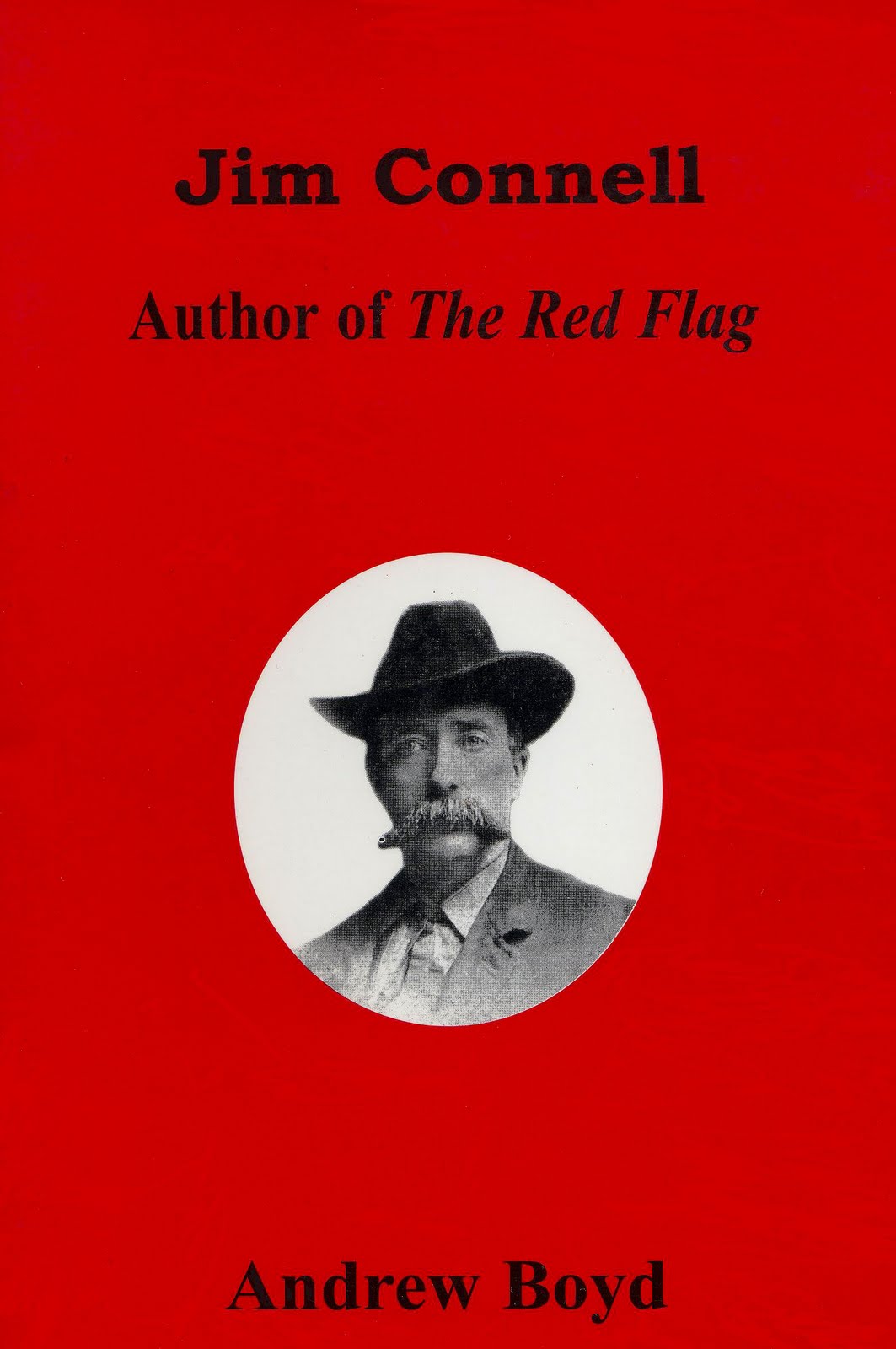
Jim Connell - The Man Who Wrote "The Red Flag"


The Rebel Poet Who Gave The Workers Their Battle Hymn
Daily Worker Friday 2 February 1962


Thirty Three years ago yesterday, Jim Connell, thet man who wrote " The Red Flag," died at the age of 76.
For over 70 years that song has been the battle hymn of the British Socialist movement.
Multitudes in each generation have sung it, but comparatively few have known anything about the author.
Jim Connell was an Irishman, born in 1852 in the village of Killskyre in Co. Meath.
During his boyhood days the terrible living conditions in Ireland under British rule awakened the class-consciousness of young Jim, and he joined the Irish Fenian/Brotherhood before he reached adult age.
Irish freedom
When Michael Davitt, one of the great fighters for Irish freedom, was released from a seven year. jail sentence and began organising the Irish Land League in 1879, Connell was then an exile in Britain, but he became a member of the British executive committee for the League.
In England Jim Connell soon realised that the fight for national freedom had its place in the inter national struggle for Socialism. and he joined the Social Democratic Federation long before the Labour Party was formed.
In 1890 he stood as a Parliamentary candidate for the S.D.F. in a three-cornered fight with Tory and Liberal in a North London constituency. He later became a member of the Independent Labour Party.
Charming wit
He was a man of many parts and once described himself as having been a " sheep farmer, dock labourer, navvy, railway man, draper, journalist, and ' a lawyer of sorts.' “ But he also had the attributes of an artist—he was an ardent student of Shakespeare and a lover of nature.
I first met him in 1924 with Tom Mann, who invited me to join them at a pub named The Golden Cross, which then stood in the Strand opposite Charing Cross Station.
I was then under 30 years of age and always remember the deep impression of that first meeting with Jim Connell. He was a hefty man over 6ft tall and very picturesque in his style of dress—a black sombrero hat, a large bright red tie and a long black cloak. He looked like an old Shakespearean actor. He had an enormous moustache and a rather high-pitched voice.
When he spoke with his rich Gaelic brogue there could be no doubt that he was an Irishman. He was a great talker with a charming wit, but he had a fighting spirit which blazed forth, whenever we talked of the class struggle.
I met him several times in the company of Tom Mann, Tom Quelch and Nat Watkins and always enjoyed his company. When Tom Mann was there it was great fun, because he had the same exultant nature as Jim.
they chaffed and bantered each other to the delight of our own group and often to the amusement of others within earshot.
At one period in his life he got his living as a poacher and later wrote a book entitled " The Confessions of a Poacher." Once when I was in his company he slapped me on the back with gusto and complimented me on my organising work among the unemployed and then added: " But why don't you advise the unemployed to become poachers? There's plenty of good food to be grabbed on the big estates of the Lords and Dukes of Britain."
Many poems
He wrote many poems and lyrics which are now unobtainable, but the one that still survives is " The Red Flag." It was first published by the S.D.F. paper Justice in 1889 the year of the famous strike of the London dockers for the " tanner-an-hour " wage.
No doubt this event prompted its publication. But I think the original inspiration of Connell for writing the song was the international protest against the execution in America, on November 11. 1887, of four militant trade unionists who were leading a strike movement for the eight hour day.
Chicago Martyrs
They became known as " The Chicago Martyrs." As they stood on the gallows they each pro claimed their faith in the ultimate victory for the working class. One said: " The time will come when our silence in the grave will be more eloquent than our speeches."
I believe that it was this tragic event in international working class history, and the challenging spirit of the Chicago Martyrs. which inspired Jim Connell to write the defiant verses of " The Red Flag."
Wal Hannington
Daily Worker Friday 2 February 1962


Why he wrote it
In The Call (B.S.P. weekly) of 'May 6, 1920, there was an article by Tim Connell entitled " How I Wrote ' The Red Flag.' " He mentioned a series of great struggles which " got me into the mood which enabled me to write ' The Red Flag.' " The first was the fight of the Irish Land League, which roused the democrats of all countries and in which he was secretary of the Poplar branch.
The second was the struggle of the Russian revolutionaries. He was in the company of one of their great figures, Stepnyak, on the night the latter was accidentally killed at a level crossing.
Stepnyak's book " Underground Russia " had had a deeper effect on him than any religious revival, Connell wrote. The third was- the hanging of the Chicago anarchists, and particularly the speech of Mrs.Parsons, the widow of one of them, which Connell heard. And the fourth was the great dockers' strike of 1889, which " aroused the whole of England."
So Wal Hannington, in his splendid article (February 9) has hit the nail squarely on the head. Connell said that he wrote the first two verses and the chorus during a 15-minute train journey between Charing Cross and New Cross, and finished the rest that night.
Then he sent it to Harry Quelch, Editor of Justice. It was printed in the Christmas number, published on a Thursday, and the following Sunday the song was sung in both Liverpool and Glasgow.
Connell was very emphatic that it should be sung to the air of " The White Cockade," not of the old German church hymn, " calculated to remind people of their sins and frighten them into repentance." known also as " Maryland."
ANDREW ROTHSTEIN. London, N.6.
Daily Worker 13 February 1962


MEN WHO SANG "RED FLAG" IN BARRACKS 1929

Highlander located in Maidstone Prison

STORY OF REVOLT

At least one of the three Sutherland Highlanders sentenced to five years' imprisonment, following a mutiny among the troops in Jamaica, according to news which has just reached the Daily Worker is in Maidstone Gaol, Kent.

The exact place where the others are imprisoned is not yet known, but here is an opportunity for London workers to strengthen the campaign for the immediate release of these men.

It will be remembered that these four men received this vicious sentence about eighteen months ago at a court martial following a mutiny and the singing of the "Red Flag " in the barracks by the soldiers.

The Capitalist Press made a great show of the affair about six weeks ago, pointing to it as an example of how stern measures had to he enforced in order to maintain discipline.

The whole scandalous affair of the brutal sentence and the way news concerning the case was being suppressed bv the Capitalist Press was exclusively exposed in the " Workers' Life last August. The whole affair first came to light following the publication, in a Communist pit paper in Fife, of a letter from a soldier in the Sutherland Highlanders.

His regiment was stationed in Jamaica, in the West Indies, and his
letter stated that scandalous conditions for the men prevailed. Deep resentment was growing among the soldiers against the bad conditions, and this came to a head in the revolt .

In his letter Private Clark described the events which led up to the revolt. An N.C.O. and two officers entered the barrack room to arrest two soldiers for making a noise after 10 o'clock. The men, it is said, demanded the remedying of certain grievances, and had the complete support of the two hundred men -in the barrack room, who commenced to singing the " Red Flag." Eventually the revolt was crushed, the four men taken to the guard room and. Later, court martialed.

Daily Worker first Edition
January 1st 1930

JIM CONNELL FACTS
Born 27th March 1852 - Kilskyre, Meath, Ireland (five miles from Kells)
Died 8 February 1929 - Lewisham Hospital, London, england

Emigrated to London in 1875
His occupations included, Dock labourer, navvy, railwayman, draper, journalist and sheep farmer
finally, Secretary of the workers Legal friendly Society based in Chancery Lane, Central London

Keen Countryman, poacher, he was taught by the local Police constable his poaching skills, Connell wrote a book "Confessions of a Poacher" which sold 80,000 copies also another book "The truth about the Game Laws"

Connell disregarded the game laws. in his opinion wild animals could not be anybody's private prporty"

"I broke ev'ry law the land robbers made
And mocked at the strength they put forth"

Connell had a favourite Lurcher called "Nellie" and he stated in Labour's Whos who Recreation as "poaching". He was caught poaching twice fined £1 Croydon (Mr Gladstones at Addington) and woolwich 13s 6d
According to a Times article in 1922 "in the authors own words the spirit of revolt against injustice in every country had become a religion"
Jim Connell wrote the Red Flag on a fifteen minute night journey from Charring Cross Station to New Cross Station, In South East London. in the Times article 22 January 1922 he states "The fortnight before Christmasof 1889"

Just prior to the train journey Connell had attended a lecture by Herbert Borrows
"As I sat down in the train for New Cross something urged me to write a song embodying the spirit of that lecture" (Times)

One of Jim Connell's favourite Public houses was the Golden Cross in the Strand

Branch secretary of Poplar Land League

Red Flag first produced in SDF journal "Justice" 1 December 1889

The "Maryland" or "Die Tannenbeaun" version was published by Adolph Smith of Headingley in 1895

The "White Cockade" "which could be heard in the mud cabins all over Ireland in the "sixties" and before" " a tune to which Robert Burns had written "John Hielan Man" Times article

He lived at 408 New Cross Road, Lewisham, later Battersea Rise and later still at 22a Standon Park,Lewisham
Jim Connell joined the Social Democratic Federation (SDF) in June 1881 and was later a member of the Independent Labour Party
1890 Jim Connell was Socialist candidate for Finchley East

Connell received the red Star Medal for composing the Red Flag by decree from V.I.Lenin in 1922

Cremated Golders Green Crematorium an ashes scattered in garden of Remembrance


The White Cockade V (Maryland) Die Tannenbaum
"The Red Flag" has fine words, yet few people sing it now because the tune is so dreary. In fact. Tim Connell, about whom Hannington wrote the interesting article on February 9, intended " The Red Flag " to be sung to the lively tune called "The White Cockade."
But in the 1880s the use of British folk tunes for workers' songs was wellnigh unheard of, so the defiant verses got hitched to the draggy German tune of " Tannenbaum."
Music fashions have changed now, thank God, and it's time "The Red Flag" text was divorced from its unsuitable German mate and reunited with the grand springing tune that Connell had chosen for it.
Then you'd hear- it really sung, by young as well as old. And .it would be a pleasure, and not merely a duty, to sing it.
A. L. LLOYD. London, S.E.10.
Maryland' version
For nearly 40 years I have been conducting " The Red Flag " to the " Maryland " tune.
When energetically and not too slowly sung it is an inspiring song.
Unfortunately the tune " Maryland " has reactionary associations in Central Europe, so to sing it there is an affront.
By all means let us try singing the words to the original tune for which they were written.
But do not let us deride the" Maryland " version as a piece of useless junk; it is still sung by hundreds of thousands of people in the working-class movement.
How can we get a new song? The only new progressive songs that have caught on in Britain since the First World War are the C.N.D. songs "The H-Bomb's Thunder," words by John Brunner to a Moody and Sankey hymn tune, and " The Family of Man ' by Fred Dallas.
A competition for a new" song could not succeed unless we controlled B.B.C. and I.T.V. and could plug it. New songs should certainly be tried out at mass meetings. Perhaps one of then will catch on.
ALAN BUSH. Radlett. Herts.


Jim Connell Author of the Red Flag
Poscript
By Andrew Boyd

In 1963 the Workers' Musical Association thought it time to settle the argument about either Maryland (Tannenbaum) or The White Cockade being the proper air to which The Red Flag should be sung.

The association produced a record of The Red Flag, sung by the Glasgow Socialist Choir and the Young Communist League Singers to the tune of Maryland on the one side and to the tune of The White Cockade on the other.

Reviewing the record, on 19 January 1963, Fred Dallas, music critic of the Daily Worker, decided there was 'no question' which tune the Labour Movement should choose. The answer was Maryland simply because it is so much better sung. The Maryland version is sung so as to give each word its proper weight and the diction of the massed Glasgow Socialist and Young Communist League Singers is so impeccable that the whole point of the song comes over.

But The White Cockade version is taken at a tremendous lick, with the words emerging like mouth music, a meaningless gabble which passes in one ear and out the other.

Fred Dallas also observed that as soon The Red Flag was sung in Glasgow and in Liverpool in December 1889 it was no longer Jim Connell's property. It belonged to the Labour movement which had created both Connell and the song. The movement had therefore the right to sing The Red Flag to whatever was judged to be the better tune.

NOTE

The Red Flag was played for the first time on the BBC in 1936 as part of the BBC radio "Songs that made history" series despite the opposition of the British Empire Union (Times 26 September 1936)


Monday, October 12, 2009

Irish Freedom Marchers - Liverpool to London 1962

Irish Freedom Marchers
Liverpool to London 1962

Members of the Irish Freedom Marchers paraded through Uxbridge High Street on the Morning of Saturday 14th April 1968, to protest about the division of their country.

The Irish Freedom Marchers later held a rally in Hyde Park to demand "human rights for the people who live in Ireland's six northern counties".

Source: Uxbridge Gazette 19 April 1962

The fact that the Irish Freedom Marchers came through Uxbridge, Hayes was probably no accident given the large Irish population in West London.


The first waves of Irish migrant workers into "industrial" West London are recorded in the thirties, but undoubtedly increased during the War and throughout the fifties and sixties, including many young Irish women employed as nurses in the newly established NHS.

John Ryan MP for Uxbridge (1966-1970) was very active in the Civil Rights Movement,

The very popular leader of the Labour Group in the 1980's and Hayes Parliamentary Labour Candidate was Peter Fagan, born in Dublin

In the mid 1980's a delegation of Sinn Fein Councillors . including Barbara de Brun (then Barbara Brown). were invited to various meetings in Hayes and to meet the Labour group Councillors. In fact Councillor de Brun was meet at the Airport by a well known Barnhill Labour Councillor and the NUPE Branch Secretary who had served in Northern Ireland.

John McDonnell MP for Hayes has used his position on the GLC and in the House of Commons to continue this tradition, including the GLC funding of the Hillingdon Irish Centre.

BACKGOUND

At this time in Britain, marches were a popular form of political activity, such as the Aldermaston marches, and the march to Holy Loch, the site of the polaris missile. In 1961.


The Irish Freedom Marchers were organised by the Connolly Association, The Connolly Club later Association had been established on 4th September 1938 at a meeting in the AEU Hall, Doughty Street, Manchester to support the Irish in England, promote the goal of a united Ireland and socialism )


Connolly Association in Manchester 1938-1962

Manchester Radical History

By Michael Herbert


The Connolly Associationhad organised two marches, the first from London to Birmingham, and later from Manchester to Huddersfield. The four reporters, on their return from the north of Ireland, were met at Liverpool by other members of the Association, and thus began the two week long Irish Freedom March, from Liverpool to London.

The information obtained had been quickly printed in the Irish Democrat, and it was distributed on the march. Meetings were held in every town the march passed through, especially with trade unions and Labour Party branches. Overnight accommodation was provided, by the Irish community and the local Labour movement. Although the 'wall of silence' was still largely maintained by national newspapers, local newspapers reported extensively on the march and its purpose.

These marches also reinforced the position of the Connolly Association, as the leading Irish political organisation in Britain.

In the summer of 1961 the Connolly Association organised a national march from London to Birmingham as a way of bringing to public attention their campaign on the Six Counties. They called for the repeal of the Special Powers Act, an enquiry into the Government of Ireland Act, an amnesty for Republican prisoners and recognition by the Stormont government of the Irish Congress of Trade Unions.

There were fourteen marchers (including a number from Manchester) who set off from London on 25th June carrying a banner which read “Ireland One Country”. They included Tom Redmond, Aine Redmond, Sean Redmond, Desmond Greaves and Chris Sullivan. Walking in temperatures in the mid 80s they spoke at meetings along the way and arrived in Birmingham on 2nd July when, to their great relief, it finally rained.

Planning for a second march began immediately, this time organised by the Manchester branch of the Association, which departed from Liverpool on 25th August after an address by Eric Heffer, vice-president of the Trades Council. The marchers this time were Joe Deighan, Desmond Greaves, Danny Kilcommins, Sean and Aine Redmond.

On the way into Manchester the marchers were given a police motor-cycle escort until they reached Platt Fields. After an outdoor meeting in Hulme the marchers headed north to Oldham, making a slight diversion to Moston cemetery where they intended to place a wreath on the grave of Seamus Barrett.

On arrival at the gates of the cemetery they found them guarded by a large posse of police who directed them to the far side of the road. A cemetery official informed them that the grave was the property of the Gaelic League, who had not given permission for a wreath to be placed. The marchers made it clear that they would not leave without laying the wreath. The stand-off was resolved when a Brother John was summoned who said that it had already been agreed that they could lay the wreath. And so they did and departed on their way, arriving at their final destination of Nottingham on 3rd September.

The third and most ambitious of the Connolly Association marches took place in the spring of 1962. This time the route was Liverpool to London, a distance of some 250 miles. The march left Liverpool on 30th March arriving in Manchester the following day where there was a public meeting at Chorlton Town Hall at which Tony Coughlan, Desmond Greaves, Sean Redmond and Joe Deighan spoke. Attempts to hold a factory-gate meeting the next day were defeated by the weather so two marchers went the offices of the Guardian on Cross Street to hand in some information about Northern Ireland, none of which was published. When they arrived in Macclesfield they found the town in uproar over rents and the town hall being barricaded for the second night running. The march arrived in London in mid April.

Looking back nearly 30 years later Tony Coughlan reflected that the marches

“were modest enough affairs, a couple of dozen Irish men and women giving up part of their annual holidays to try to show what the British government were permitting Brookeborough and co to get up to in the Six Counties. Even though they were met with indifference and ridicule rather than brickbats, these can truthfully be said to have been the first Irish civil rights marches.”


Saturday, August 22, 2009

Irish Rugby - Don't Mention The 1916 Uprising


IRISH RUGBY AND THE 1916 EASTER UPRISING

In Ireland those who fought for independence during the 1916 Easter uprising are mythologised, Indeed it is said that if everyone who claimed to be in Dublin G.P.O (General Post Office) on the day of the Rising, had actually done so, they could not all have fitted inside.


However, one group of Irishmen who were defiantly not inside the Post Office on the day of the rising, were The Irish Rugby Corps.

The Irish Rugby Football Corps (Ireland had been home national rugby champions 1914) had been established just two weeks after World War One had been declared, as part of the Irish Association of Volunteer Training Corps.

It was organised on a similar bases to the English and Scottish Football, Sporting "Pals" Battalions. Frank Browning President Irish Rugby Football Union clubs became the driving forces behind the Corps issuing a circular to Dublin Rugby Clubs in 1914 encouraging members to join up.


Almost 200 enlisted at Lansdowne Road, in D company of the 7th Battalion of the Dublin Fusiliers, those older or "unfit" were sent t
o Dublin to establish a "home guard".

Both groups would come to a unhappy end. For those who were declared "fit" and enlisted ended up in the "hell" that was
Gallipoli and those that remained behind, literally walked into the Easter Rising.

Francis "Chicken" Henry Browning had been President of the Irish Rugby Football Union clubs since 1912 and became the The Irish Rugby Union Football Corps Lieutenant-Col.


Frank Henry Browning, had been born in Dublin on 23rd June 1868. He had been a first class cricket player, having played for Marlborough, Ireland and he was also a member of MCC, In 1889 according to Wisden he made over 2000 runs. Browning had also been a keen rugby player, playing half back for Trinity, Wanderers and Ireland.


The Irish Rugby Union Football Corps, Commander was H.J. Miller, Second in Command R. McDillion, Platoon Commanders E.A. MacNair, W.G.F Allen, A.S.M. Imrie and J.W. Frith.


On the day of the rising 24th April 1916, the Irish Rugby Union Football Corps headed by Browning had returned to Dublin from a route march and drill practice with drums beating and standards held a loft and marched straight into the maelstrom that was the Rising, totally unaware of the momentous events that were unfurling around them. The Corps in civilian clothes with arm-bands were carrying rifles but not ammunition; in the ensuing encounter with the "Rebels" seven members of the Corps were wounded, four fatally. Browning was shot in Haddington Road, (Beggars Bush) and died of his wounds two days later 26th April 1916.

Browning was therefore the only first class cricketer to be killed during the War for Independence and only member of the MCC to have been involved in the 1916 Easter Rising.


Francis Henry Browning is buried in Deansgrange Cemetery, South Dublin. A headstone was erected by the Irish Rugby Football Union Volunteer Corps in memory of "an honourable comrade and true and distinguished sportsman."


NOTES:

Minute Book 1914-1917 of the Irish Rugby Football Union Volunteer Corps is still in existence
.

Francis Browning lived at 17 Herbert Park, Dublin.

Monday, July 28, 2008


BRASSED OFF

Having watched Bob Crow, General Secretary of the RMT union lead his delegation down, Tolpuddle High Street in 2008, with the RMT Easington Colliery Band.

I thought about posting a brief article on Brass Bands and the Labour Movement.


While many mining collieries had their own bands, many run and organised by the miners union their is few other examples of trade unions establishing Bras
s Bands, the only other examples I can find is the Doncaster National Union of Railwaymen (NUR) Brass Band which was established around circa 1938.

A Langham Labour League band from 1871 (this was likely to have been an agricultural workers union band). The Co-operative
movement also had numerous Brass Bands, many of them successful.

The Gas Workers Union in the late 1880's also
seem to have helped establish a number of bands and today UNISON sponsors the Kinneil Brass band in Scotland, founded by the miners of Kinneil Pit and the workers of Wilson's Kinneil Iron Works in their home town of Bo'ness, West Lothian in 1858.


The Milnsbridge Socialist Brass Band (Huddersfield) was active in the early 1930's and surely the Independent Labour Party (ILP) or the Clarion's also attempted to establish Brass Bands. Preston Clarion had a band circa 1911


I have seen reference to a Transport & General Workers Union Brass Band ? but not been able to confirm. Photo right is of a special Silver Jubilee TGWU band from 1947.
I have seen reference to a Post Office Engineering Union band from Stockport circa early 1970's

Their was a Liverpool Socialist brass band


Ireland now has only one trade union Brass Band (CWU), after the disbandment of the world famous Irish Transport & General Worker Union (ITGWU) Brass Band (lat
er known as SIPTU Brass Band) around circa 2005.

HISTORY OF THE IRISH TRANSPORT & GENERAL WORKERS UNION BRASS BAND
By Eileen King "ITGWU Liberty Magazine" June 1984


The Irish Transport & General Workers’ Union Band (ITGWU) was formed in 1919 (picture above). Senator Thomas Foran, General President of the Union, decided that a Brass and Reed Band would be of great assistance in extending Union organisation in Dublin. He already had experience of two previous bands which had been intimately connected with the young Union. One was a fife and drum band, affectionately referred to as “The Suffering Ducks”, and the other a pipe band with which Tom Kennedy (later a General Officer of the Union) was closely associated.

The Dublin dockers were interested in Tom Foran’s idea, and a committee of Dublin No. 1 Branch members was set up to raise the necessary funds to equip, clothe and train a band. The collection to raise the money was undertaken during the latter part of 1918. An interesting point about this collection, which ranged mostly over the docks and local employments, including carriers was that the carriers negotiated an increase of 7/6d per week in October, 1918 and, led by the late Jack Clarke (a member of the fund raising committee) and his eight fellow workers in Suttons, a large number of the carters subscribed their first week’s increase — 7/6d to the band fund.

Financial help came from Union funds too and the organisation of a series of “Housey-Housey” games was — according to a man who was active in the project - another source of revenue.

Early in 1919 the Band was formed, instruments purchased and rehearsals begun. The first uniforms of the band were made by the Abbey Street Co-op and designed and paid for by William O’Brien who was then Acting General Secretary of the Union.

The first public engagement undertaken by the Band was in May, 1919, when it participated in the May Procession at the church of the Oblate Fathers in Inchicore.

There were veterans who remembered how the Band practised in the drill hall of the old Citizen Army ... of the raid on Liberty Hall in 1920 by the Black and Tans who smashed up most of the instruments, and of the period in 1924 when it seemed doubtful if the Band would be permitted to survive. But survive it did and played on to become the only band to win the Royal Dublin Society Band Contest two years in succession.

During the Anglo-Irish war the Band was prominent, participating in many parades and exercises. They were frequently in trouble because of their activities, and were often stopped by the Black and Tans and ordered off parade. An amusing story is told of a parade they had in Finglas. A contingent of Tans stopped the Band and the officer in charge instructed them to cease playing Irish marches. The Band Sergeant agreed and instructed the Band to play the “Wearing of the Green.” The officer applauded and remarked ... “Isn’t that much better than your b.... Irish marches?”.

In 1932 the Band went to Belfast to support William McMullen (later a General President) who was contesting the Stormont election. On leaving Belfast they played the Irish National Anthem at the railway station, and as a result a large number of them were arrested. It was only with great difficulty that William McMullen succeeded iri getting them released the following day. A ban was then imposed on the Band’s re-entry to the Six Counties, but it was lifted in 1948 to allow it to attend the monster 1798 Commemoration in Belfast that year. Needless to say, at the railway station on leaving Belfast, history repeated itself!.

It is worthy of record that in those early years, when the Irish Army Military Band was first formed, twenty-one members of the ITGWU Band were accepted as key instrumentalists and went over en bloc.

Since its formation in 1919, up to 1936, the Band was administered by a Committee from the Dublin No. 1 Branch. Since 1937, it has been administered by the Dublin District Council of the Union.

It was in 1937 also that Adolf Gebler was appointed as Musical Director. He held the degree of Pedagoge de Musicke from a German Conservatoire of Music, and from that year until 1957, when he left to take up an appointment in San Francisco, the Band settled down to a really excellent and fruitful period. It attained a very high standard which won it many collective and individual prizes.

Up to August 9, 1954, the official title of the Union Band was The Irish Transport & General Workers’ Union Prize Brass & Reed Band. Since then the title has be-come The Irish Transport & General Workers Band World Prize Brass and Reed Band. This came about as a result of an invitation to the Band to represent Ireland at the Wereld Muzierkconcours (World Musical Competition and Olympiad) 1954, to be held in Kerkrade, Holland, in August of that year. (This contest is held every four years.)

The journey to Holland wasn’t without its troubles. The Band and officials were scheduled to arrive in Kerkrade at 9.45 p.m. but didn’t arrive until the early hours of the following morning because, first of all, they got lost at Rotterdam and, secondly, they were held up for an hour and as half in a train break-down due to an electrical storm.

When the party eventually arrived at Kerkrade it was both too late and too early to allocate the individual members to their respective abodes for the duration of their stay. They had been given up for lost and the reception committee had gone home. However, the local police very kindly opened wide the station doors and took them “into custody”. Some of the party (including the Musical Director) were so tired and worn out that they slept in the cells! However, by 6.30 a.m. everything was sorted out and the party accommodated.

In spite of their misadventures, the Band went on to win 1st Prize in the “Excellence Section”; 1st Prize in the “Contest of Honour”, and 2nd Prize in the marching competition. This achievement in Holland was a triumph not only for the Band’s Musical Director, Adolf Gebler, but to the hard work and enthusiasm of the bandsmen over a very long period.

A learners” class was established around 1956 to provide the way and the means of ready-made replacements for key instrumentalists who, perhaps, through force of circumstances or; other reasons might sever their connection with the Band back again to Kerkrade in 1958 — this time with new Musical Director, Joe Murphy who had replaced Adolf Gebler where the Band added to its laurels by winning two second prizes.

In 1962, John Carroll (now General President of the Union) became Musical Director. He had been a member of the Band since he was 14 years of age, and chairman from the age of 16. Another milestone — the Band had been an all-male one since its formation, but in 1962 John Carroll changed all that and took on two lady members.

In 1969, Michael Rogers became Assistant to John Carroll, and Junior Band Coach. He was also responsible for establishing the children’s recorder band, which is still flourishing.

In 1970, what was called the Egerlander Band was formed. It comprised 12 members from the Band proper who, in colourful Bavarian-type costumes, played tuneful and rousing music in the “beer-garden” genre. This Band was very popular in the 1970’s, playing mostly for charities. It seems to have gone to ground in recent years, which is a great pity.

The list of achievements by the ITGWU World Prize Brass & Reed Band is quite formidable and space does not allow me to list them specifically. Suffice it to say, however, that the Band excelled itself down through the years by winning many competitions and championships. In addition, many of the Bandsmen won individual gold and silver medals in solo competitions. Three more visits were made to Kerkrade — 1962/1966/1970, with John Carroll as Musical Director, and on each occasion the Band came back with prizes, both in the concert section and in the marching competition.

Due to his many commitments, John Carroll left the Band about five years ago, and was replaced by Jimmy Cavanagh as Musical Director.

The standard of musicianship of the Union Band has long been acknowledged as top class, and the honours which have come its way in competition at local, national and international level bear testimony to this.

From its foundation, the Band has been a regular participant in labour, trade union and national parades and ceremonies. Ever since then the Band has continued its labour and trade union activities and has visited most centres of the country in which the union has branches on many occasions down the years in connection with commemorative ceremonies, industrial parades and disputes and other major industrial events.

The bandsmen always have been drawn from the ranks of the workers; some of the boys from the Artane Band have graduated to the uniform of the Union’s Band, but throughout its long history it has been an amateur organisation of working people, kept alive through the enthusiasm of its members and the interest of Union personnel.

The ITGWU (SIPTU) Brass band closed circa 2005


Thanks to Andy Newman for Tolpuddle/RMT photo