We shall overcome became the anthem of the Civil Rights movement in Northern Ireland.
It was first sung at the end of the initial Northern Ireland Civil Rights Association (estb January 1967) march from Coalisland to Dungannon, County Tyrone on Saturday 24th August 1968.
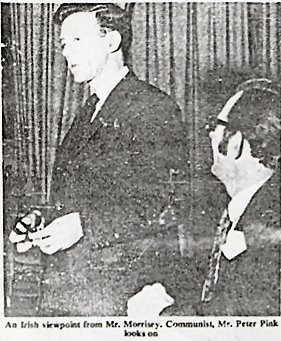
The person to orchestrated and lead the march in singing of this song was a protestant trade unionist and Chair of the Northern Ireland Civil Rights Association, Elizabeth Sinclair.
According to Austin Currie book "All hell will break loose" Betty Sinclair, as Chairperson of NICRA, concluded(The meeting in Dungannon) by leading us in singing "We shall overcome", the first to my knowledge, that the American civil rights anthem had been sung on any public platform in Northern Ireland. it was significant that the editorial in the next days(actually 26th August 1968) Irish News was headed "We Shall Overcome"
We Shall Overcome, was a spiritual song dating back to around 1903, had been made popular by the Folk artist Pete Seeger and was soon adopted by the Afro-American civil rights movement in America in the mid 1960's.
Local Uxbridge Labour MP John Ryan was heavily involved in the Civil Rights Movement and attended the next (second) Northern Ireland Civil Rights march in Derry on October 5th 1968 and witnessed the brutal attack by the RUC.
| |
|
| CHORUS: |
|
Elizabeth Sinclair (1910-1981)
 Elizabeth or "Betty" Sinclair was born into a working-class family in the Ardoyne area of Belfast in 1910. Her father was a worker in the Harland and Wolff shipyard and a “Walkerist” (pro-unionist) socialist; her mother was a reeler in Ewart’s mill. After leaving school at the age of fifteen she became a millworker alongside her mother. As an active trade unionist she was elected on behalf of her union to the Belfast and District Trades Union Council, of which she was secretary from 1947 to 1975.
In 1931 she began to attend meetings of the Revolutionary Workers’ Group (forerunner of the CPI) and in 1932 she became a member.
The same year she played an active part in the leadership of the outdoor relief (unemployment assistance) strike and the demonstrations by tens of thousands of unemployed workers. Huge non-sectarian workers’ demonstrations shook the Unionist regime to its foundations. Demonstrations were banned and a curfew was declared. Two demonstrators were shot dead by the British army; another demonstrator who was arrested and sentenced to three months’ imprisonment died later from his mistreatment.
These were the first large-scale non-sectarian political demonstrations in the North, and the last until the advent of the Northern Ireland Civil Rights Association in the 1960s (in which Betty Sinclair was also to play a leading part). Some of the strikers’ demands were met, after which the Stormont regime intensified its promotion of sectarian division.

From 1933 to 1935 she attended the Lenin School in Moscow. In 1940 she was arrested after the CPI paper Unity published an article allegedly sympathetic to the IRA, and she was sentenced to two months’ imprisonment. The same year she became a full-time party worker in Belfast. In the 1945 election for the Northern Ireland Parliament she stood as a CPI candidate and received 4,000 votes.
She was a founder-member of the Northern Ireland Civil Rights Association in 1967 and its first chairperson but resigned from this position in 1969 after the organisation had been sabotaged by ultra-leftists and pushed into provocations that would result in further sectarian divisions.
 After 1969 she travelled throughout eastern Europe and in the 1970s lived in Prague as the Irish representative on the international editorial board of World Marxist Review. She died in 1981 after a fire in her flat in east Belfast.
Betty Sinclair deserves so much more acknowledgement for her role in trying to combat sectarianism in Northern Ireland.
Thanks to the CPI for information on Betty Sinclair