Showing posts with label Clarion. Show all posts

Wednesday, October 21, 2015

London YCL Netball Team 1953


London Young Communist League (YCL) Netball team formed March 1953


Hackney Workers Sports Club had a netball team formed in the late 1920's

Saturday, October 17, 2015

International Workers Olympaid Vienna 1931 - Clarion

The International Workers' Olympiad 1931
Vienna 
Vienna July 19th -26th 1931

The Great Britain cycling team was made up six Clarion Cycling Club Cyclists

Name           Clarion Club     Bike

Colin C Copeland - Oldham (Carpenter)
Frank Johnson - Oldham (Granby)
Thomas E Hirst - Blackburn  (Merlin)
Ernest Deveney - East Manchester (Pemberton Arrow)
James A Tattersall - Heywood (Permuting Arrow)
Frank Miller - Goldthorpe (Selbach)

All bikes had Dunlop tyres

The British team arrived late and missed the first race the 140 km road race, the first event which the team entered was a 50 kilometer road race. Johnson, Miller, Tattersall took part in this, and started "en masse", this was not a practice common in Britain at the time.
The British team reported that the roads were, very bad, and the team were riding riding on one and quarter inch tyres they felt were at a disadvantage, they stated that continental riders were using up to 2 inch tyres and could stand up to the many pot holes.  The bumpy roads caused Tattersall to have chain trouble and he was delayed. Johnson had a puncture, but caught up with the riders again. Miller finished 4th and Johnson 5th.
The next event was a 20k race. mass start again and Copeland, Hirst and Miller were in this event. Miller had only just ridden in the 50km so he soon packed up and it was left our two members to work the pace for each other, as against three in other teams. near home Copeland and Hirst were in front but in the final sprint Hirst was left for 4th place but Copeland kept his position and finished 1st.
In the afternoon they went to race on the track in events 1, 2 and 10k races. Copeland and Deveney rode in the first two and these two and Hirst were in the 10k. Copeland won his heat in the 2k and Deveney in the 10k, the finals to be run on Sunday 26th.
Heats were run on a process of elimination and each rider had several times to ride the distance before the race ended.
All the teams entered the 6,000 meters (six man) relay race. this was a very fast race, and our team were second, losing by 15 seconds to the Austrians, this was considered the teams greatest success.
An hour later Johnson, Copeland, Daveney and Hirst in the 10k track race. Each took a lap as pacer in turn and twenty laps were covered at an average speed of 30 miles an hour. Again we were second, this time losing by 35 seconds.
On Saturday morning the 50k road race for teams of six (four count) started at 8am four of our team were delayed by punctures thus discounting their splendid times done by Copeland and Johnson. These two did the fastest time. being the first home, but we were not in the count.
In the Hill Climb the first race was separate starts at three minute intervals. Copeland did the second fastest time to an Austrian rider who had been practicing on the hill for several weeks and had been specially saved for this event. Next was the mass start, and only one was entered from our team. This was Hirst who finished fourth. The climb was 3k and the finish was in a lovely mountain village called Cobenzl. Sunday was the day of the finals for track events, but unforeseen circumstances prevented E. Deveney from Riding. Copeland rode in the 2k and before the result was known he had to ride four or five times. On points he was declared second
however the British cycling team won one, came second in three and fourth in eighteen cycling events 
The cycling track was made of concrete track, so was considered fast, the road on the other hand were in poor condition which caused difficulties for the British riders  (so fast) and bumpy roads

Colin Copeland of Oldham won the 20 kilometer track race and came second in 1 kilometer race 


------------


fifty Clarionettes went to Vienna to support the team in all sporting events Britain came 4th Source: 

The Clarion 

September 1931

Sunday, March 09, 2014

Daily Herald Brass Band Championship 1946

DAILY HERALD NATIONAL BRASS BAND CHAMPIONSHIP 1946

Fairey Aviation Brass Band
(winners 1945)
Barrow & Rastrick Band
Hanwell Silver Band
Munn & Felton's Works Band
North Seaton Workmen's Prize Band
Parc & Dare Workmen's band
Parkhead Forge Silver Band

Daily Herald Area Championship Bands 1946

Conductor
Dr Malcolm Sargent


Soloists

Eileen Joyce
Gwen Catley
Harry Mortimer

Grand Festival Concert
Royal Albert hall 19th October 1946

Announcer Frank Phillips

From the Programme

"Brass bands today are a living force, and their cultural value is of the utmost importance. They render a priceless service to the community from which they spring and which they serve. long may they flourish to bring delight and inspiration to the people of Britain "


NOTE
Daily Herald Winners 1946

1 Brighouse & Rastrick
2 Fairey Aviation
3 Munn & Felton's
4 Hanwell

Friday, February 21, 2014

Labour and Clarion Swimming Club History


National Clarion Swimming Club

Much has been written about the Clarion Movement's cycling clubs, rambling clubs and choir's, but very little on it's other clubs including the National Clarion Swimming Club which was established in 1905.

Above is a picture of 1908 Clarion swimming Champions (believe it is Blackburn ?) and  Bradford Clarion Swimming Club women lifesavers (now lifeguards) dated 1907, (note the Clarion logo on the swimsuit) .

Swimming would have been a very rare experience for working class people at the turn of the last century, especially women and as a consequences local newspapers frequently record the tragic stories of young working class children drowning in rivers and canals.

The other picture is of a silver national Clarion Swimming Club medal awarded in 1908 (which is now in the People's History Museum).

Bradford was the founding City of the Independent Labour Party and many early municipal enterprises such as free school meals were pioneered in Bradford


Wapping Road School, built in 1877, was a ‘Board School’ under Bradford's very own W.E. Forster's Education Act of 1870. 

More than a century ago, the school created national and international headlines with the help of education Clarion and ILP supporters campaigners Margaret and Rachel McMillan and their push to improve the health and education of working class. 

Their influence helped bring the country’s first school swimming pool to Wapping Road school and nearby Green Lane School in 1899. 


Above is a picture of Manningham swimming pool

see also Bradford Cinderella Club.

NATIONAL CLARION SWIMMING CLUB

Newcastle - upon- Tyne and London had Clarion Swimming Clubs as early as 1896 and Oldham, Liverpool and Bradford led the way in the North of England. Aberdeen and Glasgow Clarion Swimming Clubs were the first to be formed in Scotland.


By the early years of the last century there were enough Clarion Swimming Clubs to form a National Swimming Club in 1905, with its own silk woven badge to sew on swimming costumes. 

A national Clarion Swimming Team went on to compete abroad in the 1920's as part of the International Sports movement.

At the Clarion Easter meet in York 1932 Clarion swimming events were held at St George's Baths where Levenshulme Clarion swimming Club beat Oldham Clarion Swimmimg Club for the team championship. 

The Ladies breast stroke was won by Miss Elwood of York Clarion swimming Club with Miss Priestley, Leeds Clarion swimming Club second.

Ladies freestyle was won by Miss Priestley, with Miss Crowther of Halifax Clarion swimming Club second. 

The Men's breast stroke was by Mr E. Johnson of Oldham Levenshume Clarion swimming Club, with Mr F. Johnson Oldham Clarion second. Gents free style was won by E Johnson with H. Hughill , Bradford Clarion swimmig Club second


A Mitcham Clarion Swimming Club (South London)  is still in operation but it is unclear if it has a historical link.

Also Pendlebury Clarion Swimming Club circa February 1905


Michael Walker
------------------------
Bermondsey Labour Party Swimming Club 1932 (top pictured) represented at the Vienna Workers Sport Olympiad
-------------------------


London Clarion Swimming Club

A New Venture


18th June 1937 from the Tribune


A new venture which should interest your readers in London, is the Clarion Swimming Club. This group now have well over a 100 members, who meet every .Wednesday at the Haggerston Swimming Baths.

They have the use of a clubroom which is attached to the bath, and here, from 8 to 10.15 p.m. comrades can dance, play ping-pong or darts, and amuse themselves in many other ways.

From 8.30 to 9.30 they, swim, and even have instructors to teach the unenlightened.

The whole evening costs only 6d., which compares very favourably with ordinary swimming, I understand that all comrades living reasonably near are invited to go along on a Wednesday evening to try it—if they cannot swim, the clubroom is at their disposal.

Stoke Newington. Sam Roth.


Clarion Cup Team winners 1898 - S. Weeks

Friday, January 10, 2014

First Socialist Public Meeting in Hillingdon

First Socialist Public Meeting in Hillingdon

In July 1907 The London Standard announced that the London Clarion Scouts planned an “invasion” of Uxbridge, however the project was abandoned because of “inclement weather”. It then fell to the Southall Clarion Scouts to carry through on the plan and accordingly embarked upon the journey to St Margaret’s church Uxbridge on Saturday July 13th 1907 with the aim of initiating out what was the first socialist meeting ever held in Uxbridge at the old pump outside the church,

The local paper covered the event accordingly
“The meeting one of the first open air meetings held in Uxbridge was held outside St Margaret’s Church, the chief speaker being Councillor Horace Lucia (Southall) he explained that they (Socialists) aimed at the nationalisation of all means of production, distribution and exchange - not in order to rob anybody in any shape whatever, but in order to prevent the people, the workers being robbed as they were at present.
Socialism, he claimed, concerned life at every point, and would certainly sweep away the present unwholesome and unsanitary conditions in which so many of the working classes had to live, a condition, too which meant that they were underfed, badly clothed, and ill housed. He urged that the land, machinery, and other means of producing wealth. Should be utilised for the benefit of the whole nation, and not, as now, for the enrichment of a comparative few, while the mass of the people never knew how they were going to live from week to week.

Finally, he urged that if the people wanted social reforms carried out, they must look to no party but their own for they would get nothing which they did not strenuously claim and work for on their own behalf.


In November 1907 the Uxbridge gazette reported on the following regular events on Saturday night at the pump at St Margaret’s
Church Uxbridge , “The visitor to Uxbridge may see on any Saturday night just how the local people like the teachings of Socialism. Be it understood that the Uxbridge Socialist Society assembled themselves (with important speakers) in the triangle just outside the Church in Windsor Street and mounted on a box painted in flaming red, proclaimed to the public some of the advantages of Socialism. But the funny part of the whole business is that the Uxbridge people wont see the Socialists emphasise (ie) that “Socialism alone is the salvation of the masses” one of our staff went out of curiosity to watch the proceedings and the following transcript from his notebook will show pretty clearly the kind of reception the red flag has received
SOCIALIST ORAITOR: “the capitalists are..
THE CROWD: “Three cheers for Sir Frederick” (The local Tory MP)
SOCIALIST ORAITOR: “The wage slaves of England”

THE CROWD: “Good old Joe”

SOCIALIST ORAITOR: “You sweated workers”

THE CROWD: “Rot, Ailens, Jews”

SOCIALIST ORAITOR: “Think of your present conditions, I heard a man just now he had lost his job “

THE CROWD: an egg or two is thrown

THE CROWD: “Tariff Reform”
THE CROWD: Then a none too musical voice rises to song “If I could only take your hand” The notes are rendered in the slowest possible manner the musical susceptibilities of one of the socialists are hurt.
SOCIALIST ORAITOR: leaves the box and a colleague fills the vacancies.

SOCIALIST ORAITOR: “ ill sing you a song (he says) The red flag and he gets no further.
Boisterous laughter is all that is heard, discard reigns. Supreme despair on the faces of the red flaggers.
A Policeman walks round with a merry twinkle in his eye
ONE VOICE: “Three cheers for Joe”
THE CROWD: in unison they come back ONE VOICE: “And now three cheers for John Burns”
THE CROWD: “Boo - Boo - Boo - ray” When this has been repeated some half a dozen times.

THE CROWD: Sing God Save the Queen, two or three times


All then becomes quiet the Socialists have departed the crowd follows suit The Socialists however, before they went promised to return on Sunday morning.

The Secretary of Uxbridge Socialist Society was in 1907 Mr A.D. Notley of 8 Tachbrook Road, Uxbridge, who became a well known Uxbridge Socialists family.


At the end of September/early October 1908 a Socialist Van (This must have been a Clarion). The “Vanners” “entered upon a three day match with lungs and wit at Uxbridge, for about three hours each evening the pavement under the Market House rang with the heavy shock of the wordy warfare, and it must be admitted that the Socialist Orator held their own remarkably well”

Sunday, October 27, 2013

Wednesday, November 21, 2012

Hammersmith Clarion Cycling Club Estb 1895


Hammersmith Clarion cycling club take off
Clarion By Swiftsure
9th November 1895

A Clarion Cycling Club has been started in Hammersmith; meeting place Temperance Hall, Cambridge Road, Tuesdays 9 p.m. 

The secretary is
H. Cailay, 23, Fulham Palace Road, S.W. 
All unattached Clarionettes are invited to join.

Note:

Hammersmith Clarion Cyling club would be the first club in West London


Not sure about the spelling of H Cailay ???

Tuesday, October 30, 2012

Free School Meals - Edward Hartley (Bradford) 1908


How to Feed the Children

By Alderman E. R. Hartley. (Bradford)

1908 


" Whether there be one God, 
or three; no God or ten thousand,
little Children should be fed,
and their bodies kept clean." 
JOHN RUSKIN.  
 
 
The Citizen Series. 
 
This Pamphlet will be followed by others, dealing with various phases of SOCIALISM 
from the Practical Side. 


HOW TO FEED THE CHILDREN. 


NO measure of recent years does more credit to the work of the 
Socialists of Britain than the one giving power to feed the 
children. Not that the Act goes far enough or is at all 
adequate, but because it is the outcome of a demand made without 
ceasing for over a quarter of a century. 

The Act should be compulsory and not adoptive. It should 
give local autonomy by allowing the Local Authority to decide the 
amount of the rate according to the varying needs of the district 
concerned. The ratepayers themselves to decide the amount. 

Our present business is to see that the new powers are used to 
the utmost ; we have got the wedge in, it must be driven home. 

When Socialists first argued for the feeding of the children who 
were compelled to attend the Nation's schools on the ground that if 
they were obliged to go to school, we should at least be sure that 
they were physically fit to receive and benefit by what they were 
taught. We were told that the children were already fed. 

The Clarion Cinderella Clubs proved that large numbers of the children 
were not fed, or at least only partially or badly fed. The work 
grew, and children's holiday funds, &c, were quite popular. 

NOT BIG ENOUGH. 

The South African War, however, brought matters to a head ; 
when it was found that more than one-half of the young men offering 
themselves for service, in the time of the Nation's need, were not 
good enough to be shot at, or to wear the Nation's uniform, people 
began to think. The youths bred in our slums and reared in our 
factories and workshops, were so narrow across the chest and their 
general development too small, to be fair targets for the Dutchmen's 
guns, they might miss them ; and it was this serious problem that 
caused the first real consideration of the matter. A little enquiry 
soon showed the main reason to be under and improper feeding. 


2 HOW TO FEED THE CHILDREN. 

PARENTAL RESPONSIBILITY. 

When the question of Public Feeding came to the front, we 
were at once met with the statement that " to feed w 7 ould take oft 
Parental Responsibility." Results had proved this to be nonsense 
for, if it was the parents fault, they had evidently thrown off the responsibility long ago. Any way the children were not fed. 
 
CONTINUED.........
 
 
11 HOW TO FEED THE CHILDREN. 11 

A GREAT SUCCESS. 

So far the work has been a great success, and while we 
Socialists can claim to be the initiators, we have not been alone in 
our efforts to make the matter a success. Men and women of all 
parties are soon in deadly earnest when it is something to help the 
children. Help them in the best of all ways, by helping them to be 
better able to help themselves at a later day. 

MAKE THE BEST OF THEM. 

Mr. Sleary's pregnant advice to Mr. Gradgrind always seems to 
me specially adapted to our children — 

" Make the best of us, and not the worst." 

To leave children unfed and unfit to receive the fullest 
benefit from our Educational system, seems very like making the 
worst of them. All History and experience are with us. '' Healthy 
body, healthy mind," is proverbial, and the ladies and gentlemen of 
high birth and culture, who like the others are only descendants of 
the cave dwellers, owe more of their present fine habits and 
manners than thev are aware of, to the fact that for many 
generations they have be^iL temoved from the first primal struggle 
to get food. What haj served in their case will hold good for the 
race. When men and women generally have not to spend their 
main energies in getting the bread that perisheth, they will have 
both time and inclination for higher things. In a wolfish struggle 
for food, there is no time or chance for the greater things which 
make for life. 

CHILDREN  V DREADNOUGHTS. 

The present serious decrease in the birth-rate, makes it all the 
more necessary that we should make the best of tho^e children we 
have. If we are merely struggling for Trade, I have far less fear 
of the German Navy than the growth of the German Schools. No 
possible Navy we can provide will enable us to keep our place 
amongst the nations of the world, if the masses of our people are 
physically and mentally inferior. 

With a Nation of men and women "full summed in all their 
powers," having intellectual pow r er to understand and physical 
power to perform, no outside force can do us harm. But, with a 
Nation strongly recruited from the British Barbarian, and with, as 
our doctor told us, 13 per cent, of the children underfed, and 
with little (if any) chance of a right development, there is always the 
greatest danger in the future. 

Children to-day i Nation to-morrow ! ! Let us never forget 
that in a few short years the world's work will have to be carried 
on by those who to-day are in our schools and playgrounds. 


12 HOW TO FEED THE CHILDREN. 

What we make those children to-day, that the Nation will be 
to-morrow. 

Amongst the most intelligent people of to-day, the greatest 
scorn is felt for the father who neglects to give his children the 
fullest opportunity of education ; whilst scorn would change to 
anger and contempt, if it were known he also refused to give them 
proper quantities of food. 

The Nation can no more afford to neglect the children as a 
whole, than the parents. 

The tremendous economy to be made in feeding large numbers 
like these is already proved, and will lead — no one knows where. 
The Staff, at the Cookery Centre at Green Lane, prepare food for 
nearly 2000 persons. The same Staff do all the washing-up. 

Relief for Hard-Worked Mothers. 

Now ye tired mothers ! (a great part of whose lives are now 
spent in preparing meals and clearing them away) ! When Robert 
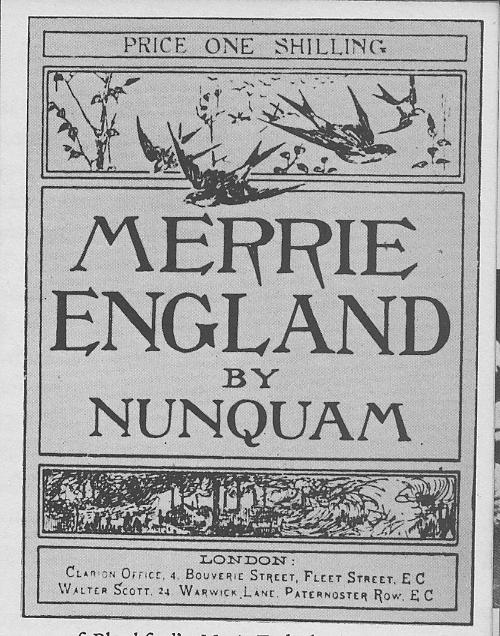
Blatchford showed in Merrie England the great saving of time and 
money, to say nothing of the saving of the lives and opportunities of 
our women by collective cooking, there were many scoffers. 

Yet, here we have a staff of six, three men and three women, 
preparing and cooking for nearly 2000, and in addition doing all 
the washing up for the same number. What a chance of relief for 
our tired mothers ! 

There are great possibilities in the future for you, where more 
leisure shall be your lot, under a wiser dispensation. 

The children will be as well, and in many cases better fed. 

The general economy will be great, and many an overburdened 
mother will have cause to bless the clay when an answer was given 
to what had often seemed a fruitless prayer for children — 

" Give us this day, our daily bread !" 


H. BEAUMONT, Printer, 18a, Laisterdyke (T.U. 48 Hours) 
 
Full text at
 http://home.us.archive.org/stream/howtofeedchildre588hart/howtofeedchildre588hart_djvu.txt
 Edward Robertshaw Hartley (1855–1918) 
----------------------------------------------------------------------------------------------


REUNION OF BRADFORD ILP LABOUR STALWARTS 1939


Greetings from the Lord Mayor (Alderman T. J. Robinson), a most happy reunion of former Labour members of the Bradford City Council took place to Branford last night.


Pioneer members of the party were present. and the earnest hope was expressed that faction would be obviated and that the Labour workers would once more present a united front.


The hope was also expressed that this would prove the forerunner of many such gatherings. A decision to hold a further reunion next year, to which members of the Bradford City Council Labour group are to be Invited, was unanimously adopted and Mr. A.T. Sutton was appointed convener. Mr. Sutton, who organised last night's gathering, revealed the fact that the idea of the reunion came from Mrs T. W. Stamford, wife of the chairman of the Bradford Labour Party


Mr Sutton sent out forty two invitations, those present


Walter Bateson, Michael Conway, Willie Crossley, Frank Duce, George Green, William Hirst, Joe Hainsworth, J.M. Halliday, Alfred Heaton, Eli Jenkins, George Muff MP, Mrs Amy Meggison, Arthur Shaw, A.T. Sutton, Mrs M.J. Sutton, Tom Stamford, Arthur Stott, R.J. Smith, Percy Thornton, Robert Varley, Theodore Warner


Guests

Mrs Palin, Mrs Alfred Pickles, (ex lady Mayoress) Mrs Stamford, Mrs Hirst, Mrs Stott, Mrs Duce, Mrs Jenkins, Mrs Shaw, Mrs Hansworth, Mrs William Leach


Mrs Conway was unable to attend to illness and apologies were given from

E. Bush, Robert Hill, Harry Mitchell, C.H. Tarbuck, E.O'Neil, Vincent Tewson, Mrs Jane Clayton,J. Bailey, J. Cox, F.W Jowlett, F. Import, Mrs Amy Sykes, Mr Foster of Sunderland


Conway stated "It was 27 years last November since he entered the City council and he soon came to the conclusion that Mr Joe Hayhurst was the real leader of the Council. He recalled Harry Palin the best fighter he had ever seen when everything was lost... and Willie Leach and Alfred Pickles , the later was "geniality and persuasiveness". Billy Land a very able man and the redoubtable E. J. Smith who bludgeoned his opponent mercilessly


MOVEMENT MEANS SERVICE


Memories were stirred by the roll-call of departed colleagues, which was read by Mr. Sutton:


Sam Shaftoe, C. Leonard Robinson, Arthur Priestman, Edward Hartley, Tom Delbridge, Joseph Hayhurst, Tom Grundy, A. Tuke Priestman, Charlie Glyde, R. Roberts, Wailter Barber, George Minty, Willie Mackinder, A. Pain,. Hall Seed, Frank Egan, Harry Wood, Tom Blythe, Ernest Fox, Robert Hiles, Arthur Goodison, Edward Siddle. Willie Rushworth, Harry Palin, Alfred Pickles, A. R. Ellis, Tom Ashworth. and Willie Brooke.


A pathetic feature about the last named is that he was alive when invited to last night's gathering, and wrote that a chill would prevent his attending.


Alderman Titterington wrote: We cannot let you be gathering together without saying how glad we are to hear of your reunion.


"When records and epitomes are turned up from time to time, the group recalls many made by all of you in the several spheres of local government activities, on behalf of the Socialist movement .. . . But that is only a small proportion of your labour, and the lifetime contribution which this gathering represents. - "


" To be in the Labour movement is synonymous with unremitting service for the common weal . . . The sum total of your service can never be recorded, other than In the minds and lives, the memories and the emotions of your associates and those workers whose interests you have served so long, so loyally, and so well."


the reunion concluded with singing of

When wilt thou save the people,

Hark the Battle Cry

England Arise


Bradford Observer 31 January 1939


Wednesday, September 19, 2012

100th Anniversary of the election of the first Labour County Councillor in 1892


In March 1892 George Garside, a Slaithwaite born blacksmith and founder of Slaithwaite Social Democratic Club was elected to West Riding County Council for what was essentially the current Colne Valley electoral ward. 

Garside was the first socialist (Labour) candidate to gain a seat on a County Council in Britain and won in a straight fight against the Liberal, gaining 55.1% of the vote. 

He sat as a ILP Labour County Councillor until his death in 1907 aged 63.

(picture above of Victor Grayson speaking from a famous Clarion Van, Grayson was elected in 1907 as Socialist MP for  Colne Valley)

Friday, August 17, 2012

"Daisy Daisy, Give Me your Answer, Do" - "Join The Clarion's"

Daisy Greville, The Countess of Warwick
Aristocratic Convert

By Sylvia Alving


In her Autobiography published in 1929, Life's Ebb and Flow by Frances Evelyn Greville, Countess of  Warwick. (Daisy to her family and friends) there is a small photograph of her with bicycle.  She is fashionably dressed and wearing a large hat.

Intrigued,  I got in touch with Cycling World, hoping to discover that, in their Archives, there might be a bigger and better photograph of the lady in cycling attire.  But imagine my disappointment, when the photograph that arrived was of the Countess, with fan, seated and somewhat languid- looking.   I did. however, discover that Harry Dacre's 1892 hit song. Daisy Bell, was indeed inspired by her legendary beauty.

        Daisy, Daisy, give me your answer, do,

        I'm half crazy all for the love of you,

        It won't be a stylish marriage -

        I can't afford a carriage

        But you'd look sweet on the seat

        Of a bicycle built for two.

The reason for my curiosity about Lady Warwick (1861-1938) and the Socialist politics to which she
devoted much time and energy from the 1890s until her death in 1938, was because I had been asked to
write a book about her politics by the owner of the remnant of her Essex estate the Gardens of Hasten
Lodge. I then discovered that I would have to explain her journey from having been the richest heiress in England, lover of Bertie, Prince of Wales throughout the naughty nineties, to being the People's friend while remaining a monarchist.

Very much a maverick figure: class traitor to the aristocracy, class enemy to the proletariat, she began her married life in   1881   as a Lady Bountiful, stood as Labour candidate against Major Anthony Eden in 1923 , and finally was a supporter of Sylvia Pankhurst's anti-fascist struggle in 1937, appealing in a letter to the latter's newspaper. New Times and Ethiopia News, for donations towards an anti-aerial bombing monument in Woodford Green in Essex and appealing for an end to aerial warfare, which is where I first came across her name.

Lady Warwick credits her conversion from land-owning Tory to Socialist, becoming a platform  speaker  initially  for  the  Social  Democratic Federation, and later for the Labour party, to the editor of The Clarion, Robert Blatchford, On the front page of the Clarion of 16th February, 1895, he had printed an article criticising the extravagance of the great costume ball held in Warwick Castle to celebrate her husband's inheriting the title of Earl on his father's death, and she becoming the next chatelaine in line. Through gritted teeth, Blatchford named it a 'costly masquerade' an example of the aristocracy's  conspicuous consumption:    'lavish luxury on lavish luxury, heap on heap, glitter on glitter, in a vulgar saturnalia of gaudy pride.'  This obscenity he contrasted with   'other men, and women, and children the while huddling in their ragged hovels, their meagre shrunken flesh pierced by the winter's cruel sting; without food, without clothes,   without  fire,   shuddering,   shivering, suffering till dawn; and then again from dawn till night, from day to day, from week to week - their souls crashed between ever-grinding millstones'!

And he ended with the unkindest cut of all: 'I can frame no angry taunts upon this one; upon my life I deeply pity the poor, rich Countess of Warwick.'

So shocked was she at being represented in this manner that the Countess travelled at all possible speed to London and the Fleet Street offices of the Clarion, appearing in Blatchford's little room in a great rage, demanding an instant apology.  None was forth-coming, however, instead she was given a lecture on the meaning of her (and his) particular brand of economics.  Thus chastened, this was followed by her return to Warwick Castle and its many guests, where she compiled a reading list, arranged for a university professor to come and answer the many questions that were crowding into her mind.  As she put it, ever after 'I joined the Union of Love in the service of those who suffer.'

END

Robert Blatchford's argument had a lasting impact on her, and she joined the Social Democratic Federation in 1904. She donated large amounts of money to the organisation and in particular supported its campaign for free meals for schoolchildren. As a patron of several parishes, she appointed socialist clergy such as Conrad Noel to their livings. She opposed World War I and supported the Soviet Revolution of 1917. After the war, she joined the Labour Party and her home was used for important meetings


The Countess of Warwick recalled

"There had been a grand ball at the Castle. Of course the ball was a great success, and the newspapers applauded with great enthusiasm, all except one obscure sheet, the Clarion. This paper only reached my attention on the second morning after the ball; and my attention was called to its special article about the ball by an ominous black line. I read with indignation and amazement a violent attack on myself for holding idle junketing in a time of general misery. This "impertinent rag" said scathingly that ours was a sham benevolence, a frivolous ignoring of real social conditions. I was so angry that the memory of that anger is vivid today. I said to myself that the write of this article was some crabbed, envious being, who grudged the chance of work to the poor people who had their share of the money spent on the festivities; someone who hated luxury because it was out of reach.
"In my bitter indignation, I forgot all about my duty to guests who still lingered. I got up at once, told my maid that I was going to London by the earliest train, and leaving the Castle without a word of explanation to anyone. I was in Fleet street by midday searching for the editorial office of the Clarion. I found this office at the top of a staircase in one of the older buildings in the street, with the editor's mane, Robert Blatchford, on the door.

I entered unannounced, and there at the writing-desk sat the man who dared to attack us for indulging in legitimate amusement that had at the time given honest work to so many unemployed. His coldly gazing eyes showed no surprise at the unexpected and abrupt vision in his dingy office of a young women dressed in the height of fashion. He made no movement of welcome. I remembered thinking that the garment he wore, which was some thing between a dressing gown and a lounge coat, was most undignified.

"Are you the editor of the Clarion" I demanded. He merely nodded. "I came about this", I went on., thrusting the marked page under his eyes. He made no reply, but his preoccupied eye seemed to hold a question and he waited for me to go on. "How could you be so unfair, so unjust" I asked. "Our ball has given work to half the county, and to dozens of dressmakers in London besides."

"Will you sit down" he replied, "while I explain to you how mistaken you are about real effect of luxury?"

"And then Robert Blatchford told me, as a socialist and a democrat, what he thought of charity bazaars and ladies bountiful. He made plain to me the differences between productive and unproductive labour. He said that labour used to produce finery was as much wasted as if it were used to dig holes in the ground and fill them up again.

"By this new standard I found that nine tenths of the money spent on the Warwick Ball had been wasted. Such elementary economics as that the only useful labour was labour that produced useful articles, which in turn helped labour to produce again, was all new to me

"My old ideas and ideals were brought to aought, and it was late in the afternoon before this plain man with the big ideas had ceased speaking"

"I was somewhat dazed when at last I left Fleet Street and got to the railway station, where I sat waiting for the train to take me back to Warwick. During the journey home I thought and thought about all that I had been hearing and learning. i knew my outlook on life could never be the same as before the incident"

"It was Robert Blatchford's honest talk on the memorable day that gave me vision of how it would be possible to change and modify the unjust conditions of our modern life".

NOTE
The Countess of Warwick "I went to  Paddington station (after their meeting) and sat on the platform for two hours thinking, I was not used to being talked to like that".

Blatchfords "most undignified" garment was according to Blatchford "a pilot jacket of the best Russian cloth, very warm and soft and comfortable, and I was really rather proud of it"