Wednesday, May 25, 2016
Cossor (Highbury) Strike 1949
Saturday, October 17, 2015
Saturday, December 08, 2012
WI Sharp Shooters - WW2
ok maybe not but still another rare picture of British women in WW2 with guns
or maybe a future solution to the equal pay question
NOTE
In December 1941, a more organised but still unofficial Women's Home Defence (WHD) was formed under the direction of Dr Edith Summerskill, Labour MP for Fulham West. WHD members were taught weapons training and basic military training.
Saturday, May 29, 2010
Muriel Coult - Forgotten Heroine of Equal Pay Struggle

Muriel Coult
Muriel Coult was an active member of the Civil Service Clerical Association (the union is today, along with other merging partners, part of
She won much praise and admiration for her pioneering trade union education courses during the war. "In spite of enemy action, transport difficulties and the complications caused by evacuation and other war time problems, she made a great success of organising weekend schools in many parts of the country. So much so that many other unions followed CSCA initiative."
Muriel was elected to the Union's National Executive Committee in 1937, a position she held until 1944, when she became a full time official, taking the title of `Assistant Secretary’. But, despite Muriel's energy and commitment, she became increasingly marginalised within the union because of her openly left-wing views and membership of the Communist Party, especially after right wingers captured the union in 1949.
However, this did not stop Muriel Coult playing the leading role in organising the union’s campaign for Equal Pay. The campaign was started on 11th February 1953with a debate on Equal Pay in the House of Lords, moved by Lord Pethick-Lawrence, who had played a part in the original suffragette movement.
This was followed up with a much-copied photo opportunity; on Valentine’s Day 1953, Muriel Coult and two other union representatives delivered a huge valentines card, with an Equal Pay slogan on it, to the Chancellor of the Exchequer, with the words “remember your promise of 16th May - Be true to US on budget day”!

Muriel Coult urged union members to collect signatures in homes, offices, special meetings, factory gates, shopping centres, and anywhere else. The aim was for a million signatures. In the event they collected 700,000 and this was presented on Equal Pay Day 9th March 1954 to the House of Commons by Douglas Houghton (a Labour MP) and Irene Ward (a Conservative MP). Outside, flags were flying bearing the old suffragette colours of purple and white, and there were purple and white buttonholes, purple and white stickers, and purple and white handbills - all bearing the slogan "Equal Pay on Budget Day".
It being Budget Day, the Chancellor posed with his red box for the famous photography. At the last minute, a group of union members produced from under their coats banners promoting equal pay, thus securing considerable press and television coverage.
Finally a Civil Service Equal Pay agreement was reached on 18th February 1955, 35 years after the House of Commons first approved the principle of Equal Pay in the sector. It was introduced in stages, which was meant it would not be fully operational until 1st January 1961.
Even so, Equal Pay disputes continued. Famously in 1959, a "Typists’ revolt" broke out, after it was discovered that the few male typists employed in service were earning 25% more than the women typists at the Treasury. Delays in addressing this grievance led, two days after the Augusts Bank holiday in 1959, to a thousand, manly young women, marching down Whitehall, singing and chanting as they went, gathering in a meeting in Horse Guards Avenue,
Muriel Coult, who became Muriel Jamieson by marriage, retired from the union in 1963 to become a teacher.
Muriel Coult surely deserves much better recognition today for her role in developing trade union education and even more importantly in securing the first real acceptance that Equal Pay in the Civil Service ought to be addressed, a fact which had repercussion's far beyond the Civil Service as the issue began to secure a foothold of attention in many, many other workplaces.
It is a scandal that in 2010 many women have still not secured Equal Pay. According to the Fawcett Society, Women working full-time earn on average 17%less per hour than men working full-time. For women working part-time compared to men working full-time the gap is 36% per hour – rising to 45% in London. But, without women such as Muriel, perhaps the scandal might be even worse than it is!
Source: the history of CPSA by Eric Wigham
Friday, March 13, 2009
Hold on Russia - Arms from London are Coming
Guns, tanks, planes made now in London
Room at once for 8,000 more women to work on them
Can take job today
London women would - will if necessary- man London's barricades as Moscow women man theirs.
It is not likely to come to that so long as Russia holds out.
Just because we know Russians battles are not only their own but ours also, we long to help them !
And the chance to do it is here ! here on the very door step of London where the great factories are turning out tanks and planes ! there is room in these factories NOW for 8,000 women.
How about you being one of that number this week.
Wage rates vary but in practice your pay packet is never lower than £2.5.0 and averages around £3. A few women make £5.15.0. Some factories work two shifts, some three. All factories are near bus routes. there are canteens where you can get a good meals. you have a week's paid holiday a year
See Munitions Being Made Exhibition
Wembley Town Hall, Forty Lane
99 Broadway, West Ealing
147 High Road, Wembley
154 High Street, Acton
Western House, Broadway, Ealing
1a the Broadway, Hanwell
Issued by the Ministry of Labour and National Service
advert Circa late 1941
Friday, October 19, 2007
ENGINEERING WAGES 1945
Communist Party Memorandum
An eminent legal gentleman recently declared that " the wages structure in the engineering industry is nothing short of crazy." If that is the reaction of an able lawyer, then how much worry and frustration must be caused amongst the thousands of men and women, boys and girls, engaged in the industry, who are quite' unable to work out how much is really due to them..
In-fact the structure of wages payment throughout the whole of the engineering industry is extremely complicated. Ever since the introduction of "war bonuses" during the 1914-18 war, it has become more involved and confusing. From District to National Agreements Wages in engineering have grown up on a district scale. Prior to, 1914, and indeed until 1919, wages, hours and conditions varied from district to district.
Although engineers were paid by the hour, the number of hours worked each week a different factories even within, a district varied so much that the amount of wages per week was the determining factor. The usual working week in those days was 54 hours, but man factories worked less than 54 hours - Nevertheless the weekly wage, the district rate, was not reduced as a consequence.
This weekly wage was divided by the number of hours per-week for the purpose of arriving at the rate per hour, so that lost time and overtime payments could be calculated. Premium payments for overtime, nightshift, Sundays and holidays also varied district by district. Even so the worker knew where he stood. IIf he obtained employment where the District rate was 38/- and the working week 54 hours, he knew that he would receive 38/- for 54 hours' work, and that his hourly rate on which lost time or overtime would be calculated was 38/- divided by 54. During the 1914-18 war period district' rates were slightly improved. War increases were applied nationally. '
They took the form of a war bonus that was added to the district rate. These war bonuses, while being separate from the district rate, were taken into account for the purpose of overtime payments, but not for piece rates- Thus the formula " basic rate, plus national bonus" was first introduced. By this method the employers did not advance any more to pieceworkers than employers did not advance any more to pieceworkers than to timeworkers. So the employers arranged to peg down piecework prices to the basic district rate.
This principle still applies. Piecework prices and all systems of payment by results are related to the basic rates, as for example the national agreement providing that systems of payment by results should be priced so that the workman of average ability should be able to earn a minimum of 27 and a half per cent over the base rate. At that time there were very few national agreements, such as demarcation, trial trips for ships, etc. There were not even national agreements for particular employers or industries covering payments by results, overtime payments, holidays with pay, shift rates. There were not even national agreements with particular employers or industries, such as Imperial Chemical Industries, Flour Millers, and so on.
The only really general national agreement was the " Procedure for the Avoidance of Disputes" (York Memo) and this did not apply to all the Engineering unions. The point to be clearly understood is that up to 1918 the fundamental basis of wages and working conditions was the district agreement- Immediately after the end of the last war a national agreement was reached, on November 19, 1918, establishing a National 47-hour working week without reducing the weekly time rates
An important provision in this agreement was that all the Unions would become parties to the " Procedure for the Avoidance of Disputes." Thereby two important issues became the subject of national agreements. In that post-war period right up to the lock-out of 1922, all districts entered into agreements with the parallel Local Associations of Employers establishing minimum district base rates for skilled workers. In most cases these marked a slight advance on the pre-war and wartime basic rates. After the slashing attacks made on wages by the employers during 1921 and before and after the lock-out of 1922, district rates ranged from 41/- to 51/- a week of 47 hours.
To this was added 10/- war bonus, title—national bonus). It is generally agreed and accepted that at this particular time the average rate for skilled engineers throughout Great Britain was 46/- plus 10/- war bonus. As regards unskilled workers, some districts had reached agreements with local employers on district rates for the un-skilled, but this was not general. Of course, the national war bonus of 10/- was paid. On a rough calculation, the difference between the skilled man's basic rate and that of a labourer was approximately 17/- per week, so the national average rate for labourers would be 29/- for a 47-hour week, plus 10/- of bonus. Unskilled rates were shockingly low.
Before 1914 unskilled men were often paid as little as 16/- for a week of 54 hours. During the war of 1914 -18, certain districts were able to improve their district rates by odd shillings, slowly and painfully trying to establish some degree of uniformity with adjoining or similar districts. The progress made by the unskilled was as slow and difficult as that of the skilled men during those years. The highest level was reached in London, where the rate was 8id. an hour, or 33/4 for a week of 47 hours.
At the same time districts were endeavoring to secure differentials for certain classes of skilled men such as toolmakers, patternmakers, millwrights, etc. The variations throughout the country in these differentials were even more pronounced than in the case of their basic rates. There are certain districts where there is still no toolmakers' differential. The " Semi-Skilled" There are only two recognised district rates, the skilled and the unskilled, even today, despite rapid technical changes and the variation in degrees of skill, responsibility and effort implied in differentials and lieu rates-
What of the semi-skilled, that is to say male workers over the age of 21 years, engaged upon work which the employers refuse to recognise as skilled work, and which, by the same token, workers will not allow to be classed as unskilled ? The semi-skilled have always been and still are paid at rates related to the labourers' rate. Notwithstanding their specialised skill, their high productivity, and the fact that they usually displace craftsmen, the rates of such workers are related to the unskilled rates according to what the employers define as the "three-fold criterion," that is, the type of machine, the nature of the skill required on the job, and the skill, ability or dexterity of the operator on the machine.
With this " criterion " there is not only a wide disparity between district and district and between factory and factory within a district, but also between shops in a factory, and between individuals inside one shop.' In certain districts -there exists what is commonly termed the " machinists' rate " for work such as milling, planing, slotting, shaping, etc. To qualify for this " machinists' rate " a worker serves an apprenticeship not quite as long as that of a skilled fitter, turner, boilermaker, patternmaker, blacksmith, etc., and then receives a rate lower than the craftsman.
The Wages Structure Today (1945) The position, of the adult male worker today may be summarised as follows:—
1. Skilled fitters, turners, blacksmiths, etc., having served a five apprenticeship, are paid district 'rates, varying from district to district, plus national bonus.
2. Some, but not all, toolmakers receive additional differentials, varying up to a maximum in certain districts of 10/- a week.
3. There is a national agreement for a minimum differential of 8/- a week for certain classes of skilled men engaged as setters, maintenance men, inspectors, and markers-off. This agreement in itself is full of " provisos" and in essence is a peculiar and particular form of lieu rate-
4. Labourers' are paid at the unskilled district rate, varying in amount throughout the country, plus the uniform national
5. is a large and growing proportion of workers designated-as neither skilled nor unskilled falling in the category of semi-skilled workers.
Today, the national average basic rate for skilled timeworkers is 66/- for a 47-hour week. The national bonus is 25/6. For skilled workers engaged upon systems of payment by results, the basic rate averages 66/- and the national bonus is 17/6.
Women's Wages Only recently have women's basic wages become the subject of trade union negotiation.
Formerly women's wages were based on what is termed the "Women's Schedule"; this meant that the employers' organisation fixed a national minimum rate and all the individual employers applied it. The unions, however, negotiated war increases which were all added to the national, bonus and eventually a comprehensive agreement was reached by arbitration and negotiation. This agreement admirably demonstrates the complicated character of wage rates in the engineering industry, On the whole it marked a big step forward in women's wages, but plainly reveals the. snags and difficulties encountered every-where in the present structure. In practice problems of definition arise quite sharply.
For instance when is a women a time-worker and when is she a piece-worker? Is she in receipt of a merit rate or a merit rate commonly applied? Is she entitled to demand a price which will enable her to earn 27and a half per cent over the base rate of 37/- (Clause 2) notwithstanding the fact that her piecework price is based on 25/- (Clause I)? In addition to these problems of definition the individual has still to calculate overtime at time and a third, or time and a half, on the inclusive timeworkers' rate, of 56/- if she is timeworking, and on the basis of 51/- if she" is a pieceworker, and pro rata if she does periods of pieceworking and timeworking during one week.
Thus for both men and women the engineering wages structure is now immensely involved, illogical and complicated.
Tuesday, July 03, 2007
Like many of the hundreds, especially young people often with music and song who "manned" the picket line at night, I (Tom Durkin) was privileged to play a small part in the picket with Brent Trades Council and Secretary, Jack Dromey. (Harriet Harman then
TRIBUTE TO THE TRICO HISTORIC STRUGGLE AND VICTORY
No more we'll stand at Trico's gates with heads and banners high.
No more will happy cheers or angry jeers our feelings signify.
But all will still recall with pride, though a thousand years should pass.
This immortal strike that few can equal, and none surpass.
At Trico's gates a golden page has truly now been written,
A page no sneering scribe nor cynic, even the hardest bitten,
Can dim or e'er belittle, for here was made an epic stand
Inspiring and exciting women, in this and many another land.
Near 90 years have passed since Unions first demanded equal pay,
Heralding for women, the dawning of a more enlightened day,
When sex discrimination and oppression would be swept away,
And equal rights triumphant reign, as the order of this new day.
Little did those Trico women dream before the month of May,
That fate had then allotted them a special role to play.
To stand upon a picket line, all through each night and day
And lead this hard demanding struggle, undaunted, come what may.
The Trico bosses scoffed and boasted when the strike had just begun
"In three short hours they'll crumble and crawling to us come.
Then we'll hire and fire to our hearts desire, we'll make them cringe and cower.
And they'll rue the day that for equal pay, they dared our might and power.
But these braggart bosses had a shock. Being neither scared nor pliant,
The women through the gates marched out, determined, proud, defiant.
And thus began that struggle grim 'gainst boss and scab and law.
For when a boss's loot's at stake he fights with teeth and claw.
Not three, nor even 3000 hours, brought those women to their knees.
It was Trico bosses, cap in hand, who said "settle if you please".
Tribunals, scabs, strike breaking cops, all proved of no avail.
For the women stood invincible, like granite cliffs before a gale.
Those pickets who stood at Trico's gates from many lands they came.
Just seeking a job and better life, not fortune vast nor fame.
Some black, some white or yellow or brown, whatever hue their skin,
They're all of the human family, are mankind's kith and kin.
And at those gates the women stood neath scorching summer sun,
Beside the ceaseless traffic that forever rumbles on.
The passing drivers often spoke by flashing lights or hooter blare,
As if to say "you'll win the day, if others help and do their share."
And through the night's long silent hours they stood when all seemed dead.
When only the moon and stars looked on from their orbits overhead.
While ghostly figures of pioneers who've long since passed away.
Matchgirls, suffragettes and others, stood there unseen supporting equal pay.
They stood there when their bodies ached and spirits all seemed spent.
When few there came to the picket line to do a welcome stint.
Oft huddling close together from piercing wind and lashing rain
They longed and sheltered homes, for glowing fires and cosy beds to lay in.
They stood there too unflinching when Trico scabs and thugs
Backed up by burly cops with hate filled eyes and vacant mugs.
Smashed through that picket line with van and juggernaut.
For measly blackleg pay their wretched little souls, were bought.
And those who crossed that picket line with a snivelling "blow you, Jill"
Whose creed is grab and never give, are lowly creatures. They're not men.
And when their children ask some day "Daddy, what did you do for equal pay ?"
"I ratted and took the Judas gold", with hang dog look, they'll have to say.
But let's salute those Trico men who joined the women's fight.
Not money did they do it for, but injustice to put right.
For they can hold their hands up high, and look all mankind in the eye
And give their children this reply "I struck, for rather than scab I'd die".
The Trico women had guts galore, but never were in a strike before.
Courage and guts need something more to put bosses like Trico on the floor.
With their Strike Committee as the core and Southall District to the fore
The fighting force they did create made Trico bosses capitulate.
A strike's a hard and searching test, some falter and some fall.
When there's debts to pay and food to buy, without the wherewithal.
When problems and worries ever mount, awaking and even in sleep.
So anger and compassion mix, for the drop-outs, and the weak.
Yes, a strike's a hard and searching test, it sorts the gold from dross.
The workers who uphold a right, from the toadies of the boss.
For progress always has its price of sacrifice and pain.
Which Trico women have fully paid, so millions more shall gain.
The bosses have no inspiring cause but they all stick together,
To rob and cheat the working-class, for this they help each other.
And though their wealth is vast indeed and buys both scab and press.
It could not buy one noble cause, though it filled this universe.
But struggles like Trico's need not be. Our Unions have such power.
Trico, or any boss could crush, within a single hour.
Without their say no wheel could turn, this country would stand still.
Bosses, even Governments, would come pleading, to settle there and then.
So, let's our tribute fully pay to sisters who bore the brunt.
Who never flinched nor faltered but proudly stood in front.
For they have shown to millions more that struggle can succeed
And millions when they strive as one, no power can them impede.
But in our flush of victory not once must we forget.
Other brave sisters who cry for aid, and who are sore beset.
In Belfast, Spain and Chile, in apartheid's ghetto hell.
Where the sadist brutes oft torture some lonely sister in a cell.
For none should have to fight alone when the cause is just and right.
And none should have to bow before the boss or tyrant's might.
Brothers and sisters hand in hand a new world we shall gain
When power into our hands we take and end all bosses' reign.
Salute then all who made this stand that echoes far and wide.
The women who broke the barrier and have released a tide.
For they have sparked a flame that grows, and nothing can withstand
Till women's rights are fully won in this green and pleasant land.
Till the new Jerusalem we have built, in England's green and pleasant land.
Tom Durkin Brent Trades Council
Tuesday, February 13, 2007
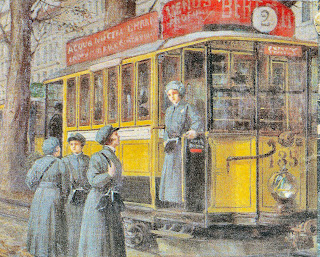
London Women Tram Workers - Equal Pay Strike 1918
of Licensed Vehicle Workers, National Union of Vehicle Workers, National Union of General Workers and Dock, Wharf and Riverside General Labourers Union.
met with Sir George Asquith today and after lengthy conference decided to recommend to the Executive Committee the following terms.
The London United Tramways began operating a service between Southall and Uxbridge (along the Uxbridge Road) in May 1904.
At Uxbridge Civic dignitaries gathered at the municipal boundaries to raise their bowler hats and wave an "open sesame" to the tram. The streets bedecked with flags and bunting, crowds lined the route to see the tram glide safely along. Hillingdon Band played and the bells of St Margaret's church rang out, children were given free rides, and a lunch was held for 90 prominent people in the Chequers Hotel