Showing posts with label WW1. Show all posts

Saturday, October 15, 2016

National Socialist Party Split from BSP - WW1 - 1916


28th September 1916
National Socialist Party split from the British Socialist Party

Thursday, October 29, 2015

Class Distinctions and the War - WW1

Article - November 1914

Class Distinctions and The War

Ever since the outbreak of the war the press and politicians have been telling us that all sections of the community have dropped their differences, and that we are now united people.


That would be very nice and comforting if it were true, it is almost as incorrect as to say that as a nation, we are at peace with Germany.

In the first two or three weeks of the war employers of labour brought pressure to bear on eligible youths in their employment to force them into the army, such as could not be enforced on the use of the propertied class.

That game was only stopped by the growing signs of resentment and the fear that serious trouble might arise. 


When the first two or three casualty list appeared, in which were included "officers and men missing" the War Office issued an order intimating that the pay of "missing officers" would be continued, but the pay of privates missing would be discontinued that is a glaring example of class distinction as any that have emerged since war began.

In the matter of providing comfort troops - socks, woollen helmets, and mittens while the women of the middle class have been free to assist in this if they chose, women who were compelled to work for an employer having a large numbers of cases being given no option. In the printing line for instance in girl and women "feeders" between the finish of one job and the start of another have usually some time to wait stop during such waiting time it has been customary for them to do some knitting or selling themselves. It has indeed been necessary in most cases in order to eke out their wages.

Now they are being supplied with wool and told to "go ahead and do something for the soldiers".

In this way the girls employed by a large Glasgow firm have done an average of five pairs of socks, four pairs of mittens and four helmets each, and then they would not be accepted by the firm until the girls had taken them home and watch them.

If the government is so mean as to shirk its undoubted duty to supply all these articles, and most of the girls and women, many of whom have brothers, fathers, sweethearts, and husbands serving in the Army will voluntary do such work, but they want no interference from the employers.

Another case of which we have heard it in connection with another Glasgow firm and the production of flags for one of those numerous "flag days" which look like becoming a permanent feature of organised charity. The girls employed on them were not paid their usual time rate, but were given a special piece rate so low that they could not make a decent wage.

There seemed a danger of trouble over it, but ultimately the girls were put off by being told that it was an "isolated incident" at and at the normal time and that in any case it was "a good cause"

It is about time that we made an effort to stop these "isolated incidents" and the sweating that is going on for "a good cause"

There is no use, however, railing at charity-mongering and all the evils that accompany it unless we are all prepared to be so "unpatriotic" as to demand that the Government assume full responsibility for satisfying in a generous way all those needs which are at present left to the prying and stingy methods of fussy charity mongers.

In the case of banking, shipping, and property interests generally, the Government has been ready to do almost anything it was asked to do, but towards the interests of the mass of the people it has shown a callous indifference, which fully justifies all that socialists have ever said against class rule.

The treatment accorded to the wife's and the dependents of men in the Army and Navy is to put it mildly, absolutely scandalous.

Thousands of them have received practically nothing of their meager separation allowance supposed due to them, While thousands of others - women of spirit have refused to be pauperised by the acceptance of food coupons at the hands of "superior" middle-class women - food coupons which specify what they are, or are not allowed to eat

The demand now being made for adequate maintenance being guarantee to every widow or dependent of men killed or maimed in battle will probably meet with a good deal of opposition from the well-to-do people who are themselves not worried by any sort of semi-starvation.

Already those carrying on the agitation are being termed mercenaries and sneered at as being devoid of patriotism.

Patriotism is quite fitting for those who get all the best in the country can give, but to men who have never even had a guarantee of a bare subsistence it does not appeal overmuch.

It is certainly mercenary to demand a reward for fighting capitalism and the wage system has been responsible for that. The only thing we regret that the demand is so moderate. It ought to be a demand for the expropriation of the capitalist class.

The Socialist November 1914
Socialist Labour Party
15 Renfrew Street, Glasgow

Sunday, June 14, 2015

National Union of Boots and Shoe Operatives


The National Union of Boots and Shoe Operatives was established in Stafford  in 1874. By 1918 the union could report that over 20,000 of its members were in military service and over 2,000 had been killed. Over £80,000 had been paid to keep serving members in benefit; £12,000 had been paid out in death benefit

An ambulance had been purchased and sent to France

National Union of Boots and Shoe Operatives though not the largest union in the country - the industry precluded that - was one of the most enlightened, most progressive, most successful, and for it size, most influential in Great Britain, or indeed, "in the whole world"

Membership
49,000 in 1914
83,000 in 1918

The National Union of Boots and Shoe Operatives union was established in 1874
Delegates to the first conference in Northampton included

Hull - J. Chapman
Birmingam - G. Sedgwick
Stafford H. Greenwood
Wolverhampton F Weare
Walsall - H. Clements
Leicester - J. Tilley
Dundee J. Forbes
Ansty - J. Bosworth
Nottingham N. Coyne
Arbroath J. Irving
Dublin J. Kelly
Leicester A. Clark
Glasgow J. O' Hara
Stafford J. Simmons
Leicester M. Leader
Northampton W. C. France
Leicester C. Smith
Newcastle - J. Collins
Bristol - T. Heron

New machinery was introduced cost and not necessarily improve quality. Each innovation involved a further splitting up of the productive process "The division of labour in a modern bookmaking establishment is enough to drive the art critic mad", John Ruskin, 

John Bedford Leno (Uxbridge) The art of boot and shoe making John Beford Leno 1885

new unionism send for John Burns socialist

"I for one am not going to follow the new trade unionism of dragging men through the gutter with flags and big drums" friend of Freak at Shoreditch town hall

London strike 24th March 1890

The national union of clickers and rough stuff cutters was established in London in 1891  had six or seven branches and about 2,000 members . it prime objective was the limitation of boy labour it had ambitious plans "capture Ipswich, attack Colchester then go into the Midlands and organise the whole country if possible" The Norwich union of clickers and rough stuff cutters merged into the National  union in 1894 as Norwich No2 Branch with Walter R Smith as president of the Norwich union in 1893

Women delegates first attended national conference im 1904 Jane Bell-Richards and Ruth Woolley from Leicester

Elizabeth "Lizzie" Willson  elected secretary Leicester Women's section in 1906 - the Leicester women's section had been formed in 1904 with 1,213 members
"The British National Union of Women's Shoe Operatives. She was the first women elected to the executive


Ted Poulton was in many was a pro type of the twentieth century trade union leader
a sober and responsible negotiator; extremely able on organisation and administration; committed to the pursuit of a welfare state by constitutional political action; holder of unpaid office in a wide and diverse range of voluntary and statutory bodies; invariably overburdened with a mass of committee work which falls to the over willing horse; Poulton for a mid twentieth century reader is a familiar figure

He took over the general secretaryship with an already impressive record

born in Northampton in 1865 he worked for eight years at the bench and became branch secretary at he age of twenty five. this post he was still occupying in 1908. in 1890 he started the trade union club in Northampton and became its first secretary; in 1892 he was president of the local trades union council and played an important part in forming the Midlands federations of trades union councils, in 1895 he became the first "direct labour" representative on the Northampton school board; in 1898 the first working man alderman on Northampton town council; in 1906 the first working man mayor of Northampton. he was also a member of the Northampton technical institute committee; governor of Northampton general hospital; active in Sunday school work (he was a lifelong Wesleyan) s teacher, secretary and superintendent. When in 1902 the Education Act did away with School Boards he became Chairman of the Education committee of Northampton Town Council

Poulton was no believer in the Class War ".... employers are largely the creaturers of circumstances" he declared in 1911

He believed strongly that centralised of power and finances was desirable in the interests of union efficiency and effectiveness

In 1904 union adopted resolutions adopting socialist ideas into rules by large majority "the socialisation of the means of production to be controlled by a democratic state in the interests of the entire community and the complete emancipation of labour from the domination of capitalism and landlordism, with the establishment of a social and economic equality between the sexes"

Thomas Frederick "Freddy" Richards
Was junior vice president of the Leicester no1 branch in 1892 vice president 1894  in 1894 also elected to the town council and union branch president 1897 by 1899 executive council
1903 an acquaintance referred to his "pale face and sharp almost ascetic cast of features by 1913 counted among the first dandies of the trade union movement bow tie and white spats were a keynote (together with was known in the Labour movement, with affectionate derision as an "anarchist hat" a few sneered at the "Beau Brummell" others satisfaction that he dressed more smartly than some employers other were merely suspicious

"full of activity and born fighter great organising ability
first dandies of the trade union movement
speak on a soap box white spats and white waistcoat and a straw hat

Thomas Frederick Richards born Wednesbury he moved to Leicester and became Leicester Branch of the Boot and Shoe Operatives From 1894–1903. He became a Leicester councillor was adopted in 1903 as Wolverhampton Trades Council Labour Representation Committee for West Wolverhampton and Richards won the seat in 1906. Later he contested East Northamptonshire 

Street Union branch Secretary Fred Laver a street officer in local Street independent Labour Party (ILP) while the chair was William Page active Tory


By 1945 the general secretary Mr G. Chester could report that

 "there are still difficulties in the odd factories, but in the main it is true to say that there is no boot factory, with one well known exception (BATA) which is not recognising and applying the terms of the national agreement" BATA did a year later


Shoe Makers Union strikes

Bata  1937
Bristol 1894
Chesham 1921
Freshwater 1894
Higham ferrers 1890
Leicester 1940
London 1891
Northampton 1887
Norwich 1897
Raunds 1905
Stoney Middleton 1918
Wellingborough 1932

1895 Lock out National
1891 London Lock out
1887 Lock Out Northampton (key in securing Northampton as a union town)
1875 Lock Out Stafford


Fred Gould of the elected MP for Frome Somerset in 1923


Walter Smith MP for Wellingborough and Norwich 


Thomas "Freddy" Richards MP for Wolverhampton West

Friday, October 24, 2014

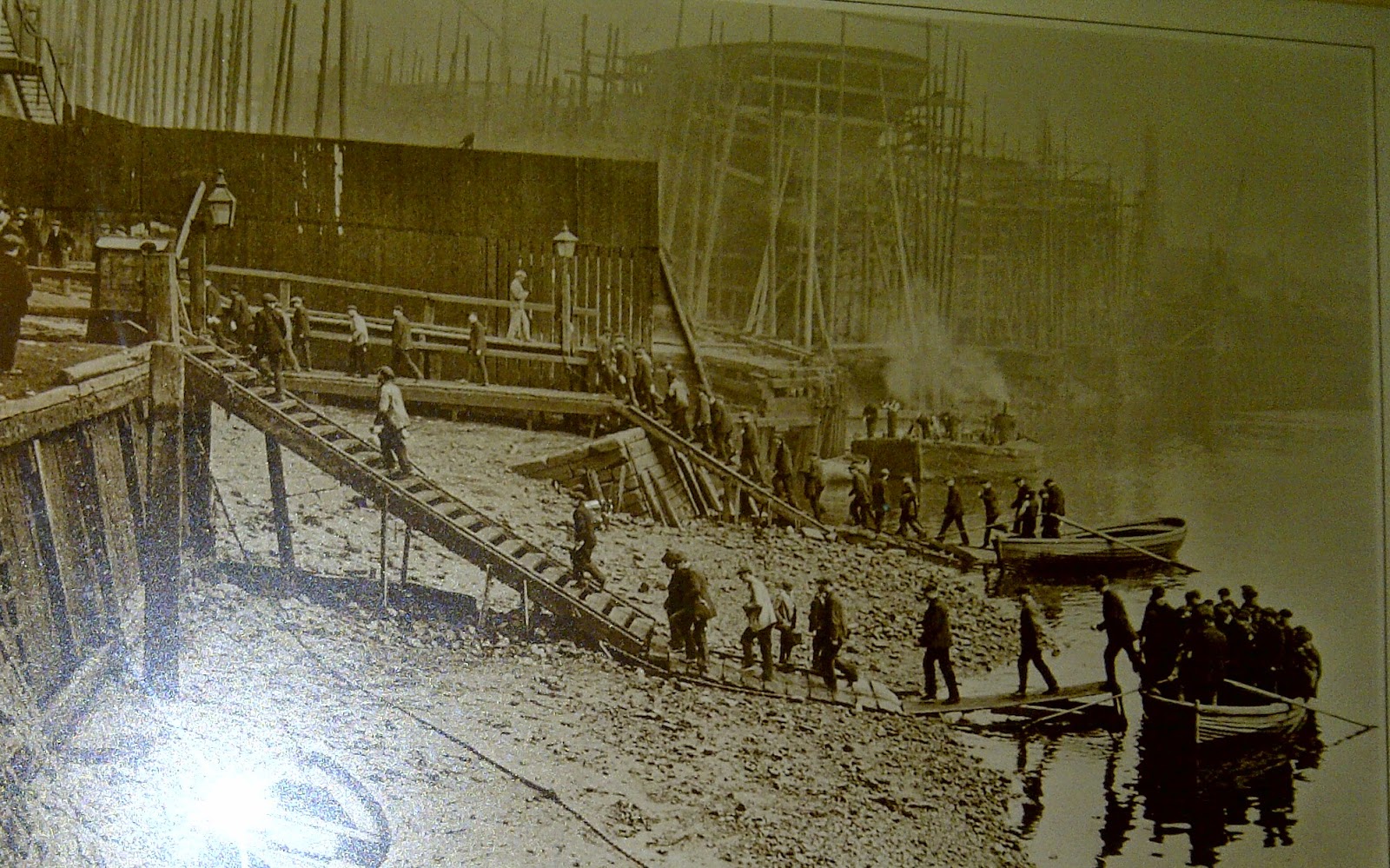
"HMS Black Prince" - The Thames Dreadnought

The first modern Dreadnought built on the Thames was in 1903

It gave its name to the Greenwich "Dreadnought seaman's" Hospital and Sylvia Pankhurst chose it as the name of her journal for the East London Federation

One trade unionist involved in the construction of the first Thames Dreadnought was Ernest "Ernie" W Cant, he recalled the  successful campaign to stop wages being cut at  the Thames Iron Works, in 1905, after the workers had completed the first "Dreadnought" battle ship  "The Black Prince" (started in 1903 and completed late 1904) at Blackwall the other yard was at Canning Town. After its completion the Admiralty demanded that if the yards were to get more work, the workers pay had to be cut to that of those on the Tyneside shipbuilders. The campaign against wage cuts was led by Will Thorne and Jack Jones (SDF MP for Silvertown). 

The Black Prince was launched on 8 November 1904 and sunk during the Battle of Jutland in May 1916 with the loss of her entire crew of  857.

The Thames Iron Works shipyard closed in 1911, but the works football team lived on however, when its players formed the basis for the new West Ham United team


 Below
The Thames Shipyards in 1902 and then 1910


Friday, February 21, 2014

Labour Party Housing Leaflet 1923


Labour Party Housing leaflet 1923

A LABOUR GOVERNMENT

will provide

MORE HOUSES
BETTER HOUSES
REAL HOUSES
AT
REASONABLE RENTS


There is a shortage of 800,000 houses


The Tories will not and cannot give you the houses you need because they rely on "private enterprise"
which means that if you want a house now you must pay extortionate rents.

Labour aims at providing everybody with good houses at a reasonable rents.

Labour stands for the Abolition of all slums; for town planning; for labour saving houses for the housewife; for healthy, open air surroundings; for reasonable rents

Labour stands four square against Tory policy pf "Hutches for heroes", against unhealthy streets and towns; against profiteering in rents

Why does the Tory Government shirk that duty ?

Because it is in the power of the landlords and their friends - people who want to line their own pockets at the expense of the workers

Tuesday, February 04, 2014

Belgium Refugees WW1 - Hayes

Belgium Refugees 

Hayes Belgium Relief Fund
The first immigrants

Hayes Belgium Relief Fund was established at a public meeting 23rd October 1914, after the Emergency Committee had received a letter from Local Government Board asking Hayes to offer hospitality to Belgium refugees.

At the outset of World War One and the German invasion , Belgium refugees had flocked to Britain (an estimated 500,000 in total).


Many Belgium refugees seem to have been progressed initially through the Earls Court Camp in London.
The Hayes Committee looked after 100 families, many of the women and children, but also wounded Belgium soldiers. 
Some refugees we know were from the Louvain region of Belgium, an area and City destroyed by the German Army in retaliation for resistance to occupation.

Initially, the committee tried to secure accommodation for the refugees at White Hall, Hayes End, but Hearne House and Lodge were secured, later The Gables at Wood End and Mr Drenon (Labour Councillor) took refugees into his home at Barra Hall.

Some of the younger Belgium men secured work in the Hayes factories, but work at the Army Motor Works was said to be "irregular".
Despite a national shortage of Labour, pay and conditions for the Belgium workers seem to have been bad, local employers taking the opportunity to cut pay rates. Belgium workers who protested at poor conditions were threatened with being conscripted into the Belgium Army.

A number of local Belgium workers in the factories joined the Workers Union, who had appointed a national Belgium full time officer, Jan Chapelle (a well know Belgium trade union leader) to look after their interests. 

The committee raised money by local collections and Belgium flag days

Hayes Belgium Relief Fund Committee:


Dr W. D. Hopkins, Cllr Juan Drenon JP, Mrs Gunton, Mrs Hudson, Mrs Ellis, Mrs Ritchings, Rev Mr E.R Hudson, Mr I. Ellis, Mr J. Hibbert, Mr H.W. Hunt, Mr E. Tucker, Mr E. J. Nyblom, Mr E. Window
Hayes Belgium Relief

Committee Secretaries:
Mr Montague Rose, The Bryan, Keith Road, Mr W. Herbert Rhodes 17, Cranmer Road


Note:
Rhodes was a Labour Councillor as was Juan Drenon
Local branch Secretary of the Workers Union was Douglas Page

Picture Top
Belgium monument on the embankment in tribute of the Belgium refugees, unveiled 12 October 1920


Hayes and World War One - WW1

It is clear despite a significant minority of the Labour Party opposing World War One, The vast majority of the British Labour Party ended up supporting the War, and it seems this division was reflected locally in Hayes, West Middlesex.

While there may have been concerns about the War by Hayes Labour Association founder Percy Langton, accusing the “gutter press ” of having “done more to bring about this war than the Kaiser.”

The German invasion of neutral Belgium and abuses of Belgium civilians had swung support to the pro War lobby.

Former Hayes Urban District Labour Councillor, Henry Palmer, who had by 1915 emigrated to Canada stated

“We are fighting a just and right war and one that was forced on us to keep our honor we were bound to help the weak and those of us who have to give up our sons to go, know that if they never come back they died doing their duty for their country. Both of my sons have gone and if they never come back I say God’s will be done

Henry Palmer; Stratford Canada December 1915

Henry Palmer, like so many paid a heavy price for his beliefs, both his sons were killed by the end of the War. William Alfred Palmer Eastern Ontario Reg (Killed 26th April 1916 Woods Cemetery, Belgium). Lieutenant Henry Arthur Palmer Central Ontario Reg (killed 30th September 1918 Cantimpre Canadian Cemetery, Nord France)

Leanold W Spencer Uxbridge ILP Secretary (Belmont Road,Uxbridge) was also killed, 1st September 1915. shot in head aged just 26. He had been a founder member of Uxbridge Labour Party and was the first man to motor cycle up Snowdon, Wales

L.W Spencers, Regiment took major loses and he underwent terrible ordeal suffer from hunger, thirst, sleepless nights and 7 months on constant bombardment, he slept with his motorcycle by his side doing his Christian socialist duty
13th Kensington Battalion Cyclist Orderly he is buried at Longuenesse St Omer


At Uxbridge, Labour Councillor Robert Hudson got caught up with the jingoism of the day in stating that “We are all British before Party”

A more main stream Labour Party view of the War was stated by Labour Perspective Parliamentary Candidate for Uxbridge Parliamentary Division (which included Hayes) Harry Gosling (Later TGWU President) at a meeting in Harefield in late1918

“I hate war and militarism but I would object to anyone taking a liberty with me (?) I believe country was absolutely right in the action it took, but it need not mean that they should go on fighting for ever and ever, the war must be settled”

In Hayes the immediate impact of the War was improved wages offered by the factory owners, (and huge numbers of women rushed to new jobs - some soilders wrote to complain about their pay compared to these young women's) as the factories switched from consumer goods to War goods. This no doubt also muffled opposition to the War in Hayes

As the impact of the War hit home, food prices rocketed and rents often doubled, there was growing local support for those that protested, such as the local National Union of Railwaymen’s branches protest at price of food “ which they viewed with alarm and extreme dissatisfaction the present high prices of food “

On Rent’s, Labour Councillor Juan Drenon was at the forefront of the campaign to expose “profiteering” by Private Landlords. It was stated that “Rents in 1915 were 3s above that charged pre-War”

Councillor Drenon in a blistering attack in July 1915 stated,

"The patriotism of many so called patriots, starts and ends with their pockets. It was the same with the coal owners who grew fat out of the country’s needs and risk the country’s safety rather than give the colliers a living wage”

By November 1915, Councillor Drenon was so concerned about the situation with regard to rents that he called for the establishment of a Tenants Defense League similar to that established elsewhere.

Councillor Drenon had also taken into his home a number of Belgium refugees (500,000 nationally), the Belgium's being the first wave if immigrants to arrive in Hayes looking for work in the Munition factories.

Hayes Belgium Relief Fund was established by Hayes Labour Councillor Mr Herbert Rhodes on October 23rd 1914 and its primary purpose was care for the Belgium refugees, especially mothers and children. by 1916 it was looking after one hundred families in Hayes alone.
 (a number of the refugees was from Louvain, Belgium). Hayes also saw a regular Belgium Flag Day to raise money

Elsewhere, in West Middlesex the harsh treatment and eviction of those with husbands and sons in the Armed Forces was typified by the heartless eviction of Mr and Mrs Fort aged 73 and 69 respectively, residing at Copthall Farm, Ickenham, who had five out of six sons in the army and one son in a restricted occupation. This eviction was not uncommon and showed the scant regard business showed to the poor during the War.

Little wonder, that the Hayes Labour Party was supportive of the principle of £1 a week for soldiers and their dependents .

In the early part of 1918 the Thames & Medway region of the National Amalgamated Union of Labour organised a delegation to visit the troops in the front line, This delegation included locally Hayes Labour Councillor Woodward. Woodward stated in Febuary 1918 that

“The impression the trip made upon him, an impression that was shared by every member of the NAUL party was the fighting must continue until a clean and lasting peace is assured”

“The only complaint I heard from Tommy was about the smallness of there pay… compared to that earned in the munitions factories”.

When conscription was introduced, a local Uxbridge branch of the No Conscription was established, primarily consisting of ILP members and included Norman Cox (Hillingdon)and Adam Priestley (Northwood). Most conscientious objectors received short shrift and were handed over to the military authorities and ultimately prison.

At Harrow School, the school boys organised a strike in order to remove a Teacher, Mr Sutherland from employment because he was a conscientious objector

In total 16,000 men refused to fight of whom most were pacifists, 7,000 acted as stretcher bearers and suffered high casualty rates.


A unique letter home from Reginald Hamaton of Hillingdon who was in the Army of Occupation in (Cologne) Germany in January 1919, shines a small light on the situation in Germany.

“We are very lucky here as we are in Jerry’s peace time barracks, and have nice single cots, pillows, and soft beds, plenty of coal for the fire, “bags” of electric light, etc. We are not allowed to walk or talk with the civilian population…..I suppose this is the place where they make the Eau de Cologne, but I have not seen any about. Of course, I cannot speak any German, and it is hard to understand the people, but they are very nice and treat us very good – far better than I thought would be the case. It is funny to see Jerry’s bicycles with the patent spilings for tyres. As you know, he has no rubber, and his motor lorries have iron tyres, and it makes the people look when they see all ours using rubber. Another thing they are very short of soap”.


At the end of the War, what is of note is the refusal of the Labour councillors and therefore the Hayes UDC to mark or participate in the victory and peace celebrations carried out by nearly every other council in the country.

NOTE

Picture
Belgium refugees monument, South Bank, London unvailed 12 October 1920

Belgium's can therefore claim to be the fist immigrants to Hayes (excluding people from Wales and North of England)


German atrocities in Belgium and France as well as raids on Scarborough and Hartlepool, Zeppelin raids all helped populate anti German feeling

Hayes Urban District Council is very unusual in refusing to  officially celebrate victory in WW1 on the grounds of cost and glorifying war

Friday, January 10, 2014

Hayes Labour attiude to WW1

It is clear despite a significant minority of the Labour Party opposing World War One, The vast majority of the British Labour Party ended up supporting the War, and it seems this was reflected locally in Hayes, West Middlesex.

While there may have been concerns about the War by Hayes Labour Association founder Percy Langton accusing the “gutter press ” of having “done more to bring about this war than the Kaiser.”
The German invasion of neutral Belgium and abuses of Belgium civilians had swung support to the pro War lobby


Former Hayes Urban District Labour Councillor, Henry Palmer, who had by 1915 emigrated to Canada stated
“We are fighting a just and right war and one that was forced on us to keep our honor we were bound to help the weak and those of us who have to give up our sons to go, know that if they never come back they died doing their duty for their country. Both of my sons have gone and if they never come back I say God’s will be done
Henry Palmer; Stratford Canada
December 1915

Henry Palmer, like so many paid a heavy price for his beliefs, both his sons were killed William Alfred Palmer (Eastern Ontario Regiment) 26th April 1916 Lieutenant Henry Arthur Palmer (Central Ontario Regimen) 30th September 1918.

Likewise Uxbridge Councillor and Uxbridge Independant Labour Party Secretary, L.W. Spencer was killed


And
At Uxbridge, Labour Councillor Robert Hudson got caught up with the jingoism of the day in stating that “We are all British before Party” 

A more main stream Labour Party view of the War was stated by Labour Perspective Parliamentary Candidate for Uxbridge Parliamentary Division (which included Hayes) Harry Gosling at a meeting in Harefield in late1918
“I hate war and militarism but I would object to anyone taking a liberty with me (?) I believe country was absolutely right in the action it took, but it need not mean that they should go on fighting for ever and ever, the war must be settled”

In Hayes the immediate impact of the War was improved wages offered by the factory owners, (and huge numbers of women rushed to new jobs - soilders complained about their pay compared to these young women workers pay) as the factories switched from consumer goods to War goods. This no doubt also muffled opposition to the War in Hayes

But as food prices rocketed and rents doubled, there was growing support for the stance of those that protested, such as the local National Union of Railwaymen’s branches protest at price of food “ which they viewed with alarm and extreme dissatisfaction the present high prices of food “
On Rent’s, Labour Councillor Juan Drenon was at the forefront of the campaign to expose “profiteering” by Private Landlords. It was stated that “Rents in 1915 were 3s above that charged pre-War”

Councillor Drenon in a blistering attack in July 1915 stated,
The patriotism of many so called patriots, starts and ends with their pockets. It was the same with the coal owners who grew fat out of the country’s needs and risk the country’s safety rather than give the colliers a living wage”

By November 1915, Councillor Drenon was so concerned about the situation with regard to rents that he called for the establishment of a Tenants Defense League similar to that established elsewhere.
Elsewhere, in West Middlesex the harsh treatment and eviction of those with husbands and sons in the Armed Forces was typified by the heartless eviction of Mr and Mrs Fort aged 73 and 69 respectively, residing at Copthall Farm, Ickenham, who had five out of six sons in the army and one son in a restricted occupation. This eviction was not uncommon and showed the scant regard business showed to the poor during the War.

Little wonder, that the Hayes Labour Party was also supportive of the principle of £1 a week for soldiers and their dependents .

A unique letter home from Reginald Hamaton of Hillingdon who was in the Army of Occupation in (Cologne) Germany in January 1919, shines a small light on the situation in Geremany.
“We are very lucky here as we are in Jerry’s peace time barracks, and have nice single cots, pillows, and soft beds, plenty of coal for the fire, “bags” of electric light, etc. We are not allowed to walk or talk with the civilian population…..I suppose this is the place where they make the Eau de Cologne, but I have not seen any about. Of course, I cannot speak any German, and it is hard to understand the people, but they are very nice and treat us very good – far better than I thought would be the case. It is funny to see Jerry’s bicycles with the patent spilings for tyres. As you know, he has no rubber, and his motor lorries have iron tyres, and it makes the people look when they see all ours using rubber. 
Another thing they are very short of soap”.


At the end of the War what is of note is the refusal of the Labour councilors and therefore the Hayes Urban District Council to mark or participate in the victory and peace celebrations carried out by nearly every other council in the country

Saturday, February 23, 2013

Walter Tull - 17th Middx Regt (Football Battalion) Bolton Octagon Theatre


Walter Tull - 17th Middlesex Regt - 1st Football Battalion

Following the extraordinary success of War Horse, the novel by Michael Morpurgo that inspired the National Theatre and then Steven Spielberg, another forgotten tale from the first world war is now set to find a wider audience.

Nearly a century after the great conflict began, Bolton's Octagon Theatre will mount a play telling the story of Walter Tull, one of Britain's first black footballers, who joined the 1st Football Battalion and went on to die on the Somme as the first black army officer. Cited for bravery under fire, Tull did not receive the posthumous recognition many now believe he deserves.

 http://www.bbc.co.uk/programmes/b01qmb0d

Friday, February 22, 2013

Shop Workers Against Fascism

The onset in 1930 of the severest recession  the world had ever  known made 20 per cent of Britain's workers unemployed.
 

The town of Jarrow in the North East of England epitomised the human misery of unemployment  in the hungry thirties.

Virtually a single-industry town, its life blood came from Palmer's shipyard. when the shipyard closed down the consequences were catastrophic. Nearly 80 per cent of the workforce was out of work. 

Malnutrition was claiming lives and the death rate from tuberculosis was double the national average.   

In 1936, with Shop Workers union sponsored MP Ellen Wilkinson at their head,  the men of Jarrow set off to march to London. Throughout the journey the march was fed.and sheltered largely by.the efforts' of trade union members  and Co-operative Societies.  


Ellen spoke nightly at public  meetings en route  and  finally led  the weary yet triumphant marchers into London's Parliament Square.  

The  march  roused  the  whole  nation, but the Tory Prime Minister, Stanley Baldwin, refused to see any of the marchers.

Apart from the recession, another great  shadow lay over the political scene of the thirties—the  increasing power of Fascism across Europe and the threat of a second world war.

The Shop workers union joined with other unions in highlighting the abuses of fascist regimes in Europe, while opposing fascism in Britain at a time when the ruling establishment including the Daily Mail, Conservative MP's and members of the Royal Family were embracing Hitlerism and his fascist ideology.

Union members fought the fascists on the streets of the East End and elsewhere. They died in the International Brigade defending Republican Spain against fascist enemies.

When the second World War came the union would lose over 2,000 members fighting fascism and a further 140 civilian members killed in aerial attacks  on Britain


NOTE
The Shop Workers union lost 2,047 member during World War 2 fighting fascism, to add to the 2,103 killed in World War 1

Saturday, November 10, 2012

WW1 Hayes, Middlesex- Roll of Honour (Updated Nov 2012)


Hayes - Roll of Honour WW1 (UPDATED 2012)
HAYES & HARLINGTON - WW1 ROLL OF HONOUR

HAYES & HARLINGTON
(MIDDLESEX)

ROLL OF HONOUR

WORLD WAR ONE


Listed below are the brave men of Hayes, West Middlesex who gave their lives during World War 1.

Additional information is based upon an initial cross reference with the Commonwealth War Graves Commission.

What we can say about these men, is that many were young, they had their lives ahead of them and they gave their lives for what they believed was a just War. Many gave their lives to defend what they believed was the "honour" of Belgium, others were caught up in the jingoism or peer pressure of the time. We can call it an "Imperialist War" a "Capitalist War", we can blame the folly of their leaders like Earl Haig and Winston Churchill (Galopilli).

But we must never forget they gave their lives for what they believed was an "honourable" and "just" cause, at least in 1914, many were young working class men and far from being caught up in the "jingoism" of the ruling class believed it right to fight for the liberation of Belgium.

This view was no doubt reinforced by the Belgium refugees who streamed into the munition factories of Hayes during the War.

HAYES WW1
ROLL OF HONOUR


E.J. Arnold (Not found)

S.P. Aird (Not Found)

H. Balls(Possible Match)
Herbert Frederick Balls, 20 Royal Fusiliers died 20/07/1916 ??????

F. Bamforth (possible match)
Francis Bamforth, 8th Bat Royal Fusilers died 07/07/1916 ??

R.Bates (CONFIRMED)
Prvate Richard Edward Oliver Bates of Son of Annie Bates"Ivydene," Hayes End, 11th battalion, Middlesex Regiment died 09/04/1917

S.C. Bennett (CONFIRMED)
Sidney Charlie Bennett Private 8987 Royal Fusilirrs 1st Battalion aged 20 killed 23/09/1915 buried New Irish Farm Cemetery. Son of William & Gertrude Bennett 11 Blyth Road, Hayes

D.C. Blyth (Possible Match)
Second lieutenant 28/08/1915 Royal Engineers 93rd Company, Dickenbusch cemetery, Ypres, Belgium

C. V. Bowgett (CONFIRMED)
Charles Victor Bowgett age33 Son of George and Fanny Eliza Bowgett; husband of Emily Bowgett, of 10, Rosedale Avenue, Hayes End, Hayes, Middx.
Rifleman 3rd Battalion Rifle Brigade died 20/10/1914

C.W Bray (CONFIRMED)
Charles Bray aged 36 Pioneer Field survey corps, buried Padumain Cemetery plot B:11 son of Charles and wife Mary Ann Bray 1 Letchworth Cottage, Hayes End, Middx

H. Calf (CONFIRMED)
William Henry Calf, Gunner 196th Siege Bty. Royal Garrison Artillery Son of Frederick and Kate Eugenie Calf, "Acacia", High Rd, Hayes ., died 05/04/1917 CEMETERYANZIN-ST. AUBIN BRITISH

R. Calf (CONFIRMED)
Robert Noel Calf, age 20 Private 13th Battalion, Royal FusilersSon of Frederick and Kate Eugenie Calf, Acacia", High Rd., cemetery Humercamps

C.Castle (CONFIRMED) Sergeant C. Castle age 27 Son of William G. and Sarah Castle, of 4, Railway Cottages, Hayes, Middlesex. Native of Iver, Bucks. 9th Bat Royal Fusiliers died 28/06/1918 Gezaincourt Cemetery

E.L Chambers (Possible Match)
Eric L Chambers Rifleman 301386 London Regiment, Rifle Brigade, 1st/5th Brigade,  Thiepval (almost certainly)

A. Charlesworth (CONFIRMED)
Thomas Samuel Charlesworth, aged, 21 Driver Royal Field Artillery, 146th Bde Ammunition Col. Killed 11/07/1915.Son of Thomas Joseph & Sarah Charlesworth, Hayes Middx

J Chinnery (CONFIRMED)
Private James Chinnery, 9th Bat Royal Fusiliers 21 years old Son of Mr. and Mrs. Chinnery, of 49, Rosedale Avenue, Hayes End, Middlesex. 04/04/1916

P.Chitty (Possible Match)
Percy Chitty, Lance Corporal Royal Medical Corps 12957, 12/10/1918 aged 24 Tooting. 
Or Harold Percy Chitty aged 29 Tank Corps A Battalion, Cambrai parents Claygate

J. Churchill (CONFIRMED) Private John Churchill aged 17 Son of Ena Elizabeth Churchill, of 39, Rosedale Avenue, Hayes, Middx 18/09/1916 Philosophe British, Mazingarbe.

R.E. Coleman (CONFIRMED)
Ralph Egerton Coleman aged 35 Private Essex Regiment 1st Battalion , son of Serjeant James Coleman (Connaught Rangers) of Attlebough, Norfolk. Husband of Harriet Elizabeth Coleman 25 Rosedale Avenue, Hayes, Middx – Helles memorial

J.Cooke (CONFIRMED)
Private John Gatwood Cook age 39 husband of Ellen Cook of 13 Austin Road, Hayes, Brother Colour Sergeant Cook. 13th Loyal North Lancashire Regiment, died 13th July 1917 at Baddow campa, Essex buried St Mary's Hayes.

H.Court (Possible match)
HARRY ROBERT COURT 12th Middlesex Reg Husband of Phoebe Rebecca Court, of 19, Montague Avenue, Hanwell, Middx. ????? 10/01/1917 ?????

W.Curtis (Not Found)
G. Druce (CONFIRMED)
Private George Druce, aged 18, Son of Mr. and Mrs. George Druce, of 5, Church Walk, Hayes, Middx.9th Battalion Royal Fusiliers,20/10/1915 Noeux-les-Mines cemetery


R. Egerton (CONFIRMED)
RALPH EGERTON1st Essex Regiment age 35 06/08/1915 Son of the late Serjt. James Coleman (Connaught Rangers) and Mrs. Coleman, of Attleborough, Norfolk; husband of Harriett Elizabeth Coleman, of 25, Rosedale Avenue, Hayes End, Middx. Helles memorial


T.D. Elderidge (Possible Match/CONFIRMED)

Thomas Eldrige Private Royal Fusiliers killed 06/04/1918 Verness son of Edward and Rachael Eldridge. Sipson, Middx (almost certainly)

W.J. Emmett (CONFIRMED)
Private W. J. Emmett age 18 Son of Charles J. and Emma Emmett, of Hayes, Middx. 2nd Battalion London Regiment (Royal Fusiliers) died 01/07/1918 CONTAY BRITISH CEMETERY,
George Charles Ensby (CONFIRMED) George Charles Ensby Private No2 Coy 12th battalion, Royal Fusiliers killed 31 July 1917 son of George Ensby (brick maker?) 10 Rigby’s Cottage Dawley Hayes Ypres Menin Gate Memorial


G.Gates (CONFIRMED) George Gates age 30 Son of Mary Ann Gates, of Walnut Tree Cottage, Yeading, Hayes End, Middlesex. 2nd Bat Middlesex Reg 31/07/1917 - Ypers Menim Gate memorial

B.St J. Glanfield (Not found)

H.Gohm (CONFIMED)
Private Henry Gohm 4th battalion Royal Fusiliers died 25/09/1915 Sanctuary Wood cemetery

T.W. Gregory (CONFIRMED)
Thomas williamage 26 Son of Thomas and Sarah Gregory, of 16, Angel Lane, Hayes End, Middx.C" Coy. 7th Bn.Royal Fusiliers died 06/02/1917 Thiepval cemetery

F.D. Gregory (CONFIRMED)
Corporal Frederick David Gregory age 30 Husband of Ida May Gregory, of 37, Rosedale Avenue, Hayes End, Hayes, Middx. 2nd Batallion Grenadier Guards 31/07/1917 Artillery wood

A. Gray

C Gye (CONFIRMED)
Charles Gye 1st Royal Fusiliers Son of Robert and Caroline Gye, of 33, Rosedale Avenue, Hayes, Middlesex 17/11/1915


F.Halford (Possible match)
Private F. Halford 4th middx reg 23/08/1914 St Symphorien Military ?????

S. Hambridge (Possible Match)
Sidney John Hambridge 2nd bat Grenadier Guards Grenadier Guards24/05/1918 ??????

G. Hammond (CONFIRMED)
Private George age 22 Son of Mr. G. Hammond, of 4, Melior Cottages, Yeading Lane, Hayes, Middx. 8th Bat Middx Reg died 19/05/1917 1st/ Aaras

J.W. Hart (not found)

A. Hawkins (Not found)

A. Haynes (not found)

F.A. Hewens (CONFIRMED)
Lieutenant F.A. Hewens 16/07/1918 RAF buried St Mary's Hayes

A. Higgs (CONFIRMED)
Arthur HiggsS on of Mrs. J. Higgs, of 4, White Row, Yeading, Hayes, Middx. 2nd bat Royal Fusiliers died 01/07/1916 Hawthorn ridge

A.W. Higgs (Possible match)
Albert William Higgs 2nd Battalion Middlesex Regiment 24/04/1918 ?? 90% sure

E. Higgins (CONFIRMED)
E. Higgins 32 Son of Mr. E. Higgins, of 7, Pillions Cottages, Hayes End Rd., Hayes, Middx. bat Royal Fusiliers died 19/06/1917 DICKEBUSCH NEW MILITARY CEMETERY

A. Howard (not found0

G.F. Hunnisett (CONFIRMED)
Private Frederick George Hunnisett "Sunnyside", Yeading, Hayes, Middx. 01/04/1918 Queen's Own Oxfordshire Hussars - Pozieres Memorial

W.E. Hunt (Possible match)
Son of Henry James and Elisabeth Sarah Hunt, of 12, Elthorne Park Rd., Hanwell. Born at Hanwell. Air Mechanic 2nd Class RAF 06/04/1918 Hanwell cemetery ??

E. Jermie (Jermy) (CONFIRMED)
Lance Corporal Ernest William Jermy age 21 son of William and Annie Maria Jermy of 3 Brown's Cottage, Hayes End, Middx 1st Battalion Royal Fusiliers died 25/03/1918 Pozieres Memorial

M.R. Johnson (Possible Match)
Mark Robert Johnson aged 20 Private Royal Berkshire Regiment killed 05/04/1918

F. Joyce (not found)

A. Knight (CONFIRMED)
Private Albert Alfred Knight age 22 Son of mrs Alice Clark 61 Albert Road, Yiewsley, Middx 1st/8th Bat Middlesex Reg died 30/04/1915 Ypres cemetary

G. Langley (CONFIRMED)
Lance Cororal George Langley 21,Son of James and Ada Langley, of 19 Mellor Cottages, Yeading, Middx. 1/8th Bat Middlesex Regiment 16/08/1917 Tyne Cot cemetery


H. Langley (CONFIRMED)
Private Harry Langley age 27 Son of James and Ada Langley, of 19, Melior Cottages, Yeading, Hayes, Middx. 17th Battalion, Middlesex Regiment died 28/04/1917 Aaras cemetery

W. Leather (CONFIRMED)
Private 205341 James Leather aged 25 son of Mr G Leather 5 Rosedale Avenue, Hayes Private Devonshire Regiment 13 Works Battalion buried St Mary’s , Hayes


A. Lovett (CONFIRMED) Private Arthur Samuel Lovett aged 19 1st east Surrey regiment Son of Arthur George and Ada Lovett, of 35, Clayton Rd., Hayes, Middx. 24/09/1916 Thieva

F. Merchant (Possible Match)
F.T. Merchant Rifelman London Regiment (Post office Rifles) Warlencourt British Cemetary

B. Matthews (Possible Match)
Percy Matthews aged 32 killed 12/10/1916 Private Essex Regiment 1st Battalion, Husband of Mary Matthews 4, Third Avenue, Hayes, Middx. Thiepval

G.F. Mattingley (CONFIRMED)
George Francis Mattingley, age 25 , Son of James and Annie Mattingley, of Yeading, Hayes, Middx Yeading. 20 Bat Kings Royal Rifles16/07/1916

G.W. Meads (Not found)

W.H. New (CONFIRMED)
William Henry New aged 18 Private 70693 Royal Fusiliers 5th Battallion Son of Henry John Edward & Elizabeth New 6 Drenon Square (William Henry New was Born Kentish Town) buried St Marys. Hayes

E.C. Nice (Possible Match)
Edward Charles Albert Nice aged 20 Nice10th Bat Essex Regiment 26/09/1916 Thiepval ???

A. Norwood (CONFIRMED)
Corporal Alfred Norwood age 40 Son of Charlie and Helen Norwood, of 17, Cowley Mill Rd., Uxbridge; husband of Emily Norwood, of 18, New Windsor St., Uxbridge, Middx. 12th bat Royal Fusiliers 15/06/1917 Ypes

W. Palmer (Not found)
(Might be William Plamer - Candaian son of Henry Palmer

A. Penn (not found)

R.C. Pickering  (CONFIRMED) Private Robert Cecil Pickering aged 25 Machine Gun Corps 65th Company killed 18/09/1918 son of John & Edith Pickering Doiran-Agny, Hayes buried Doiran


W,H. Pomeroy (Possible Match)

12 Bat Suffolk Regiment 05/05/1917 ?????

H. Powell (CONFIRMED)
Lance Corporal Harry Powell age 31 son of Stephen William and Ellen Powell of 5 Mill's Cottages, Wood End Green, Hayes End. Middx died 15/10/1918 Duhallow ADS cemetery

H.M. Prince (Not found)

E. Rayner (CONFIRMED)
Private Eric Norman Rayner age 24 Son of Mrs M Rayner of 35 Angel Lane, Hayes End, Middlesex 13th Battalion Royal Fusiliers 5/10/1917 Tyne Cot Cemetery

W. Rayner (Not found)

W, Redden (Possible Match)
George Redden ?? Rifelman London Regiment  1st/17thBatt 571231 15/09/1916

T. Renton (Not found)

W. Richardson (Not found)

F. Sadler (POSSIBLE MATCH)
Frederick Frederick John Sadler, 2nd Middlesex Reg ,Thiepval 01/07/1916 ????

T. Salter (CONFIRMED)
Private Thomas Henry Salter age 19 Son of Silas and Emma Salter, of 1, Park Lane, Hayes End, Middx. Royal Fusiliers 02/10/1915 Loos

W. Sargood (Possible Match)
Hugh Frank Sargood, 16th Bat  Middx Regiment Second Lieutenant killed 10/05/1917 Arras

C. Sherwood (Not found)

C.Sherwood (CONFIRMED)
Private Charles William Sherwood 8th Battalion Royal FusiliersSon of Emma Sherwood, of 8, Town Field Rd., Hayes, and the late Thomas Sherwood; husband of Maud Elizabeth Sherwood, of 1, Grainges Yard, Uxbridge, Middx age 35 05/10/1916 Thiepval


J. Smith (Not found)

H. Stacey (Possible Match)
Herbert Walter Stacey, Sergeant RAF aged 35 03/02/1919 Longuenesse (St Omer) wife Ethel Grace 1 Rolls court Avenue, Herne Hill

A. J. Stonestreet (Possible Match)
Private Alfred John Stonestreet age 22 Son of Benjamin John and Sarah Emily Stonestreet, of Myrtle Cottage, High Rd., Southall, Middx.13th Kensington Bn, London Reg. died 01/07/1916 Couin British cemetary

W. Sullivan (CONFIRMED)
William Sullivan aged 20 Middlesex Regiment 2 Battalion 01/07/1916 son of Mr & Mrs A.J. Higgs, 1 Meilor Cottages, Yeading, Middx Thiepval memorial 12d and 13 b

W. Syred Lance (CONFIRMED)
Corporal William Arthur Syred Son of the late William Arthur Syred and of Betsy Witherly (formerly Syred), of 33, Blyth Rd., Hayes, Middx. 25/09/1915 Ypres 5th Bat Oxford and Bucks Light Infantry

W.C. Tapping (Possible Match)
William George Tapping, Rifleman, London Regiment, Queen Victoria Rifles KIA 01/07/1916 aged 26 son of William Thomas & Sarah Tapping School Green Shinfield, Bucks - Thierpal

W.H. Taylor (Not found)

A. Tripp (Possible Match)
Albert Tripp, Rifleman Rifle Brigade 16/12/1914 Ploegsteert ?????

W.T. Turner (Not Found)

H.A. Turner (CONFIRMED)

Henry Albert Turner, aged 35 Husband of Florence Fearnley Turner, of "Claverley," Cromwell Rd., Hayes End, Middx. Born at Hayes End. 6th Battalion Queen's Own (Royal West Kent Regiment) died 09/04/1918BOUZINCOURT RIDGE


H. Tyrell (Possible match)

P. Tyrell (Possible match)
Percy John Tyrell, Rifle Brigade  9th Battalion, KIA 29/08/1916 Thiepiral


W. Vaughan.(Possible Match)
William Vaughan , Royal Fusiliers  28/06/1915 Helles

J. Watts (not found)

G. West (not found)

W.T. Williams (Not found)
ALSO

The Palmer Brothers from Hayes (sons of Hayes Labour Party founder and Councillor Henry Palmer) They died fighting in the Canadian Army.

William Alfred Palmer, Eastern Ontario Reg (Killed 26 th April 1916 buried Woods Cemetery, Belgium).

Lieutenant Henry Arthur Palmer, Central Ontario Reg (killed 30th September 1918 buried Cantimpre Canadian
Cemetery, Nord France)


LEONARD SPENCER - UXBRIDGE ILP SECRETARY

L "Leonard" W. Spencer was born in Guildford 29th July 1889, educated at Collegete School at Reading, He was the son of Mr. T. B. Spencer, of 66, Kidmore Road, Caversham, Reading.

Aged just 17, he left home to open a business in Uxbridge, living later at Belmont Road, Uxbridge. Leonard Spencer went on to helped establish and became the first secretary of the Uxbridge Chamber of Commerce, while also participating in the establishment of a local parliament (debating society).

As an early motor cyclist enthusiast he was reported to be the first person to have ever successfully motorcycle up Snowdon, he also toured Norway and Iceland as a young man.

Spencer had been a keen supporter of Mr Edmund Dene Morel (later Labour MP for Dundee and married to Mary Richardson) agitation over the brutal rule of King Leopold in the Belgium Congo (Now the Democratic republic of Congo).

Spencer became a Christian Socialist believing "that there was no incompatibility but rather the fullest harmony between Christianity and socialism".

He went on to become the founding Secretary of the Uxbridge Independent Labour Party (ILP) and in 1910 he had been elected to Uxbridge Council as a Labour candidate along with Edwin Westcott. While on the council he was involved in the plan to build some of the first Uxbridge Council houses and it was stated that these "were definitely a monument to the energies and the eloquence of Mr Spencer".

When World War 1 broke he considered it his Christain duty to serve and he was one of the first to enlist as a Cyclist Orderly in the (London Cycling Regiment) later 13th Kensington Battalion in order to defend the sovereignty of "little countries overseas".

He wrote home stating "he would not come home for the world until victory was won" and encouraging others to follow him and enlist.

At Ypres, during the Battle of Neuve Chapel during March and April 1915, A battle which represented the first large scale organised attack undertaken by the British army during the war. Spencer's Battalion took major losses, he underwent a terrible ordeal, suffering from hunger, thirst and sleepless nights. He only took off his clothes to wash and slept every night with his motorcycle by his side (probably providing a vital courier service). He served without respite for seven months.

The Regimental History of the Kensington's Regiment describes their experiences during Neuve Chapelle. C Company was involved on the first day, and advanced at 9 a.m. to the village cemetery, where they had to take cover amidst churned-up graves. On the 12th of March, their C.O. (Lieutenant-Colonel Lewis) noted that by 12.25 p.m. the German bombardment of their positions (in the old front line) was "Perfect Hell".

It seems that this "perfect hell" had finally undermined Leonard Spencer's fundamental Christian beliefs, it was stated later that he had rediscovered his beliefs before his untimely death, shot through the head by a German snipper on the 1st September 1915.

Private (and Comrade) L.W. Spencer is buried at Longuenesse St Omer, France.


SPENCER L W
United Kingdom Private 2024London Regiment01/09/1915 Age: 26 II. A. 23.

REMEMBER NURSING SISTER - ADDIE TUPPER
Canadian Nursing Sister buried at Uxbridge (Hillingdon)


Nursing Sister: Adrienna or Adruenna “Addie” Allen Tupper
Canadian Army Medical Corps
Born Yarmouth Nova Scotia 13th October 1870
Daughter of Mrs Mary E Trefry of Bridgend, Nova Scotia, Canada.

Addie Tupper from Bridgewater Nova Scotia
Enlisted Quebec

UPPER, Addie Allen (Adruenna), Royal Red Cross (RRC
Graduated General Hospital Concord, New Haven
  No. 2 General Hospital, Le Treport, France
Died of illness 9th December1916 aged 46

Remer also


Remember

Yiewsley's 19 year old sailor lost at the Battle of Jutland 1916 WW1

Able Seaman: Henry James Fox
Aged 19, Son of Henry and Jane Fox 20 Horton Road, Yiewsley, Middx

Died 31/05/1916 (Battle of Jutland) HMS Queen Mary, 

Plymouth Naval Memorial


Yiewsley 18 year old Sailor killed Cromarty Firth 1915 WW1

Ordinary Seaman: Charles Henry Axten

Aged 18 Son of Mr. and Mrs. R. J. Axten, of 1, Ivy Cottage, Falling Lane, Yiewsley, Middx.


Died 30/12/1915 Sunk HMS Natal, Cromarty Firth

Chatham Naval Memorial