Sunday, October 10, 2010

WW1 July 1917 Uxbridge Notes


GERMAN PRISONERS 1917

German Prisoner have been at work in the (Harlington) village this week and caused a little curiosity especially on the part of the children.

if our own men in the hands of the Germans look well and contented as these men there would be little to worry about (July 1917)

PRIVATE NEWMAN
Private Alfred Newman of Harlington, youngest son of Mr & Mrs Robert Newman is reported missing since the end of may

SHERATON GLASS FACTORY
A hostel for boys working at Sheraton Glass Factory has been opened at Botwell Lodge. Mr Jenner is the superintendent.

Mr GRIMSDALE
A well known member of the Uxbridge and West Middlesex Athletics Club Captain G.C. Grimsdale of the London regiment has been wounded

SCOUTMASTER
Mr G.W. Beach the Scoutmaster of 1st Uxbridge Troop who is serving in East Africa has been promoted to Sergeant

CYCLE REPAIR MAN
A cycle repairer from Slough who had been rejected fourteen times for military service has now been classified C3

NATIONAL UNION OF RAILWAYMEN (NUR)
The National Union of Railwaymen have lost 2,758 members killed in the war


POW LETTER

Private Percey Perryman a wounded prisoner of War (POW)in Germany, writing to his wife under date May 7th 1917 says that he had just come across a lad from Uxbridge named Shirley "Whom I knew very well in fact I used to work with two of his brothers". his letter altogether is very cheerful, although he is still in hospital, but as it was not serious it was nothing to worry about.

Charles Harrison (Cowley) was serving in his Majesty's fleet

R.F.A. (Driver) Bench serving in Mesopotamia (worked previously at home Nursery

Private G Howe (Uxbridge)

Private R. Bowler A.S.C. (Uxbridge) on service in Mesopotamia

Rev Luther Bouch conducted the fourth anniversary service in his connection with his Ministry at the old Meeting Congregational Church

UXBRIDGE WORKERS EDUCATIONAL ASSOCIATION (WEA)
This Newly established branch of the WEA held its AGM (July 1917)

H.T. Hamson was the Secretary of Uxbridge WEA

three local Associations affiliated to Uxbridge WEA in 1917, National Union of Railwaymen, National Union of Teachers and Uxbridge Adult School

MUNITIONS DEATH

Uxbridge County Court dealt with the clainms on behalf of two munition workers in local factories
Daisy Hitchings of 16 Pickett Street, Balham (loss of finger)
Daughter of Mary Ann E Bosher of Melbourne Cottages, Alma Road, Windsor - Killed in an accident at the Munitions factory 3rd January 1917

TAX RESISTANCE

Miss Katherine Ann Raleigh, the assiduous local worker on behalf of the Women's cause (Suffragette) had refused to pay certain taxes as a protest to the government in not guarantying the franchise (Vote) to women,
Her property was seized and sold on this occasion a half dozen silver tea spoons in a case. these were bought by another suffragette Miss Underwood

HAREFIELD NUGW UNION
Harefield National Union of General Workers NUGW requested direct representation on the local Food Control Committee

July 1917

Uxbridge History


Leno's History of Uxbridge

In 1870, Matthew Leno had a shoe and clothing shop in the place now occupied by Mr Butler, opposite the market house, Uxbridge and he published a sixpenny pamphlet, entitled "The history of Uxbridge", in a condensed and popular form from the earliest times to the present; by John Bedford Leno author of "Drury lane Lyrics"The Autobiography of a Shilling "etc ,

The main portion of the earlier history was doubtless compiled from the more complete work of George Redford and Thomas Hurry Riches, but quite a lot of new and later details were included, some of these being quaint and little known to the present generation. For instance, he tells us that "The chief business thoroughfares are London Street, high Street, Windsor Street (formerly called the lynch) and Vine Street (formerly Blind Lane or Woolwind Lane). also that the town was divided into two wards under the local Board of health, the old township being known as the "Inward" and the part lying without as the "outward".

28 September 1917 The Advertiser & Gazette


St Margaret National School erected in 1864
A School of industry for girls erected 1816 (George's Fields)
The British School for Boys (Cowley Road)
The Public Rooms (or Town hall) erected 1836 (London Street)
Belmont Hall erected 1866
The Uxbridge Old bank established 1806


A Petty Session has been held for over 150 years prior to 1917, held every Monday at the uxbridge Town Hall

Theatre buit 1869

The Grand Junction Canal was opened at Uxbridge in 1805

The Uxbridge (Vine Street) Station of the Great Western Railway 8 th September 1856

Uxbridge Fair Days

25th March
31st July
29th September
11th October

Uxbridge Wool Fair 1st August


Sheep worrying at Southall
In late 1917 at Uxbridge County Court William Goddard of Waxlow Manor farm, Southall sued William Morgan of the "Hare & Hounds" Northolt for £37, 8 s, 9d being damages for injury to twelve in lamb ewes by the defendants Airedale terrier dogs at Waxlow Manor Farm, Southall on the morning of 29th December 1916

The defendant William Morgan was now serving with Royal Marines at Chatham

The case continued

SIGNALMAN

Mr W. M Cheney retired from service as a signalman for the Great western railway after thirty eight years service. twenty three at Slough GWR station then later at west Drayton and maidenhead. Retired September 1917

HAYES SALEM CHAPEL

The Rev Henry R Rutherford who is coming from Slaithwaite, Huddersfield, Yorkshire to take up the pastorate of Hayes Salem Baptist Church September 1917, H
ayes. Rev Henry Rutherford is a native of Ulster, but as his name indicates his ancestory comes from Scotland.

Rev Rutherford was in business for several years before taking up religious work aged 21 at Chadderton, Oldham, at one point he worked at the baptist Chapel in Athlone, Ireland and later
(in July 1912) to Slaithwaite.

NATIONAL UNION OF RAILWAYMEN (NUR)
Uxbridge Branch of the National Union of Railwaymen (NUR) established 1913.
W. Tulett Chairman since 1913.

By July 1917 it had been reported that the National Union of Railwaymen (NUR) has had 2,785 members killed in the War to date.

Michael Walker

Bradford Locarno Ballroom Colour Bar 1960-1962


Pickets for colour bar ballroom

Bradford's colour bar ballroom, the mecca owned Locarno, will be the scene of a mass protest picket on Saturday night ( 11th November 1961) by young trade unionists and students.

Protests by local clergymen and councillors have failed to get the management to withdraw its ban on coloured men not accompanied by a partner from entering the dance hall.
Mr Alan Boyce, the ballroom manager has confirmed that the ruling applied only to coloured people and power to drop it was at his discretion.

Boyce also stated that he was only concerned with "protecting our womenfolk"

Leeds University students representating Labour, communist, liberal, baptist Methodist and African societies are supporting the picket, which starts at 7:30pm. Leeds participants are urged to catch the 6.36 pm Bradford train from Central station

12th November 500 strong picket by students, trade unionists, Labour party, socialists and Young Communists of the Locarno with posters stating "Beat racialism now" and "Outlaw the colour bar"

According to the Daily Worker the local Pakistani community joined the picket to express support. Mr M. Hussain a clerk in a textile mill said "unless the colour bar is stopped here it will spread"

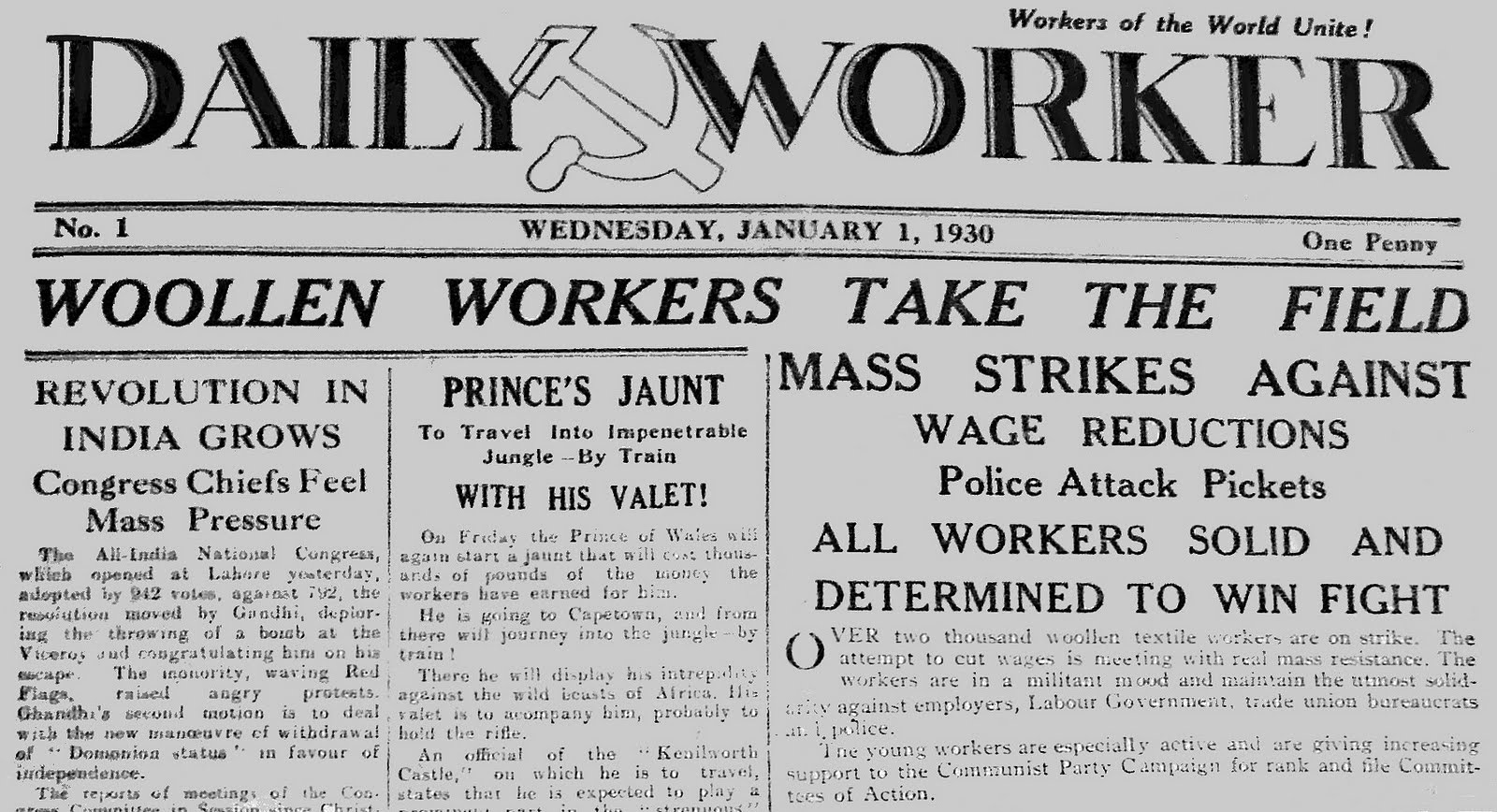
Daily worker 8 November 1961

The Musicians Union stated 17th November 1961 that the policy of Mecca owned Locarno was "one of which Dr Verwoerd (South Africa apartheid President) and the late Adolf Hitler would be proud"

Bradford Trades Council Secretary Councillor Jim Backhouse stated " We are calling upon the ballroom management to treat all its clients alike"

In reply to the local Students Union Mr C. L. Heimann of Mecca stated "nature has made us different"

Students voted 230 - 4 to reaffirm their opposition to racial discrimination and condemning the Mecca colour bar

Bradford and Leeds Students (Leeds University Anti Racialist Committee) were at the forefront of the campaign against the Colour bar.

A planned student march in Bradford against the Colour bar was banned by the Police Chief Constable as was demonstrations close to the Locarno. The Police also issued an order restricting city centre processions to 20 people. Students were threatened by the police with £50 fines or three months in prison if their was a breach in the order by Police Supt P E Keep.

Keith Jones Press Secretary of Students Anti Racialist Committee " This is a complete infringement of our democratic right to demonstrate against the evils of the colour bar"

The first meeting of West Riding Co-ordinating Committee against racial discrimination was held on 22nd November 1961 at 40 St Paul's Road, Bradford

Note

On the 13th January 1962 The Musicians Union introduced a boycott and "Blacked" the Locarno.


By the 30th January 1962 the Colour Bar at Bradford's Locarno had been reversed.


The "Mecca" Locarno at Bradford had been built in 1960 on Manningham Lane, Bradford
. Built at a cost £500,000 to build opened September 1961 and held 2,500 dancers.

Tuesday, September 28, 2010

"Doc" Galin - Middx Teacher & Activist 1965


The "Doc"

By the sudden death of "Doc" Galin —the teaching profession, the N.U.T. and the peace and Labour movements have lost a great personality. Hundreds of us who were privileged to work with him over the fifty years of his active life have lost a great friend.


Looking back over the forty years since I first met "Doc" in the early years of the Middlesex Secondary and Technical Association I can not think of anyone who has won a higher reputation in all the progressive movements of teachers than "Doc".

He was a life-long socialist who stuck to the best traditions and principles of the Labour Party through thick and thin.

He was a stalwart Unionist, one of the pioneers of professional unity. By his sincerity and down-to-earth humanity he won the respect and affection of the N.U.T. Conference.

How often did Conference applaud his humorous, witty but never malicious debunking of pretentious, self-seeking mediocrities! And how many battles did he fight and win for unfortunate colleagues!

"Doc" was one of the founders of the Teachers' Peace movement and stuck to it through the most difficult witch-hunting years when not a few gave up.

He never wavered and never gave up. He was still at it when he died, but he lived long enough to see the causes which he pioneered near the top of the agenda.

He would not expect a finer epitaph.

G. C. T. Giles

Education Today and Tommorrow Volume XVII March/April 1965 Number 4
Price nine pence

Monday, September 27, 2010

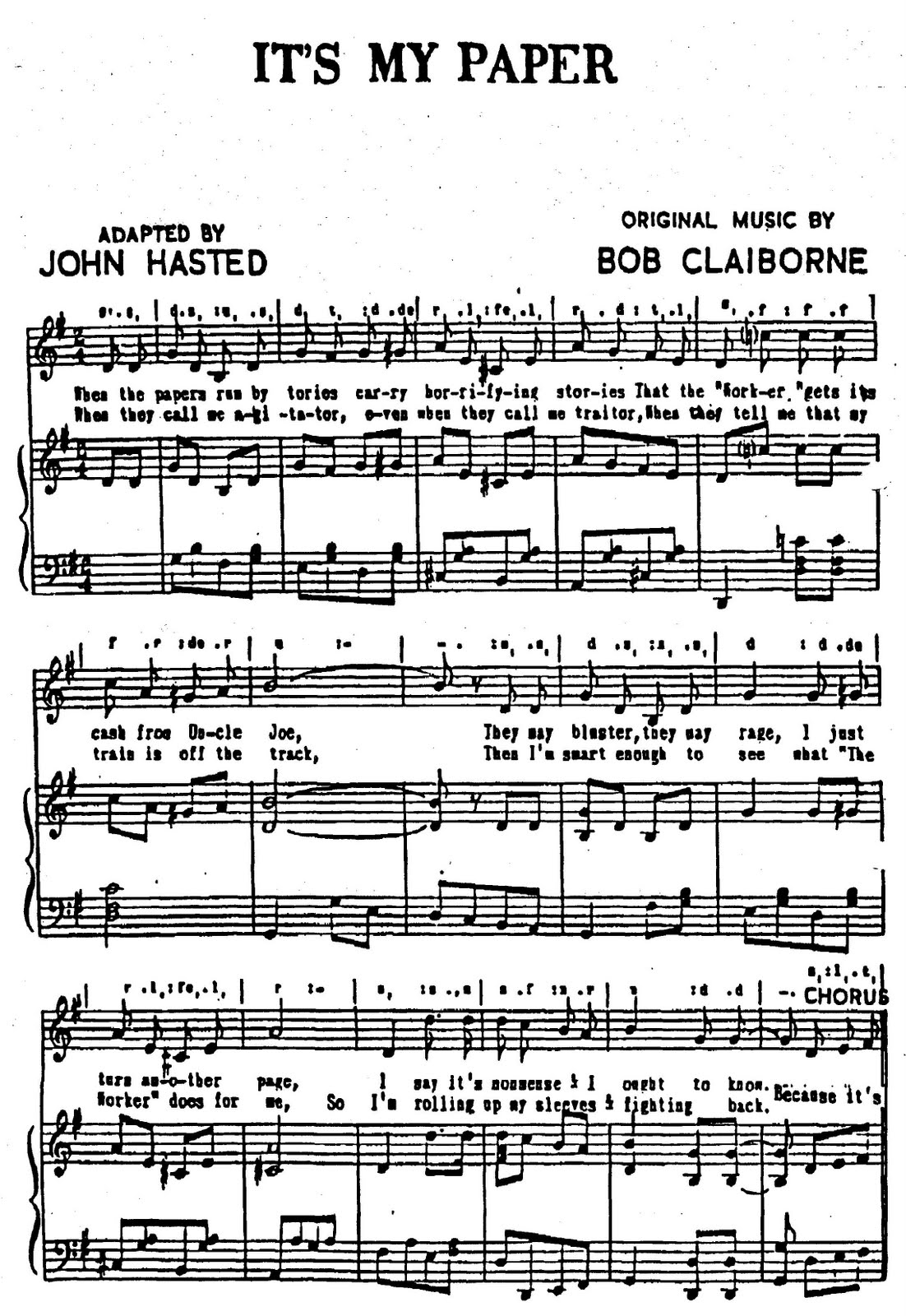
Daily Worker Song - "It's My Paper"


DAILY WORKER SONG

IT'S MY PAPER

When the papers run by Tories carry horrifying stories

That the Worker gets its cash from Uncle Joe

They may bluster, they may rage.

I just turn another page, I Say it’s nonsense I ought to know

Because its

(CHORUS)

My paper, I built this paper,

If you want to know who runs it, I’m the guy!

And no matter what they say,

The truth is here to stay, Because i’ll fight for the WORKER till I die


When they call me agitatator,

even when they call me traitor,

when they tell me that my train is off the track,

then I’m smart enough to see what “The Worker” does for me,

so I’m rolling up my sleeves and fighting back

Because it’s


My paper I built this paper,

If you want to know who runs it, I’m the guy!

And no matter what they say,

The truth is here to stay,

Because i’ll fight for the WORKER till I die


Words by John Hastead 1921-2002

Cira late 1940s

(Click to enlarge music)


* I have heard a recent version song during the miners strike in the 1980s replacing "It's My Paper" with "It's My Union"

Saturday, September 18, 2010

Hillingdon Poll Tax Rebels - Remembered 1989

Hillingdon Labour Councillors opposing the Poll Tax 1989

Nine Labour Councillors refused to pay

including

Brian Hudson
Chris Rogers
Jon Davey
Keith Dobson
Michael Walker
Jane Rose
Richard Farrell
Pete James

Tuesday, September 07, 2010

A Peoples' History of the Blitz


September 7th 2010 marks the seventieth anniversary of the London Blitz. The real story differs from the one so often recounted writes Michael Walker.

The media will dust off the black and white photos and the TV will show old news reels of Londoners clambering out of the dust and rubble, of their devastated homes, smiling for the camera while union jack flags flutter in the wind.


They will record how the King and Queen were pleased that Buckingham Palace had been bombed because “(We) can look the East End in the face”. (no bombs infact landed on the Palace)

Of course these programmes will not record how the working class of London reacted not by deference or defeatism but by fighting back and not just against the Nazi’s who had destroyed their Capital, but against the British establishment.

The revolt was on an unprecedented scale, the East End was in revolt , the King, Queen and Prime Minister, Winston Churchill were booed and parts had become a no go area.


Harold Nicholson, Minister for Information recalled in his diary;

“Everybody is worried about the feeling in the East End of London where there is much bitterness”.

The bitterness reported by Nicholson was not without substance.


The working class communities of Inner London had suffered badly during the depression of the 1920’s and 30s with its high unemployment and slum housing. Now they suffered the heaviest levels of devastation – large parts of Stepney, Bethnal Green, Poplar, West Ham, Bermondsey, Deptford, Lambeth, St Pancras & Westminster were destroyed.


These communities were more aware of the of the impact of “Total war” on society than any other grouping outside the military. They were not only politically aware but had already given up their best sons and daughters to fight fascism in Spain. They knew from first hand report backs the impact of aerial bombing by Germans and Italians of Madrid, Barcelona and famously Guernica. Unlike the Government, they recognised the need for deep underground shelters for the civilian population. The Republican Mayor of Barcelona stated in early 1938 that:


“Instead of small gas and incendiary bombs, for which officials are trying to prepare the British public, the real danger in Barcelona, just as it would be here, came from large explosive bombs”.


“The only way to provide anything like adequate protection was to build enough underground shelters to house the majority of the population”.

However, the government had failed to pay any attention to the significant air raid precaution agitation preferring to leave such matters to local councils, employers or individuals to do the best they could. Those in the know began to strengthen the spaces under their stairwells, opened up disused cellars and dug up parts of their gardens if they were fortunate to have one. Corrugated iron was in great demand.


The authorities feared that once down in the relative safety of underground shelters Londoners may not return to the surface to carry out vital work. This was called “Deep shelter mentality”. This abdication of responsibility was masked by a supposed concern about children falling onto the underground track.

The establishment had backed Franco, Mussolini and Hitler prior to the war. The Daily Mail had backed the British Union of Fascists. Churchill had flirted with support for Franco though he later came to dislike his politics. Even the Queen had said of Hitler’s Mein Kampf “ even a skip through gives you a good idea of his obvious sincerity”. The Cliveden set, established by the Astors schemed to turn Hitler against the USSR, which was the most public peace force and supporter of collective security through the League of nations. One Tory MP Archibald Ramsay leader of the pro fascist Right Club, while detained in Brixton prison was asking questions about the number of Jews in the armed forces and resumed his seat at the end of the war .

Just as this establishment were denying working class communities deep shelter safety, they themselves were moving to the suburbs or the country. London’s exclusive hotels and clubs were busy building deep shelters under their premises.

At the beginning of the War those that spoke out in favour of deep shelters or produced leaflets highlighting the dangers of the Anderson and trench shelters found themselves harassed, arrested and their publications confiscated.


After Dunkirk (June 1940), the German Luftwaffe had concentrated their attacks upon attempts to destroy British air defences, in the Battle that became known as ‘The Battle of Britain’.


However, frustrated at the failure of the German Air Force to secure a decisive knock out, the German command sought alternative targets. Attention turned to attacking Britain’s manufacturing and munitions industries, much of which was based in cities and in close proximity to densely populated residential areas.

On the first night of what became known as the “Blitz” 7th September 1940 the first large scale attack against London was launched by the Luftwaffe involving some 364 bombers, escorted by 515 fighters attacked the Capital.


London’s defences were ill-prepared for such an onslaught and as a result large areas of the Capital were destroyed.

On the first night of what became known as the “Blitz” over 2,000 Londoners where killed or injured (436 killed and 1,666 injured). This compared to 250 personnel killed in the armed forces for the whole of September 1940.


According to Phil Piratin (future Communist Member of Parliament for Stepney)

"That night the East End burned, the dockside was ablaze...........
it lit up a great part of East and South East London....... It was a night when London was ringed and stabbed with fire."

Daily Worker journalist Fred Pateman writing in the 9th September 1940 edition of the Daily Worker stated

“Yesterday, I walked through the valley of the shadow of death –the little streets of London’s East End.....Along the main roads is a steady stream of refugees – men with suitcases, women, with bundles, children with their pillows and their own cot covers – homeless in the heart of London.


The fires caused by the bombing raged out of control for weeks and merely acted as a beacon to further waves of German bombers. London suffered according to the London County Council a further seventy six consecutive nights of enemy bombing.

The RAF retaliated at the bombing of London by bombing Berlin. Infuriated, Hitler declared to his Luftwaffe commanders,"if they think that they can destroy our cities.......then we shall wipe theirs from the face of the earth....". Orders were given to air crews to bomb at "random" and thereby the German air force gave up any pretence of attempting avoid civilian areas.


Ted Bramley London leader of the CP stated in October 1940, In September...."Sometimes six times a day the raiders come. For weeks every night, as regularly as clockwork, from sunset to sunrise. Ten long, weary hours. Hour after hour the drone of the Nazi planes, the pounding of guns, the whistle and scream of bombs. The tense, clenched teeth and hands, waiting for the explosion. The quiet calculation " How near is it? " The deep breath of relief to be still alive. " Did it go off! " " Is it a time bomb? " " How far away? " A desperate effort to snatch some sleep in the cramped space and the foul air of the basements and shelters where we crouch. Then to stagger out to face another day, pale and weary, more exhausted than the night before."

Initially, the civilian population had attempted to take refugee in government prescribed trench shelters but these soon filled with water, the street level shelters had been destroyed and the famous back garden Anderson shelters, made of corrugated steel, offered only limited protection from bomb blast and splinters.

Anderson shelters were named after Sir John Anderson who stated in the House of Commons in 1938, "I do not think we are prepared to adapt our whole civilisation, so as to compel a large proportion of our people to live and maintain the productive capacity in a troglodyte existence deep underground" and on 12th June 1940 "I am devoutly thankful that we did not adopt a general policy of providing deep and strongly protected shelters".

How the working class paid for such stupidity, as Londoners were, according to Ted Bramley, "uprooted, blasted from their homes, scattered over the face of Britain" . At Kennington a trench shelter took a direct hit killing 104.

The few deeper shelters, which were situated mainly underneath large warehouses, once deserted, were now full to overflowing. They were poorly lit, wet, and unsanitary. People lined up from 12 in Stepney to enter the Tilbury shelter, originally planned for 1,600 now holding 10,000. Meanwhile, Godfrey Phillip’s shelter in the City, a shelter for 3,000 was locked every night at 5.30pm. Ted Bramley estimated another 200,000 safe shelter places were available in the City, but locked at night.


Many Londoners were forced to “trek” from East London to North London, West London or South London and even the Kent countryside (Chislehurst Caves in the side of the North Downs). Others took coaches into the countryside to sleep by the roadside at a cost of 2s 6d.


By mid November 1940, it was reported that some four out of every ten houses in the London Borough of Stepney had been destroyed or damaged. Many factories suffered a similar fate.


The Government had failed seriously to listen to the Communist Party advice about the need for a comprehensive and universal air raid precautions, preferring to leave it to individual councils, employers or individuals to do the best they could. Yet many of the Government’s own appointed observers such as the famous scientist J B Haldane were pressing for deep shelters and came up with many novel ideas to defend the people.


Ted Bramley states
"The real reason is to be found in their callous refusal to provide for the people and their cynical disregard for the suffering and lives of working people. They value the lives of the workers cheaply. There are 800,000 unemployed - left on the scrap heap. So long as their own families, their own privileges and profits are secure they don’t care".

One look at Winston Churchill lunch and evening meal menu, shows that he for one was not ready to make some sacrifices.

It is unsurprising that faced with whole sale destruction, looting and a lack of support, working class communities took it in their own hands to stop the looting, secure alternative housing, shelter and when Churchill or the Royal Family turned up to show sympathy they were booed and pelted with rubbish..


SHELTERS FOR THE RICH

Meanwhile, the rich secured access to their own private shelters. None was more famous or elaborately decorated than the shelter beneath the Savoy Hotel, which even boasted nurses on standby.

During the early days of the Blitz Government controlled media tried to show that life in London was carrying on as normal, and there was much coverage in the press of people going to parties, dining out and clubbing in the West End. Buckingham Palace had been hit, but in reality involved minor damage to out houses.


This was all at odds with the experience of the people in the working class areas of London, who were now being systematically bombed day and night.


On Saturday 14th September 1940 to highlight the plight of the people of Stepney, the communist councillor Piratin took fifty workers, including a group of what Time magazine called
“ill-clad
children" from Stepney and burst into the Savoy Hotel.
Within minutes and with the help of sympathetic waiters the group had invaded and occupied the Savoy Hotel shelter, stating “ if it was good enough for the rich it was good enough for the Stepney workers and their families”.

The next day the press was full of stories about the audacious occupation of the Savoy Hotel shelter and the terrible conditions of the shelters in Stepney.

At St Pancras, a picket was organised of Carreras, the tobacco factory, demanding its shelter - capable of holding 3,000- be opened to the public at night. In Walthamstow councillor Bob Smith went with some homeless "bombed out" families to occupy empty houses. Similar actions took place in Chiswick (Heathfield Court) and at Kensington.


OPEN UP THE TUBES

A the beginning of the Blitz, the doors to the Underground stations were surrounded by barbed wire and systematically locked by the Police during air raids, in order to stop civilians seeking refuge.

One Kennington resident stated, “The public shelter was horrible, smelly, it had a mouldy slab of concrete for a roof. But you couldn’t go anywhere else as the Oval station was full of barbed wire they wouldn’t let you near it”


Finally, one night (some state 8th September) at Liverpool Street underground station, with the East End shelters overcrowding due to intense bombing, huge crowds of East Enders forced entry and surged down to the platforms.

Warren Street, Goodge Street and Highgate underground stations were "broken open" and according to Ted Bramley "every inch of stairs, corridors and platforms taken by the people. Working men, women and children of all types and trades, from all parts of London, including soldiers and their families, were and are united in their resolve to share the Tubes".


At other underground stations crowds of people organised by the CP swept past police guarding the stations and used crowbars to force open the underground station network to thousands of Londoners seeking refugee from the bombs.


The people established shelter committees in order to secure proper conditions such as provisions for feeding and amenities from the authorities.


Finally, Herbert Morrison the Labour Home Secretary in the War time Coalition was forced to reconsider the issue of the underground being used for shelters and finally allow civilians to use the underground for shelter.


By the end of September 1940 it was estimated that 79 underground stations catering for 177,000 people were being used for shelter at night.

WOMEN ON THE FRONTLINE


Undoubtedly, during this period of the War it was the East End and it's women in particular who were the front line. It was they who were forced to search for shelter for their families, salvage possessions from bombed out houses and find enough food for their families, despite rationing and a 25% rise in the cost of living. This was in addition to organising childcare so that they could carry out vital war work.

At its peak 1,500 fires raged across London during the Blitz. During the War over 20,000 Londoner's were killed including 327 firemen and women, as well as numerous Anti Aircraft personnel, nurses, police, rescue, salvage specialists and bomb disposal staff.In just two nights in April 1941 148,000 London homes were damaged by German bombs. By the end of the war incredibly only one house out of ten had not received some kind of bomb damage.

Despite the bravery of Londoners’ and the British people, it would take another year after the Blitz (December 1941) before the American’s joined the war, until then the full force of the fascist military was waged against Britain and our Russian allies

The German bombers continued to bomb London for the rest of the War until the front was pushed back so far making it impossible for raids to be effective. At that point Hitler launched his unmanned rockets known as the V1 and V2.

In total, Nazi bombs killed 40,0000 in Manchester, Liverpool, Glasgow, Belfast, Cardiff, Birmingham, Southampton, Bristol, Portsmouth, Bath, Plymouth, Exeter, Nottingham, Newcastle, Sunderland, Middlesbrough, Hull, Ipswich and Norwich.

The official date for the ending of the Blitz is 11th May 1941.

The blitz is a special moment in our working class history. Troops fighting desperately on the war front were in constant fear for the safety of their family on the home front.

As a result of these sacrifices the Nazi’s never got to fly the swastika from Senate House, in Central London as they had planned to use it as their English Head Quarters of the Third Reich

When the War in Europe finally ended in 1945, the people of London as elsewhere in the country swept away Churchill and the establishment and gave victory to a landslide Labour Government.

The failure of the government to act is part of our history. That failure led to many unnecessary casualties. The failure of the rich to share the burden, evidenced throughout the economy did much to raise consciousness of class. Most of all it clarified that victory over fascism would only arise from a Peoples’ War in which the people took the lead.


Maya Angelou - History despite its wrenching pain cannot be unlived but if faced with courage need not be lived again-


Michael Walker


Friday, August 13, 2010

Jimmy Reid - 1952 Apprentice Strike

JIMMY REID 1932-2010
WORKING CLASS HERO


"Reject the insidious pressures in society that would blunt your critical faculties to all that is happening around you, that would caution silence in the face of injustice, least you jeopardise your chances of self promotion and self advancement"
.

Jimmy Reid 1971

1952 Apprentices Strike

Jimmy Reid (Scottish Y.C.L.) Congress 1952


On Wednesday, 2 April 1952, the lads on the Clydeside, after being on strike for 31 weeks, decided to resume work, with the full inten
tion of continuing ithe strike, failing a satisfactory reply from the employers before April 20.

During the strike the employers used every means to try and split the unity of the lads. They sent letters to their parents, posing as philanthropic gentlemen only interested in the welfare of the lads! When this failed, the employers began threatening the lads
eligible for National Service with cancellation of their deferment. One employer was rash enough to send postcards threatening wholesale cancellations of the deferments.

The response of the lads was, to paraphrase Churchill, "prompt, resolute and effective". They held a demonstration through the streets and publicly burnt the postcards. Certain right-wing union officials tried to undermine the movement among the lads.

They did everything to try and prevent action being taken. But the apprentices ign
ored them and went on strike.. Yet this did not affect their attitude to the union. During the course of the strike, 1,000 took application forms for the A.E.U.

The apprentices on the Clydeside are now aiming at 100 per
cent trade unionism. Communist Leadership This feeling was not generated overnight. It was a direct refle
ction of the growing discontent amongst young people at the gradually worsening conditions they are asked to live under.

We can only bring into being and develop such a m
ovement under the leadership of the Young Communist League and with the assistance of the Communist Party, It was explained to the lads on the Clydeside that indignation was not enough, the £1 would not be handed to them on a plate, and they would have collectively to organise and struggle against the employers.We now have on the Clydeside a collective movement among the apprentices which has its roots in every factory in Glasgow. This movement has left deep impressions on the lads. It has led to a re-awakening of the class-consciousness amongst these young people. It was the first time they had participated in s class battle.

They now appreciate their own strength. It is one step from that to realisation that once workers move into action they represent an invincible force. We also learnt very valuable political lessons in regard to the press. Many had illusions
about the press which were soon shattered. The lads were q
uick to realise that if the press wrote lies about them, they wrote lies about a lot of other things.

When on demonstrations, they always wanted to march past the newspaper offices and boo them. The boys are beginning to realise the tie-up between the press and the Tory Party. This was one of the most valuable lessons they learnt.

Ready to Defend Conditions

This movement, above all else, has shown the readiness of y
oung people, given proper leadership, to go into action in defence of their living standards, and on all issues which affect them.

The decision taken at this year's annual Junior Workers Conference of the A.E.U. declares for the reduction of service to twelve months, and that to be served inside Britain. This indicates that the people, given proper leadership, are prepared to move into action on all issues which affect them.


NOTE 1952 APPRENTICES STRIKE SPREAD

The strike soon spread to England and an estimated 40,000 apprentices went on strike for better wages. After three and a half weeks the strike ended with a significant pay rise across numerous sectors.


JIMMY REID 1932-2010

Jimmy Reid born on 9th July 1932 in Govan, He left school at 14 to work in the yards and led his first strike, of engineering apprentices, aged 19 with Bristol Polar Engines; before long he was a shop steward. Initially a Labour supporter, he cut his teeth on rent strikes in Govan, joined the Young Communist League in 1950 (serving on its executive with Arthur Scargill) and became a Clydebank Communist councillor. Reid came out of the work-in as shop stewards’ convener at the Marathon rig-building yard, Clydebank — which he remained for several years despite being a national figure.

Reid became the Scottish Secretary of the Party in the late 1960s.

Reid's involvement with the Upper Clyde Shipbuilders (UCS) came when he returned to his trade in the Govan Division of UCS in 1969, moving to the John Brown Division in Clydebank where he married Joan Swankie and was elected as one of the four Communist Party councillors on Clydebank town council.

The semi-nationalised UCS had been created in 1968 by Tony Benn to rescue five loss-making shipyards on the upper Clyde.

The Conservatives came to power pledging to kill off industrial "lame ducks" and in June 1971 they withdrew trade credits, pushing the company into administration.

Some 6,000 workers were scheduled to lose their jobs within three months.

Under the leadership of Reid, Airlie and Barr the co-ordinating committee of the joint shop stewards refused to accept this outcome and occupied the yards.


His most prominent claim to fame arose from his joint leadership of 8,000men at the Upper Clyde Shipbuilders work in from June 1971 for fourteen months, even John Lennon of the Beatles backed the work in with £5000

Students at Glasgow University voted him Rector.

He stood three times as a Communist candidate in General Elections for Dunbartonshire in 1970, 1974 (twice). In 1974 he tripled the Communist vote. Securing inoneelectionover 6,000 votes.


Reid joined the Labour Party in 1979 and into new century was still involved with the Scottish Left.

Jimmy Reid on election to position of Rector at Glasgow University in 1971 stated

"Reject the insidious pressures in society that would blunt your critical faculties to all that is happening around you, that would caution silence in the face of injustice, least you jeopardise your chances of self promotion and self advancement"

Jimmy Reid died Rothesay 10th August 2010

UCS Statement


"We are taking over the yards because we refuse to accept that faceless mencan make these decisions. We are not going to strike. We are not evenhaving a sit-in strike. Nobody and nothing will come in and nothing will go out without our permission. There will be nohooliganism, there will be no vandalism, there will be no bevvying, because the worldis watching us."

Jimmy Reid 1971

Michael Walker

Addition

THE CLYDESIDE APPRENTICES' STRIKE 1952.

THE CONFERENCE.

January 27 1952 saw an event that set the ball rolling for the first major apprentices' strike since 1937, before the second world war. On that Sunday the Young Engineers Clydeside Conference was called. It took place at 1pm in Community House Clyde Street Glasgow, wages and conditions being the main subjects up for discussion. A Clydeside Apprentices' leaflet claimed, “Apprentices pay the same as journeymen for meals, travel, tools and overalls, etc.” The conference also called for Action Committees to be set up in every workshop and to pursue a claim for £1 week increase on apprentices' wages. At the conference there were 31 firms represented with 114 apprentice delegates representing all trades in engineering and shipbuilding.

Committee secretary, Jimmy Reid, stated, ”--it is not enough to feel indignation, but it was necessary to translate it into action. The committee supported 100% trade union membership among apprentices and stated, “We are the skilled tradesmen of tomorrow---and it is in our hands that the future prosperity of this country depends--.” At this time young lads were being sent to fight in Korea, Egypt, Malaya etc.

A RISE IN FEELINGS.

A delegation from Fairfield Shipyard, Govan, Glasgow, stated that the apprentices there believed that the next step forward was a token strike and demonstration on the streets of Glasgow. “We will make the bosses shake when they see 1,000 apprentices marching through the streets of Glasgow.” Some working conditions were described, saying, apprentices were working on water tests, up to their knees in muck and rust and earning 24 shillings a week.

FIRST DAY OF ACTION.

The first one day strike and demonstration saw 5,000 apprentices march through Glasgow city centre. There was a roar of cheering when the demonstration was informed that 1,200 Greenock apprentices had stopped work in solidarity. At the Hydepark Locomotive works Springburn Glasgow, the management tried to get the apprentices to go to an arranged film show instead of striking. It failed miserably.

Eric Parks of Weirs Pumps Cathcart Glasgow said he was called before the apprentices' supervisor who said, “Eric my boy, you've fallen down in my respect. The employers are making sacrifices in our works--.” Eric pointed out that Weirs had made £1.25 million profit last year, or £6 per head per week.

A comment by a member of the government that a loaf of bread might soon cost 10/- (ten shillings, -50p). This was taken up as, 3 loaves of bread a week—an apprentices wage.

THE LONDON DELEGATION.

A delegation of apprentices interviewed employers representatives in London and it was stated in the press, that these young engineers didn't fear important looking gents in Anthony Eden hats and impeccable suits. On this London delegation were Eric Parks, Jimmy Reid, John McColl, and Ernest Skilling.

SPREADING.

In Aberdeen 600 apprentices noisily marched through the city streets, the call for strike action was now spreading. There was now apprentice action in Glasgow, Greenock, Aberdeen, Manchester, Shefield and London.

THE RESOLUTION.

At a delegate conference on Sunday March 2nd a resolution to call a strike for Monday March 10th 1952 was carried by 95 for and 5 against. The resolution stated, This conference of delegates representing apprentices from all over Scotland, demands a reply not later than 12am of Friday March 7th to the claim of the Confederation of Shipbuilding and Engineering Unions for a £1 per week increase in all apprentices wages. An unsatisfactory reply or a failure to reply will be regarded as deliberate refusal to reach agreement and will result in strike action commencing on Monday March 10th at 11am..

BULLISH ATTITUDE.

The attitude of the apprentices was very bullish with speaker after speaker emphasising that apprentices wanted strike action in the belief that only militant action would lead to a successful campaign. At the conference Jimmy Reid stated; “Before the lads went into action the employers had no need to worry about them, but now these people are sitting up and having to take notice of the apprentices,--- the lesson is clear.” Eric Parks reminded the conference of the huge profits being made by the employers and said; “We must see the necessity of forming apprentices' committees in every factory as the main form of organisation----it is better to suffer a little hardship than to grovel on our bellies and accept the miserable and intolerable conditions of the present time.”

THE STRIKE.

On Wednesday March 6th 500 apprentices from Caledonian Shipyard Dundee staged a half day token strike in support of the £1 claim. Other action, demonstrations and marches of support sprang up in London, Manchester and elsewhere.

No satisfactory answer arrived so the strike went ahead on Monday 10th March. With 5,000 Clydeside apprentices walking out at 11am that day. By March 22nd over 17,000 apprentices in engineering and shipbuilding and other key industries were on strike. At this period Birkenhead, Manchester and Shefield joined the strike. There was union and financial support form workplaces, some workplaces were levying workers 2/6 (two shillings and sixpences,12 and a half pence.) to 5/- (five shillings, 25 pence.) Workers at the Rolls Royce Works donated £150.

By March 25th nearly 20,000 apprentices were on strike. March 26th Glasgow shop stewards decided to take token action to support the apprentices strike. In Edinburgh where apprentices had decided to go back, they walked out again the same day 800 strong. Harland and Wolf's Belfast now joined the strike with over 1,000 apprentices walking off the job.

That week there was a march and demonstration in Glasgow which saw 5,000 apprentices march through the city streets. By this time Rolls Royce had donated £500 to the strike fund.

THE RETURN TO WORK.

Approximately 20,000 apprentices who had been on strike for more than three weeks went back to work on the understanding that it would speed up negotiations with the employers. Delegates representing 14,500 took decisions for future action should the employers fail to give a satisfactory response. The conference adopted a strong worded resolution which expressed determination to carry the fight to a successful conclusion.

Pat McCauley, secretary of the Greenock strike committee stated; “This is only the first round in the struggle. The lads have shown their mettle and shaken the bosses. If we don't get a reply to our claim shortly, the bosses must be held responsible for what will follow--- this is a tactical retreat not a defeat. The boys are still in fighting mood.” On Friday April 25th apprentice delegates from Clydeside, Aberdeen, Manchester, Shefield and York decided in Glasgow to accept, under protest, the recent wage award agreed between the trade unions and the employers. The conference stated that this was only the first stage in the struggle for better conditions.

DISCONTENT.

Eric Parks, secretary of the Clydeside Apprentices committee said that the amount employers gave which was higher than their first offer, and the fact that they negotiated a separate wage claim for the apprentices at was entirely due to the militant action taken by the lads in the workshops and shipyards. The fact that there had been a separate negotiated wage claim for the apprentices represented a terrific victory for the lads. Previously the apprentices wage increases, if any, were simple tacked on to the end of the wages agreement made with the journeymen.

The general feeling among the apprentices, especially the 1st. 2nd. and 3rd year lads was one of discontent. A discontent that said it should be accepted under protest and immediately make arrangements to go forward for a new demand.

THE AWARDS.

Age-- Award.

15-- 5s 6p

16-- 6s 5p

17-- 7s 4p

18-- 8s 3p

19-- 10s 1p

20-- 11s

The 10s and 11s award was a fair bit of money to many apprentices and this may have been the aim of the employers by making it less likely that the older lads, who would be journeymen in a year or so, would be less likely to support further strike action.

Posted by John Couzin.

Thursday, June 24, 2010

Johnny Ralph - Socialist & Champion Cyclist


Johnny Ralph

John "Johnny" Ralph was a champion cyclist and a committed Communist Party member.

He was born on 6th October 1931 at Hammersmith hospital and his family lived locally in the Acton and Hammersmith area. His father was Fredrick Ralph, a motor fitter for Wimpey, and his mother Bessie originated from near Poole, Dorset.

At the start of World War Two, he and his sister were evacuated to Dorset. After a period of time, his mother sent him and his sister to live at Johnny’s grandparents. They also lived in Dorset– Johnnie’s grandfather was a fishermen by trade. While in Dorset, he attended school at Shipstall, Wareham, Dorset, which he later recalled was a long walk from his grandparents’ house

When Wimpey’s, the construction company that Ralph’s father worked for, relocated to Denham, Buckinghamshire, Frederick was able to move there. Wimpey had built huts for staff near to the aerodrome. Johnny and his sister joined their father and the boy joined the Uxbridge Wheelers Cycling Club, which had been established in 1936.

It was at this that Johnny met his future wife, Jean Hunter, in around 1948. Jean came from Uxbridge and was a local nurse; she later worked as a manager in Hillingdon Social Services.

Later Johnny undertook his National Service; during this period, he was based at Hendon and spent the majority of his time racing and training for RAF cycling team. He described his national service, unlike many others, as a “cushy number” – although this was not a general experience!

After National Service Johnny undertook a motor fitting apprentice but later secured a job as a laboratory technician and instrument maker at Taylor Woodrow at Ruislip Lane, Uxbridge, Middlesex joining the ASTMS trade union.

His cycling was going from strength to strength but he needed more track racing experience and subsequently joined the highly prestigious, Regent Street-based cycling club, Polytechnic “Poly” around 1949. This was a large club, with over two hundred members of which half were racing cyclists, knows as “Poly-boys”. The team-kit colours of were a blue based jersey with a red band in the middle and they raced at Herne Hill and Paddington track.

By the mid 1950s, Johnny was working his way up to the very elite of his sport, excelling in sprint and five and ten mile races. He participated in national championships and was a team pursuit champion, while regularly cycling for England.

Dennis Seacombe described Johnny as “very good rider”. This may have been an under-estimation! However his misfortune was to be cycling at a time when the great Reg Harris was at the very pinnacle of his success, for he often overshadowed Johnnie Ralph’s many achievements.

He also had the misfortune of being selected to race for England at the Empire games in Cardiff in1958, but a puncture robbed him of that opportunity for victory. Worse still, because of this injury, Johnny was not able to work for a living and Polytechnic agreed to make a relatively small donation to his wife to help them make ends meet.


He represented England at events in Germany, Denmark and France and he was a member of the "Poly" team pursuit team that won the national team pursuit in 1957

But this was to prove a bitter pill for Johnny. He had joined the Communist Party and now wished to ride for the famous socialist Clarion Cycling Club. But the Polytechnic Club demanded the repayment of the donation and, when Johnny understandably refused, the Poly Club went to the Cycling Unionto ban him from racing. They were able to pull this off, leading Johnny to feel that all the power in cycling was concentrated in the hands of those with “the right hand shake”, a reference to Masonic influences.

Despite the ban on him racing, Johnny continued training younger cyclists at his favorite track, Palmer Park, Reading, one of the oldest in the country.

In the 1950s, John secured a job at Fairey Aviation at Park Way Hanger Lane, later moving to Fairey, Hayes, West Middlesex. Whilst there, Johnny met a number of leading Communists who worked for Fairey, such as Frank Foster and John Mansfield. However, as Johnny was working on a guided missile system, the company was less than pleased when Johnny announced he was visiting the GDR (East Germany) to compete in a cycle race.

Totally out of the blue, Johnnie was offered a job at a small company on much better terms and conditions. So, he left Fairey but when he arrived at the new company the potential contract and job had mysteriously disappeared. Johnny then tried to secure his old job back at Fairey Aviation but soon realised he had been `blacklisted’. From then on, he recalled, he would often secure a new job, only to be told later that his references were not acceptable. In the end, despite being a skilled man, he was forced to undertake window cleaning to earn a living. Later, he secured a job with the LondonCo-operative transport maintenance department based at Yiewsley and then a post back at Taylor Woodrow.

Johnny Ralph had been greatly influenced by a fellow Uxbridge cyclist and West Drayton trade unionist, a veteran committed socialist, Bob “Digger” Downs. There were many others, such as Communist cyclists like Fred Riley of Slough, a Communist Party full-timer; Harold Goodwin, a former merchant seaman and Party member; Bob Bragan, a Geordie and Communist teacher at Harlington Primary School, and his wife, Edith, who hailed from Birmingham. There was Stan & Nora Emeversley of Ivor; Stan being a former South Walesminer who was suffering from pneumoconiosis. Harold Thomas was another, and there was Dickie Bond, who had cycled in the Workers’ Olympics in the 1930s. (See separate entries for many of these personalities.)

Johnny sold the Daily Worker and later Morning Star on a regular basis on Saturdays outside the Uxbridge tube station, as well as standing as a Communist Party candidate for Hillingdon East. Along with many progressives in Hillingdon in his later years, he worked for John McDonnell, MP, from when he was first a GLC councillor for Hayes.

On 8th July 1984, Johnny and his eldest son Stephen went for an early morning ride while on holiday in Dorset. When descending Corfe Castle, he was involved in an accident with a car and caravan which had failed to see either him or his son. As a result, Johnny Ralph was severely injured, tragically dying in hospital on the 11th July 1984.

He was cremated at Uxbridge and his funeral was very well attended by local dignitaries, including leading trade unionists and Communists such as Mike Hicks (Print Union - living in Hayes), Fred Riley, and Harold Goodwin.

Later an Uxbridge pedestrian and cycle crossing – possibly in Cowley Road– was named after Johnnie. Surprisingly, but much to his credit, local Tory leader of the council, Andrew Boff (now a GLA member), who had known John and his son, was associated with this.

Tragically, one daughter (Lisa) was killed as a pillion rider on a motorcycle. Johnnie’s oldest son, Stephen, has gone on to a successful career in computers and another son is a director of youth and community services.

His wife, Jean, who went through all the tribulations of Johnny’s many victimisation's as well as his triumphs, continued to be an ardent defender of her husband’s memory.


Photo- Johnny Ralph winning the Cooper Cup at Herne Hill 1957


Many thanks and apologies to Jean Ralph for corrections