Monday, July 28, 2008


BRASSED OFF

Having watched Bob Crow, General Secretary of the RMT union lead his delegation down, Tolpuddle High Street in 2008, with the RMT Easington Colliery Band.

I thought about posting a brief article on Brass Bands and the Labour Movement.


While many mining collieries had their own bands, many run and organised by the miners union their is few other examples of trade unions establishing Bras
s Bands, the only other examples I can find is the Doncaster National Union of Railwaymen (NUR) Brass Band which was established around circa 1938.

A Langham Labour League band from 1871 (this was likely to have been an agricultural workers union band). The Co-operative
movement also had numerous Brass Bands, many of them successful.

The Gas Workers Union in the late 1880's also
seem to have helped establish a number of bands and today UNISON sponsors the Kinneil Brass band in Scotland, founded by the miners of Kinneil Pit and the workers of Wilson's Kinneil Iron Works in their home town of Bo'ness, West Lothian in 1858.


The Milnsbridge Socialist Brass Band (Huddersfield) was active in the early 1930's and surely the Independent Labour Party (ILP) or the Clarion's also attempted to establish Brass Bands. Preston Clarion had a band circa 1911


I have seen reference to a Transport & General Workers Union Brass Band ? but not been able to confirm. Photo right is of a special Silver Jubilee TGWU band from 1947.
I have seen reference to a Post Office Engineering Union band from Stockport circa early 1970's

Their was a Liverpool Socialist brass band


Ireland now has only one trade union Brass Band (CWU), after the disbandment of the world famous Irish Transport & General Worker Union (ITGWU) Brass Band (lat
er known as SIPTU Brass Band) around circa 2005.

HISTORY OF THE IRISH TRANSPORT & GENERAL WORKERS UNION BRASS BAND
By Eileen King "ITGWU Liberty Magazine" June 1984


The Irish Transport & General Workers’ Union Band (ITGWU) was formed in 1919 (picture above). Senator Thomas Foran, General President of the Union, decided that a Brass and Reed Band would be of great assistance in extending Union organisation in Dublin. He already had experience of two previous bands which had been intimately connected with the young Union. One was a fife and drum band, affectionately referred to as “The Suffering Ducks”, and the other a pipe band with which Tom Kennedy (later a General Officer of the Union) was closely associated.

The Dublin dockers were interested in Tom Foran’s idea, and a committee of Dublin No. 1 Branch members was set up to raise the necessary funds to equip, clothe and train a band. The collection to raise the money was undertaken during the latter part of 1918. An interesting point about this collection, which ranged mostly over the docks and local employments, including carriers was that the carriers negotiated an increase of 7/6d per week in October, 1918 and, led by the late Jack Clarke (a member of the fund raising committee) and his eight fellow workers in Suttons, a large number of the carters subscribed their first week’s increase — 7/6d to the band fund.

Financial help came from Union funds too and the organisation of a series of “Housey-Housey” games was — according to a man who was active in the project - another source of revenue.

Early in 1919 the Band was formed, instruments purchased and rehearsals begun. The first uniforms of the band were made by the Abbey Street Co-op and designed and paid for by William O’Brien who was then Acting General Secretary of the Union.

The first public engagement undertaken by the Band was in May, 1919, when it participated in the May Procession at the church of the Oblate Fathers in Inchicore.

There were veterans who remembered how the Band practised in the drill hall of the old Citizen Army ... of the raid on Liberty Hall in 1920 by the Black and Tans who smashed up most of the instruments, and of the period in 1924 when it seemed doubtful if the Band would be permitted to survive. But survive it did and played on to become the only band to win the Royal Dublin Society Band Contest two years in succession.

During the Anglo-Irish war the Band was prominent, participating in many parades and exercises. They were frequently in trouble because of their activities, and were often stopped by the Black and Tans and ordered off parade. An amusing story is told of a parade they had in Finglas. A contingent of Tans stopped the Band and the officer in charge instructed them to cease playing Irish marches. The Band Sergeant agreed and instructed the Band to play the “Wearing of the Green.” The officer applauded and remarked ... “Isn’t that much better than your b.... Irish marches?”.

In 1932 the Band went to Belfast to support William McMullen (later a General President) who was contesting the Stormont election. On leaving Belfast they played the Irish National Anthem at the railway station, and as a result a large number of them were arrested. It was only with great difficulty that William McMullen succeeded iri getting them released the following day. A ban was then imposed on the Band’s re-entry to the Six Counties, but it was lifted in 1948 to allow it to attend the monster 1798 Commemoration in Belfast that year. Needless to say, at the railway station on leaving Belfast, history repeated itself!.

It is worthy of record that in those early years, when the Irish Army Military Band was first formed, twenty-one members of the ITGWU Band were accepted as key instrumentalists and went over en bloc.

Since its formation in 1919, up to 1936, the Band was administered by a Committee from the Dublin No. 1 Branch. Since 1937, it has been administered by the Dublin District Council of the Union.

It was in 1937 also that Adolf Gebler was appointed as Musical Director. He held the degree of Pedagoge de Musicke from a German Conservatoire of Music, and from that year until 1957, when he left to take up an appointment in San Francisco, the Band settled down to a really excellent and fruitful period. It attained a very high standard which won it many collective and individual prizes.

Up to August 9, 1954, the official title of the Union Band was The Irish Transport & General Workers’ Union Prize Brass & Reed Band. Since then the title has be-come The Irish Transport & General Workers Band World Prize Brass and Reed Band. This came about as a result of an invitation to the Band to represent Ireland at the Wereld Muzierkconcours (World Musical Competition and Olympiad) 1954, to be held in Kerkrade, Holland, in August of that year. (This contest is held every four years.)

The journey to Holland wasn’t without its troubles. The Band and officials were scheduled to arrive in Kerkrade at 9.45 p.m. but didn’t arrive until the early hours of the following morning because, first of all, they got lost at Rotterdam and, secondly, they were held up for an hour and as half in a train break-down due to an electrical storm.

When the party eventually arrived at Kerkrade it was both too late and too early to allocate the individual members to their respective abodes for the duration of their stay. They had been given up for lost and the reception committee had gone home. However, the local police very kindly opened wide the station doors and took them “into custody”. Some of the party (including the Musical Director) were so tired and worn out that they slept in the cells! However, by 6.30 a.m. everything was sorted out and the party accommodated.

In spite of their misadventures, the Band went on to win 1st Prize in the “Excellence Section”; 1st Prize in the “Contest of Honour”, and 2nd Prize in the marching competition. This achievement in Holland was a triumph not only for the Band’s Musical Director, Adolf Gebler, but to the hard work and enthusiasm of the bandsmen over a very long period.

A learners” class was established around 1956 to provide the way and the means of ready-made replacements for key instrumentalists who, perhaps, through force of circumstances or; other reasons might sever their connection with the Band back again to Kerkrade in 1958 — this time with new Musical Director, Joe Murphy who had replaced Adolf Gebler where the Band added to its laurels by winning two second prizes.

In 1962, John Carroll (now General President of the Union) became Musical Director. He had been a member of the Band since he was 14 years of age, and chairman from the age of 16. Another milestone — the Band had been an all-male one since its formation, but in 1962 John Carroll changed all that and took on two lady members.

In 1969, Michael Rogers became Assistant to John Carroll, and Junior Band Coach. He was also responsible for establishing the children’s recorder band, which is still flourishing.

In 1970, what was called the Egerlander Band was formed. It comprised 12 members from the Band proper who, in colourful Bavarian-type costumes, played tuneful and rousing music in the “beer-garden” genre. This Band was very popular in the 1970’s, playing mostly for charities. It seems to have gone to ground in recent years, which is a great pity.

The list of achievements by the ITGWU World Prize Brass & Reed Band is quite formidable and space does not allow me to list them specifically. Suffice it to say, however, that the Band excelled itself down through the years by winning many competitions and championships. In addition, many of the Bandsmen won individual gold and silver medals in solo competitions. Three more visits were made to Kerkrade — 1962/1966/1970, with John Carroll as Musical Director, and on each occasion the Band came back with prizes, both in the concert section and in the marching competition.

Due to his many commitments, John Carroll left the Band about five years ago, and was replaced by Jimmy Cavanagh as Musical Director.

The standard of musicianship of the Union Band has long been acknowledged as top class, and the honours which have come its way in competition at local, national and international level bear testimony to this.

From its foundation, the Band has been a regular participant in labour, trade union and national parades and ceremonies. Ever since then the Band has continued its labour and trade union activities and has visited most centres of the country in which the union has branches on many occasions down the years in connection with commemorative ceremonies, industrial parades and disputes and other major industrial events.

The bandsmen always have been drawn from the ranks of the workers; some of the boys from the Artane Band have graduated to the uniform of the Union’s Band, but throughout its long history it has been an amateur organisation of working people, kept alive through the enthusiasm of its members and the interest of Union personnel.

The ITGWU (SIPTU) Brass band closed circa 2005


Thanks to Andy Newman for Tolpuddle/RMT photo

Saturday, July 26, 2008

Hayes Cottage Hospital Occupation office based at the hospital.

Steve Clare taking credit for his and 20 other supporters (including an 80 year old) being thrown out of the District Health Authority meeting held at Harefield Hospital.

The Police man handled campaigners down the stairs, even to disgust of local Tory Councillor Elsie Boff.

This event was a turning point in the campaign and soon after the management were forced to drop plans to close the hospital.

the hospital was occupied on the 25th October 1983

Wednesday, July 02, 2008


LAND NATIONALISATION SOCIETY

The Pioneer Yellow Lecture Van of the Land Nationalisation Society visited Southall in July 1905, a good attendance was present for the lecture on the objective of the Society.

The Society was founded by Alfred Russell Wallace in March 1881, its journal was the "Land and Labour".

Alfred Wallace is best known as the codiscoverer, with Charles Darwin, of evolution by natural selection.

Alfred Russell Wallace was born on 23rd January 1823 at Usk, Wales and died on 7th November 1913 at the Old Orchard, Broadstone, Wimborne, Dorset. (picture below)

Propositions of this Society in 1882 were agreed as-

1.Unrestricted private property in land is inherently wrong, and leads to grievous and wide-spread evils.

2. In order that the land of the country may be free for the enjoyment of all its citizens to the fullest extent compatible with the well-being of the community, the following principles should be embodied in law:--The land alone in its inherent value, as dependent on natural conditions, means of communication, nearness to markets, is to become the property of the State; the houses, buildings, private roads, improvements, the property of the owner, and constitute his tenant-right. All land whatever must be held direct from the State, and solely for the personal use and enjoyment of the occupier; complete freedom in the choice of a home, and ample space whereon to build a dwelling-house, would be the greatest boon to the community, and are essential to the wealth and happiness of its individual members


3. In order that the community may reap the full benefit of the proposed system of land tenure as soon as possible, it is essential that the entire interest in the land of the country (as distinguished from tenant-right) should pass to the State by means of a general law, securing to all existing landowners and their heirs revenues equal to the annual value of the land apart from the tenant right."

William Gladstone (Speech at West Calder.)

"In my opinion, if it is known to be for the welfare of the community at large, the Legislature is perfectly entitled to buy out the landed proprietors. . . . Those persons who possess large portions of the earth's space are not altogether in the same position as the possessors of mere personalty.

Personalty does not impose limitations on the action and the industry of man and the well-being of the community as possession of land does, and therefore, I freely own that compulsory expropriation is admissible, and even sound in principle." -


Marx, Lenin and Adam Smith on land

Theories of Surplus Value
, Marx reveals the “essence of different theories of rent”: the theory of the monopoly price of agricultural produce and the theory of differential rent. He shows what is true in both those theories, insofar as absolute rent contains an element of monopoly. Concerning Adam Smith’s theory: “it is quite true” that rent is monopoly price, insofar as the private ownership of land prevents the levelling of profit. by fixing profit at a level higher than the average.—Lenin


Tuesday, July 01, 2008


FIRST TRADE UNION MARCH IN UXBRIDGE 1900

At a mass rally of United Builders Labourers Union held in Uxbridge on Saturday 10th Novemeber 1900. A march took place at six o clock, the procession headed by the Uxbridge & Hillingdon prize band,
included 14 or 15 branches of the union, "as each contingent brought a beautiful banner there was considerable public evoked in the gathering."


With the procession
formed and "the men and their banners flying they marched through the High Street, up St Andrews Road, The Greenway and Waterloo Road, to the Lynch and through New Windsor Street to the rally at the Drill Hall, followed by a large crowd of men, women and children, the members of theunion being distinguished by a ribbon or sash worn round the shoulders".

The most "prominent and most beautiful amongst them (banners) all being that of from West Drayton which seemed to be quite new and bore the following"

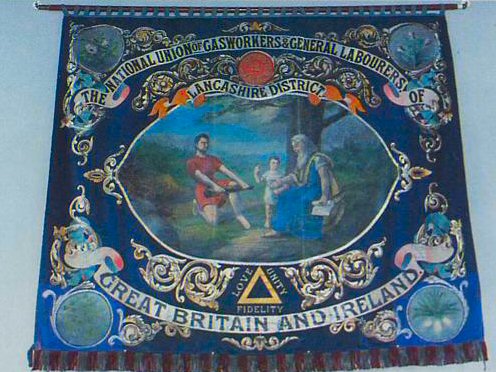
National Union of Gas Workers and General Labourers of Great Britain and Ireland , West Drayton, branch no 23


The banner had actually been unfurled on 27th September 1890 at West Drayton during a speech addressed by Will Thorne the union's General Secretary and Eleanor Marx (daughter of Karl Marx). see report below

Mr John Brown, the local branch secretary of the union said that some time ago according to the resolution of the branch he was instructed to wait upon Mr E. Humbert, and ask him if he would unfurl the banner that afternoon.

That gentleman said he was very sorry but he had an engagement which necessitated his refusing the request. At the same time he assured Mr Brown that anything he could do for them on a future occasion he would do with pleasure and wished them success (applause)

That being the case it devolved upon Mr Brown to unfurl the banner himself but he could not help feeling that such a pleasing duty was not deserve by him. There were men in the branch who had done a great deal more for the cause than he had and he was sure they would all have liked one branch officers to have undertaken the duty.

Before unfurling the banner he might say that they had their own band there that afternoon and hoped they would do credit to West Drayton branch (applause)

Mr Brown then proceeded to unfurl the banner and upon being hoisted it was greeted with loud cheers

On one side of it was represented an employer and a labourer (the later baring a strong resemblance to one of the members of the branch) shaking hands, while on the other side was a brickfield in the district. The recognition of the portraits caused another cheer from the bystanders.

A procession was then formed and headed by the band, proceeded through Yiewsley and back to Drayton Green.

The banner it is understood was made by Mr William Ellen of 257 Hackney Road, London.

(picture above is of a similar banner, the last records of the West Drayton banner are in 1908)

NOTE
Other (early) trade union banners


Southall ASLEF banner
Southall NUR banner (Amalgamated Society of Railway Servants) circa 1905
Willesden
Amalgamated Society of Railway Servants banner
Paddington
Amalgamated Society of Railway Servants banner
Brentwood Lighterman 1895
Acton Communist Party "New Dawn"


National Association of Operative Plasterers, Southall branch established July 1905

Southall Trades & Labour Council meeting posite the King of Prussia public House in March 1905, Mr Horace E Lucia Chairman, speakers at March 1905 meeting. Mr W. Smith G U Carpenter & Joiners Union District delegate; Mr Lovatt District Secretary OBS (Bricklayers Union); Mr W. Randall A S Carpenter & Joiners Delegate; Mr W Wall UBLU (builders Labourers union) Fulham Board of Guardians

Southall Carmen's Union established November 1905

Richard Bell MP spoke to
Southall Amalgamated Society of Railway Servants branch April 7th 1907

(picture right Rickmandsworth ASRS 1912 march and rally Neasden banner front)


Thursday, June 19, 2008

LABOUR CANDIDATES HAYES WEST MIDDX 1925


LABOUR CANDIDATES 1925
HAYES AND WEST MIDDLESEX 4th APRIL 1924

Hayes (East Ward)

Douglas Page (Elected)

(Chair of Hayes Trades & Labour Council, Horticultural Society, Sec Workers Union)

William Sutcliffe (Elected)
(Employed at NUR head Office)


Hayes (South Ward)

L Fitzgerald (Elected)


J.C.C. Hayden (Sec of Hayes Municipal & General Workers Union branch, Ex Servicemen's Assoc)


Hayes (West Ward)

Robert William Gunton, 1 Westgate Villas, Park Road, (Civil Servant)

Horace Sydney
Greenhead

Board of Guardians

Mrs I. M. Fowler (Guardian for six years)
Mrs Anna Begitta Greenhead (Secretary of the Women’s Section)

It was reported that the Municipal Reform (Tories) had had a majority on the council for the last twelve months (1924-1925) In 1925 they changed their name to the Residents Association.
1925 the Labour, anti Labour councillors were equal. However in a special additional election November 1925 Labour secured a one seat majority on Hayes Urban District Council a position it held until another blip around 1929-1930

At this election in 1925
Labour secured the election of Sutcliffe, Page an
d Fitzgerald

As the election resulted in equal numbers of Labour and non Labour it was agreed that Councillor Leach and Councillor Ellis take the chair for six months each. This novel agreement was agreed


EXTRA ELECTION HAYES UDC 28th NOVEMBER 1925

William John Smith (South Ward) Elected 13 Third Avenue, Hayes (Organ Builder)
Robert William Gunton (East Ward) Elected
Albert Edward Knight (West Ward) not Elected The Nursery, Pistils Lane (Insurance Agent)

With the election of two extra Labour Councillors Smith and Gunton, Labour once again secured a majority on the council by 8-7

East Ward Labour 530 RA 232 52% turnout
South Ward Labour 456 RA 367 66% turnout
West Ward Labour 262 RA 345 53% turnout


YIEWSLEY LABOUR CANDIDATES APRIL 1925
A. Hunt

Samuel Thorne
Mrs Read

UXBRIDGE LABOUR CANDIDATES APRIL 1925
John W. Brooks
Joseph W. M. Hart
G.A. Kingsford


Board of Guardians Mrs Sarah Ann Dubberley - Elected unopposed

HARROW LABOUR CANDIDATES APRIL 1925

G.A. Jordan, 5 Roxborough Road (topped the poll)
Sarah Rebecca Ludbrook, 23 (or 28) Sumner Road
B.W. Handley, 82 Roxeth Hill
F.W. Perkins, 4 Gayton Road

WEALDSTONE LABOUR CANDIDATES APRIL 1925
Mrs A Belshaw, 32 Claremount Road, Wealdstone (Elected)
Sidney Bleaney, 58 Graham Road
Henry George Gange,19 Peel Road

Gilbert Postlethwaite, 16 Spencer Road
NOTES

Mr Horace Greenhead stated during the 1925 council elections that
"A return of all Labour candidates and a council similar to that which held office in 1921 was the expressed desire, (he considered this)..."the finest council they had ever had in Hayes"

Robert William Gunton of Park Road, Hayes stated during the same election that

"There was more solid progress when the Labour Council prevailed than had been obtained in the last twelve months"

Robert William Gunton was
"convinced that every branch of the Council's work it was necessary to illuminate private contractors as far as possible........Mr Isreal Ellis (Municipal Reform) had said he was out to smash the Labour movement but it simply could not be done........Working people ought to be proud of the work of the Council in cleaning away slums, demolishing them, so that no reactionary Council could open them again.....The decline of the death rate (in Hayes) since the Council houses had been errected"


Hayes ILP (Independent Labour Party doubled its membership during 1925, active in the ILP were Douglas Page, and Robert William Gunton (speakers includes Seymour Cocks from Chiswick ILP)

East Ward was seen as a Labour stronghold

George Albert Manley was Chair of Hayes Labour Party

HAYES LABOUR LEAGUE OF YOUTH
The national Labour Party, Labour League of Youth was formed in 1924, Hayes Labour League of Youth was established in 1924 (or before) it established a cycling, rambling and swimming section in 1925

The Hayes Labour League of Youth first cycling outing was in May 1925 was from Hayes Cinema to Ruislip.

Other League outings included a trip in July 1925 to Virgina Water via Staines, Egham and Thorpe, where they meet the Rambling section who arrived by "Charabanc".

The swimming section of the Hayes Labour League of Youth was offered the services of Mr J. Harley a "well known" Surrey athlete, this attracted 40 to the bathhouse.

The Leagues first Concert was held at the Brotherhood Hall in January 1925 and developed a Hayes Young Pierrot Troupe of entertainers

Hayes Labour League of Youth meet with Southall Labour League of Youth and Southall Socialist Sunday School at a joint meeting in September 1925 at the White Hart rooms, and on Mr Green’s meadow West End (Northolt) Hayes Labour League of Youth pierrots gave a performance, as did Hayes young gymnastics. Mr Gardner was present. Mr Frank Hall stated “need for Labour organisation in West End and Northolt either ILP or Labour party as best suited to the district”

Hammersmith ILP Cycling Section
INDEPENDENT LABOUR PARTY
Uxbridge Independent Labour Party was founded by Councillor Leonard W. Spencer (killed 1st September 1915, during WW1) meeting initially in Rockingham Hall and in the 1920’s its branch secretary was Ernest A Cave.
The Uxbridge ILP protested at the arrest and prosecution of the 12 Communist Party leaders for alleged seditious conspiracy and Harrow Labour Party women’s section took a collection for the "Communist defence Fund" its secretary was Mrs Smith, Mrs Reid Chair and Mrs Lee Treasurer. The branch also condemned the failure to prosecute the attack “outrage” by four fascists on the Daily Herald

Ruislip Independent Labour Party (ILP) a Mr H. Hirst was active as was Mr Collins of Richmond ILP. Mr Ernest E Hunter, Divisional chairman ILP and National Advisory Committee representative organised a Ruislip ILP day school in September 1925
Mr J.S Collins, Chair West London Federation of the Independent Labour Party, Mr F. Seymour Cocks, Mr H Stewart Ryde, ILP Regional representative and finally Mrs Cook, Mrs Oresten, Mr Hagg and Mr Simpson of the Central London Independent Labour Party (ILP) Players performed Barrie's "The twelve pound look"
Harrow Independent labour Party was established at the turn of the last centaury circa 1900 with Ramsey MacDonald as one of its members
Hammersmith Independent Labour Party (ILP) Cycling Section also active in 1925
FIRST LABOUR COUNCILLORS
Henry Palmer: Hayes UDC 1911
Percy Langton: Hayes UDC 1912
Leonard Spencer: Uxbridge UDC 1910
E.R. Westcott: Uxbridge UDC 1910
Horace Lucia: Southall UDC 1905 (40 Waltham Road,Southall)
J. Perkins Southall UDC 1905 (Endesleigh Road, Southall)
G.A. Jordan: Harrow UDC 1919
A.H. Bartle: Harrow UDC 1919
LENIN AND TROTSKY

Mr H. Hirst spoke at a meeting of the Ruislip & Eastcote Labour Party in March 1925 about the Russian revolution
“Russia went through a revolution and if their was a country that needed a revolution it was Russia….Lenin the lecturer said was an able man with a strong sense of humour and a ready grasp of practical politics. He practically carried out the whole of the work of an opposition in Russia. Of his successor Trotsky the lecturer was not so enthusiastic and of Zinovieff of the red letter fame he had little favourable to say “

WOMEN’S SECTION OF THE LABOUR PARTY
At Wealdstone, Mrs A. Belshaw (Social Worker) 32 Claremount Road, Wealdstone, was elected as a Labour candidate, topping the poll at Wealdstone in the April 1925 Council elections. Belshaw was the first woman to be elected to Wealdstone Council (and therefore probably the first women councillor elected in Harrow)


In August 1925 Mrs Sarah Rebecca Ludbrook Chairman of the Roxeth Labour Party Women’s Section unveiled the new banner of the Roxeth Labour Party Women's group "This handsome emblem designed and embroided by the members themselves and greatly admired by visitors" at the Harrow Labour Party Fete August Bank holiday 1925. Mr G.A. Jordan was also present
Freda Laski, lectured on Birth Control to a packed meeting of Wealdstone Labour Party Women's section at the Co-Operative Hall, Wealdstone in October 1925


Labour Candidates in Middlesex elections (These need checking)
W. G. Sillitoe (West Ward Southall)
W. Garrod (or Garson) (East Ward Southall) Labour win
W.H. Knowles (Hillingdon)
W.L. Carr (Hayes/Northwood/Ickenham/Harefield/Northolt) ??
Capt Fawcett (Feltham) Labour

MUNICIPAL REFORM AND RESIDENT ASSOCIATION
Municipal Reform, was primarily Tory front active in it was Mr C.E. Dobson Secretary, Dr W.D Hopkins, A. Simpson, A.H. Boot, I. Ellis, W.S. Barnes, F.F. Osgood, J.H. Gardner, E.J.Bell, W.W Westacott

RESIDENT ASSOCIATION

Mr C.E. Dobson Honorary sectary; Dr W.D. Hopkins Treasurer; J.R. Scott President; Boot, Leach, Barnes, Gardner, Russell, Holland, Major Shuter, Mrs Haldane, Mrs Hawkins, Mrs Perry. In the 1925 additional seats election they supported George Fulford, John Robert Scott and Arthur .L.F. Cook and Mrs Pickering for the guardians


"It was quite conceivable that if those who had taken an active intrest in affairs of the Parish withdrew, that before many years were over they would see a state of affairs such as had been witnessed in Poplar and West Ham statement founding meeting of Hayes residents association November 1925 (I believe C.E. Hopkins or Ellis)
The Junior Branch of the Primrose League (Tory- anti socialist) established Hayes April 1924 meeting in the new hall claiming 361 members in 1925

Hayes Liberal Association established March 1904
Harrow League of Young Liberals Mr S.V. Kirkpatrick Chairman
Uxbridge Esperanto group circa 1922 Frederick Bradbury 1 Ickenham close, Ruislip
Socialist Party of Great Britain local activist Joe Cohen 15, Eastholme, Hayes, West Middlesex in the early 1920’s

Monday, June 16, 2008


Pinner Labour Party Fete 1924

The first of the "Famous" Garden Fete's held by Pinner Labour Party was held on Saturday 28th June 1924 at Waxwell Farm, Pinner by the permission of Reginald Bridgeman.

Robert Latham Labour Perspective Parliamentary candidate for Hendon was present

Hayes Co-Operative Guild 1925 Meeting at St Anselms Church room, Hayes

Thursday afternoon (October 1925)


President Mrs Hamer, (or Mrs Harner)
Vice President Mrs Harding,
Treasurer Mrs Edwards,
Asst Secretary Mrs Shelden,


Committee

Mrs Ravening

Mrs Barney
Mrs Richards

Mrs Hollingum

Mrs Dawson


Women's Co-Operative Guild
District Secretary Mrs Samuelson


Southall Women's Co-operative Guild dates from at least 1905


Co-operative store at 1 and 2 King Street, Southall
J. W Horsfall

Yiewsley & West Drayton Co-operative Society
established in September 1893 had after a rather slow start stores in Yiewsley, Uxbridge, Hayes, Hayes End, Harefield, later merged into London Co-operative Society


Photo Bexley Women's Co-operative Guild (Northumberland Heath)

LABOUR CANDIDATES 1924
IN WEST MIDDLESEX ELECTIONS


HAYES UDC 1924
Frederick Henry Conway, 66 East Avenue, Hayes (Wood Worker) (E)
Robert John Leach, 1 Clarevillas, Clarendon Road, Hayes, (Engineer) (E)
Ernest Kirby Harding, Old Post Office, Station Road (Seedman/Corn dealer)

* Frederick Henry Conway and Robert John Leach for Labour are elected with increased majorities in East and South Ward, however W.W.Westacott slips in West ward beating Ernest Kirby Harding.

* In 1924 Labour lose control of Hayes UDC, for the first time since 1914 (ten years)

UXBRIDGE UDC 1924
Mrs Sarah Ann Dubberley, 9 Waterloo Road, Uxbridge ( active Welfare & Maternity clinic)
Frank Price 37 Walford Road, Uxbridge (Sanitary Engineer and Captain Uxbridge FC)
John W Brooks, 40 Walford Road (Civil Servant) (prominent Uxbridge C & AC cyclist)
Joseph William Hart, Bungalow, Hawtree Road, (Civil Servant)


YIEWSLEY 1924
Harry Ashby, 63 Ernest Road, Yiewsley (Railway Clerk)
Samuel Thorn, 12 Horton Road, Yiewsley, (Assurance Agent)
Wilfred Roberts, 47 Otterfield Road, Yiewsley (Railway Clerk)

HARROW 1924
Sarah Rebecca Ludbrook, 23 Sumner Road, Harrow
*Sarah Rebecca Ludbrook (Labour) First woman of any Party to stand for Harrow Council


SLOUGH 1924
William Mapstone, 82 Montague Road, Slough
Miss Lilian Maud Whiley, 68 Albert Road, Slough (School Teacher)
Arthur John Frenchum 32 Gillint Road, Slough (Railway Time Keeper)

* Only Mapstone is elected for Labour the National Citizens Union is Labours opposition

WEALDSTONE 1924
Sydney Bleaney, 58 Graham Road, (Railway Carman)
Edward Joseph Hurley, 48 (or 18) Canning Road (Lithographic Printer)

* Local Wealdstone Labour Party establsihed 1924

NOTES:

* In 1924 Labour lost control of Hayes UDC for the first time since 1914 (ten years)

* Robert William Gunton stated that he first came to Hayes eleven years ago (1913) the roads were so bad that the Government stamp factory provided electric lanterns to staff to see their way to the station. He stated that one of the first things the first Labour Council had done in 1914 was to appoint a sanitary inspector to "compel landlords to put their houses in a proper state of repairs". Mr Gunton spoke with pride of the housing scheme and their acquisition of the town Hall (Barra Hall) and Park.

Gunton states "The Labour Party was generally associated by the reactionary press with high rates, well the rates in Hayes did not happen to have high rates, they were the lowest in West Middlesex, due possibly to having such large factories with a large ratable value"

It was reported that Mr R.W. Gunton was not standing as he was soon to move to Watford

Ernest Kirby Harding
"is an enterprising local tradesman, well know
n in Labour circles as the Vice President of Uxbridge Divisional Labour Party. Who came into the limelight in the debate at Hayes with Commander Burney Conservative MP on the laters public funding for Imperial airship scheme (Hayes Parish Hall, Novemeber 1923)

Robert John Leach was certainly one of the most prominent Labour Councillors during this period he stated that he had secured "£3 a week (minimum) wage and one weeks paid holiday"


Frederick Conway stated
"The Municipal Reform (Conservatives) were making an extra special attempt to obtain a majority on the council because they will never get another chance"......"If we (Labour) lose one seat we shall be on the wrong side of the hedge". However, it was noted that Municipal Reform had fallen out amongst themselves


Hayes Labour Party had been promised the support of Dr Somerville Hastings MP, who seems to have maintained close links with the Hayes Labour Party over many years

* The Labour Party stood on a platform of securing the Underground to Hayes, the other issue was a Labour Exchange in Hayes, presently young unemployed Hayes men had to travel to Uxbridge daily to sign on (Picture right Douglas Page)

Mr G.A. Manley was the Hayes Labour Party Chairman

John Brooks (Uxbridge Labour Party was active in the Uxbridge Cycling & Athletics Club, a Mr W. H. Gough being Secretary. The other Cycling club was the Western Road which meet at the De Burgh Arms where from 1924 it had a club room

In May 1924 Councillor Ambrose Simpson was elected Chairman of Hayes UDC he was a retired Acting Sargent in the Metropolitan Police, which he joined in 1890 retiring in 1915 having served 19 years in Southall and 5 years in Hayes


Sunday, June 08, 2008

LONDON CLARION CLUB HOUSE

The Clarion Cycling Club was established in 1895 by readers of the socialist weekly newspaper the Clarion.

Romford Clarion's were obviously very well organised and used the opportunity of the 1911 coronation to organise a Clarion Cycling Camp (June 22, 1911).

So successful was the Camp that in order to "escape the renewed searching for sites, the Sabbatarian rules and regulations of the English Sunday, and the smoke and turmoil of the Metropolis", the London Clarion Cycling section decided at a meeting on September 15th, 1912, to secure a Clarion Club House of their own.

The London Clarion Cycling Club entered into possession of the London Clarion Club House at Broadley Common, near Nazeing, Essex at Whitsun, 1913, and very soon established itself as the rallying point for the cyclists and the London Clarion Fellowship.

The London Clarion Club House is in the hamlet of Broadley Common, near Nazeing, Essex was about 17 miles from the G.P.O. and was said to be situated amongst picturesque rural surroundings, and near to the famous Epping Forest, the open moorland of Nazeing Common, and the historical neighbourhood of Rye House, Waltham Abbey, Waltham Cross, Ware and Hertford.

In 1914 the Clarion hadbook stated "Extensive developments on the estate are contemplated, and all interested Clarionettes and Socialists can assist by taking up 2s. 6d. shares in the Society. General Secretary : Jack Hinton, 5, Vine Street, Romford."

The Romford Clarion Club House closed at the end of 1920. The building still exists, although much altered, as a private residence.


The Romford Clarion Cycling club emerged as the the 1930's

Dagenham & Romford Clarion Cycling Club 1937

Chairman: Alfred S Haddock

Secretary: C. Ayrton 13 Treswell Road, Dagenham

Asst Secretary: L. Lovelock 126 Flamstead Road, Dagenham

Racing Secretary: E. Penegelley 34 Woodstock Avenue Harold Park, Romford


NOTE
Details of the Club House are to be found in the National Clarion Club Year Book for 1914 and 1937 Clarion Handbook

Denis Pye book on the Clarion Cycling Club, Fellowship is Life

CLARION SOCIALIST YOUTH HOSTEL

The Clarion Socialist Youth Hostel was established in Hoddesdon, Hertfordshire from the early 1933 by the London Labour League of Youth and was used by the Labour Party until at least the 1950's.

The hostel was set in ten acres of grounds, with two pavilions, tennis courts, sports facilities for lecturers, classes and even a library,

In 1934 over thirteen thousand Labour League of Youth members (The League had over five hundred branches) camped at Hoddesdon.

Grace Oakden states

"We had a great deal of fun in those days as as serious politicking"

"Labour of Youth branches from all over London used to go there at weekends, camping. There was a big house there we used to have a wonderful times at weekends there. discussions at night, quite a big social programme, dances, a wonderful way of meeting people from London"

A picture is available (http://www.scienceandsociety.co.uk) of the Clarion Youth Hostel van starts for Hoddesdon (Herbert Morrison on right), 1934. Herbert Morrison, (1888–1965) was a British Labour Party politician and Cabinet minister. Morrison held various cabinet posts, including Foreign Secretary, Deputy Prime Minister and Home Secretary.

Wednesday, June 04, 2008

1891 Bus strike

LONDON BUS AND TRAM WORKERS

LONDON BUS AND TRAM STRIKE 1891


The first person to try and organise the London tram and bus workers into a union, was a young barrister called Thomas Sutherst.

He managed, with considerable help from the London Trades Council to organise between two and three thousand tram workers, into The London County Tramway & Omnibus Employees union founded in 1889.

London had some 8-9,000 bus and tram workers in 1891, the three main London Tram and Bus companies running services in the Capital were the London Road Car Company, Tillings and the London General Omnibus Company (LGOC), the later the LGOC was by far the largest .

However, the LGOC was a notoriously bad employer, with employees sacked for “The slightest cause of complaint" crews were even expected to contribute to a fund to cover accidents, repairs and fines levied for any misdemeanours.

London bus and tram drivers wages in 1891 were 7 shillings a day and conductor 4 shillings 6 pence, this was comparatively low compared to other manual workers. They also worked long hours, between fourteen to sixteen hours a day with as little as ten minutes for lunch.

However, it was the introduction of new ticket machines that sparked the first ever London bus and tram strike in July 1891. The issue being the ability of the conductors to keep a percentage of the fares to subsidise their meager earnings.

Two mass meetings were called by the union, both starting after midnight, to enable crews to meet their shift obligations.

Over 3,000 bus and tram workers attended the first mass meeting at Fulham Town Hall in first week of June 1891 and a second meeting the following day at the Great Assembly Hall, Mile End Road

The Trade Unionist magazine of 6th June 1891 reported the Fulham Town Hall meeting and included the following remarks

“Great excitement prevailed during the whole meeting and speakers were frequently interrupted with snatches of song, Brakes and private buses conveyed the men to their different districts of London in broad daylight”

The London County Tramway & Omnibus Employees, union demands included

12 hour day

One clear day off every fortnight

A weeks notice of dismissal

Abolition of stoppages for accidentals

Daily wage of

Drivers 8 shillings a day

Conductors 6 shillings a day

Horse keepers & Washers 5 shillings a day

When their demands were not met, the first London bus and tram strike commenced at midnight on Sunday 7th June 1891.

The strike seemed to have secure generally high level of support from the public, media and the vast majority of bus and trams crews answered the strike call. Some men remained at work, but their efforts to take the buses and trams out were frustrated by the “angry mobs” of strikers.

The strike soon spread to bus crews in other companies, the London Road Car Company, who came out on strike in sympathy and demanding the 12 hour day.

London's other bus and tram company Tillings, was unaffected by strike and continued to run a normal service, having agreed to the unions terms earlier.

One area of surprising support for the strikers came from the "entrepreneurs" who organised "Pirate buses", far from undermining the strike, they actually maintained the strike by paying large donations to the strikers to keep the strike going, thereby pocketing large profits, while providing only a limited service.

On the second day of the strike the bus and tram unions President, Thomas Sutherst met the LGOC and LRRC directors to discuss the strikers demands, they agreed a 12 hour day but no significant movement on pay.

The London bus and tram workers continued the strike for the rest of the week finally securing the following agreement.

12 hour day

Drivers 6 shillings 6 pence a day (after one year)

Conductors 5 shillings a day (after one year)

Horse keepers and washers 5 shillings 6 pence

As well as Thomas Sutherst, George Shipton Secretary of the London Trades Council “worked day and night addressing meetings and organising pickets” collected nearly £1,000 for the strikers

The "Great Bus strike" was called off on Saturday 13th June 1891, after one week on strike, final agreement was reached on the 18th June 1891, however the return to work had not gone smoothly, some activists had been victimised and despite Sutherst assertion at Fulham Town hall that their would be no resumption of work until every union member reinstated, this failed to materialise and despite the efforts of even the Lord Mayor.

While the strike was not totally effective in secure all its demands, importantly the union had won the right to a 12 hour day as well as putting down a marker for future generations of bus and tram workers.

After the strike had concluded The London Trades Council agreed to pay £10 towards Fred Hammill costs while he organised the busmen’s union in the Capital.

One interesting aspect of the strike was the attempt by a group of strikers to establish a London Co-operative Omnibus company to rival the private enterprise giants.

They even purchased an omnibus to the front they attached a broom symbolising how they were determined to sweep the LGOC and LRCC away

Thomas Sutherst the unions President called for the "municipilisation" by the Council and arguing tat the council should buy the whole tram lines and rolling stock, as had happened in Huddersfield (The first municipal tram system opened in January 1883)

The demise of Sutherst, London County Tramway & Omnibus Employee union was the result of the general, onslaught by the employees after the original flame of "New Unionism" that had spilt out the London Dock Strike of 1899.

J. Hibbs states in his book that
“In its short life it was a useful on
e and it was responsible for considerable improvement in working conditions of bus and tram crews”

Later a Bus, Tram, Motor Workers Union merged with the London Cab Drivers Union (the later established in 1894) to form the

London & Provincial Union of Licenced Vehicle Workers (LPU) established in 1913 but also known as the “Red Button Union” because of the colour of their union badge. The L PU was strongly influenced by syndicalism, and distinguished itself from the start as a highly political union, supporting nationalization of transport and opposing world war, while supporting the Russian revolution of 1917. The LPU was prominent in the August 1911 London strike wave that hit the capital as well as the 1915 Tram strike.

While the union was now dominated by tram workers it maintained a separate London cab owners section under the leadership of branch secretary Blundy .

The LPU's Journal was entitled the "Licensed Vehicle Trades Record", edited by George Sanders and produced fortnightly and cost 1d.

The other union to have membership amongst London Tram workers was the Manchester based Amalgamated Association of Tramway & Vehicle Workers (AAT) established in 1889.

The AAT tram union (which had members in West London at Chiswick, Hanwell and Fulwell) secured a larger base in London when it merged with the small London Tramways Employees Association in 1910. The AAT was known as the“Blue Button Union” again because of the colour of its union badge.


See the article by John Grigg on the April 1909 Fullwell Tram strike led by Jack Burns

In late 1919 early 1920 The LPU (109,425 members) and AAT (56,979 members) merged in to form the United Vehicle Workers.

The United Vehicle Workers union became part of the Transport & General Workers Union on its establishment on January 1st 1922.

SOURCE

Radical Aristocrats by Ken Fuller

J.Hibbs history of British bus service 1968

Thomas Sutherst had been active in the Shop hours Labour League and I believe a candidate for Liverpool West Toxeth for the Amalgamated Society of Railway Servants (now RMT)

George Shipton founder and secretary of the Amalgamated Society of Housepainters & Decorators

A referenace is made (London Illustrated News 13th June 1891) to a women in the East End Mrs Reaney organsing East End tram workers and Mr Sutherst in the West London

The LGOC main rival was the London United Transport but the LUT did not arrive until 1894

The LPU and later TGWU cab section had the highest ratio of Communist Party members in any workplace in Briatin

First Tram in London 1860

First electric Tram Croydon 1901

Last (old) Tram 6th July 1952

STRIKES

Bus and Tram June 1891*
Tram strike May 1915
Bus strike May 1917

Tram Bus Tube Women Workers August 1918 (see picture above)
Tram and Bus strike March1924 (23,000 LGOC bus)

Bus and Tram May 1926 (General strike)
(see cartoon)
Bus LGOC January 193
3
Bus May 1937 "Coronation strike"*
Bus strike May 1958*
Bus overtime ban
1965
Bus and Tube strike
1982 Bus and Tube10 March "Fares Fair"

Major London Bus/Tram strikes 1891, 1937 and 1958


Bert Papworth

Albert (Bert) Papworth was known to his colleagues as “Pappy”. He was born into a Catholic family. stating his involvement in the trade union movement was down his uncle “My uncle was a Christian Socialist, a Bible Reader and Lay Preacher. He hated injustice.

Bert Papworth started his union activities at the tender age of 16, becoming a Municipal & General Workers union branch chairman , he led his first strike at Morgan Crucible in 1916 for “equal treatment”. Later he organised for The Workers Union at Woolwich Arsenal from 1917-1918 where he was also involved in strike action. He once again was involved in the Municipal Workers at the Gas Light & Coke Company in 1923

As an unemployed man he refused to take work except at trade union rates. “I would not blackleg those who were working”

In 1927 Papworth secured employment with the London General Omnibus Company (LGOC) and soon became the branch secretary of the Transport and General Workers Union (TGWU) at Chelverton Road Bus Garage, Putney, South London (one of London’s oldest bus depots).

His reputation for organising and speaking soon won him the trust of his colleagues from across London.

In 1932 The London General Omnibus Company, used the opportunity of the world wide depression to seek a two and half to five percent pay cut and the loss of 400 jobs.

Discussions dragged on until August when the TGWU leadership , fearing the use of non unionised labour and having secured the principle of an eight and half hour day signed.

The more militant elements amongst the London Busmen responded by supporting Communist Minority Movement resolutions opposing the deal and in July restarting the Busmen’s Punch, as a result of this eight or nine busmen joined the Party.

A month later on the 12th August 1932, the Busmen’s Rank & File Movement (RFM) was established and mass meetings of busmen at Penge, Stratford, Holloway, Battersea and other venues

While Papworth was undoubtedly a major figure in the establishment of and the RFM other key activitists included Bill Jones a Communist at Dalston Garage, Frank Snelling of the Socialist Party of Great Britain and Bill Payne of Dalston while the RFM was a “united front” organization it in reality worked closely with the Communist Party, indeed the technical Editor of the Busmen’s Punch now selling 8,000 copies a month was Emile Burns of the Communist Party.

1932 Communist Party had 40 members amongst the London busmen one cell at Cricklewood and Chelverton garage’s in 1932 a number of individuals at Holloway, Edgware, Enfield and Willesden, including Bernard Sharkey an ex policemen sacked during the infamous 1919 police strike. The Party members working under the guidance of George Renshaw London District Industrial Organiser of the Communist party.

At the TGWU bi annual delegate Conference Papworth spoke effectively on the need for a “United front” against the growing menace of Fascism, so well in fact that the leadership, who opposed the motion were defeated.

Building on this success and his growing power base amongst the London Busmen Papworth was elected to the TGWU national Executive in 1935

When the fascist threat materialised in Spain when Franco and his fascist allies Hitler and Mussolini attempted to seize power, from the democratically elected Government Papworth was keen to support the Republican Government, joining a delegation to visit Spain in 1937 visiting Barcelona, Alicante, Valencia and Madrid, his experience in Spain deeply affected.

“I beg you to do something to help the people of Spain. Create such an agitation that the (British) National Government shall either fall beneath it or be forced to render justice to a friendly country and a friendly democratic government. Please help Spain”

It should be recorded that at least one London Busman, Bill Brisky (Communist Party member) from Dalston had risen to the rank of Company Commander in International Brigade and was killed at Jarama in February 1937 defending liberty in Spain (as did a number of other TGWU members including George Brown from Manchester killed at Brunete in July 1937 and ken Bond of London at Ebro in July 1938. Jack Jones a future General Secretary of the TGWU also fought in the International Brigade.

On Papworths return from Spain, he threw himself into the campaign to secure a seven hour day and to the issues of speed, meals, relief’s, stand time and weekend working.

Issues agreed at a Special Delegate Conference of London Busmen in December 1936. Management refused to negotiate and a London wide busmen’s strike started at midnight on April 30th 1937, lasting until the 28th May, as this period included the George V1 Coronation as King the strike became known as the “Coronation strike” .

The strike itself ended in defeat and while defeat may have been evitable, given the economic climate, the defeat was impounded, because of the role of the TGWU right wing General Secretary’s Ernest Bevin who was “tacit” in collaborating with management. Primarily, because Bevin both feared the power of the London Busmen and it’s Communist leadership

After the strike, Bevin moved swiftly to expel the London strike leaders from the TGWU, Bert Papworth(CP Calverton), Bill Jones(CP Dalston) garage) and William Payne were all expelled from the TGWU for life, Hayward, Bernard Sharkey (CP Willesden garage); Bill Ware (CP Enfield garage) were debarred from holding office in the TGWU until 1942 and Mark Cravitz barred from holding office in the union until 1940.

The expulsion were ratified at the TGWU Torquay Bi-annual Delegate Conference in July by 291 votes to 51. Bevin then moved to marginalise the Communist Parties ninety eight members in London's twenty eight Garages.

The London busmen’s simmering anger at the role of TGWU leadership and Bevin in particular, lead to the formation of a breakaway union by radical elements within the London Busmen (around Snelling, Payne and Hayward) promoted by the unlikely avowed right wing union leader W.J Brown of the Civil Service Union (who later briefly joined Mosley’s New (fascists) Party)

The breakaway union, established in February 1938 was called the National Passenger Workers Union and had some immediate success. crucially, Papworth and the Communist Party recognized the “opportunism” of Brown and remained loyal to the TGWU.

Bevin always a pragmatist allowed the expelled Communists (Papworth Joined the Communist Party only after the1937 Coronation strike) to rejoin on the understanding that they would fight the break away union and this they did with vigor.

The left, Unity Theatre produced a highly successful play based on the strike “Busmen” which chronicled the struggle for sped up and pay cuts to the defeat in 1937 written by Herbert Hodge a London taxi driver and Montagu Slater, Alan Bush provided the music.

Despite the defeat of the strike, defeats in Spain and expulsion, Papworth kept up his commitment to anti fascist work joining the Co-coordinating Committee for Anti-Fascist Activity along with, Bill Jones (TGWU London Busmen), Harry Adams (Building workers union); R Bringshaw (NATSOPA Printers); Leah Manning (Teachers union); Ellen Wilkinson (Labour M.P); D.N.Pritt and the secretary John Strachey.

It was this Committee that organised the huge counter demonstration to Mosley Hyde Park Rally on 9th September 1937, over one million leaflets were produced in aid of mass mobilisation, primarily by the Communist Party’s publicity officer Bert Williams an ex miner.

The result was a staggering 100,000 anti fascists (including many London busmen), faced up to Mosley’s 2,500 fascists, protected by 6,000 police

During the war Papworth like so many other Communists gave their total support to the war effort and the need to increase productivity Papworth stating

“Our Russian comrades are working worse schedules than ours in the tanks on the battlefield in the East. They are fighting our battle”

Soon after their readmission to the TGWU both Papworth and Jones were elected to the TGWU National Executive (Papworth for the second time)

And in 1944 Bert Papworth was elected to the TUC General Council, as the first out Communist to be elected to the TUC General Council.

Walter Holmes in the Daily Worker of the 20th October 1944 states

“His busmen comrades call him “Pappy” but he is anything but what that might imply....The TUC General council certainly won’t find the first Communist member A. F. Papworth a sleeping partner”

(Bill Jones was also later elected to the TUC General Council)

In 1958 another major London bus strike was called, the first full strike since the "Coronation strike" of 1937.


Papworth won three "gold medals" for services to the TGWU

Bert Papworth died 18th May 1980

Ben Smith Hayes First Middlesex County Councillor was an officer of the LPU

Michael Walker

Source

Radical Aristocrats London Busmen by Ken Fuller and Country Standard

First woman bus driver since the War

Mrs Rosamund Viner aged 22 passed her test May 1974 started on the chessington to Ealing route inJune 1974