Friday, February 09, 2007

Marion Cunningham - Hayes Suffragette


HAYES SUFFRAGETTES

Suffragette outrages.

Hayes ladies support the militants.

At the resumed hearing at Bow Street on Thursday of the Suffragette Conspiracy charges, Detective Inspector Hawkins stated that, "In his search of Miss Jessie Kennedy and Miss Rachel Barrett's flat he found a letter addressed to Mrs Pankhurst and signed by

Marion Cunningham of Oakdene, Hayes End, Middlesex which said,
'I applaud your courage and perfectly believe in militancy. Nothing else can succeed but many of your union can agree with you.'


These dashes appeared in the letter as given here. 'Isolated cases involve much agony to the proprietors and little or no damage to the government. Whatever is done now must be something big, something done by all members. Some careful night attacks where all women get off scott-free if possible. Why not a gigantic raid on pillar boxes with specially made Indian rubber bags filled with staining acid, say sulphuric hydrogen? I am a volunteer for that.'
Advertiser, May 10, 1913.


NOTE
Marion Cunnigham Hayes Suffragette was a very vocal and supporter of militant action, however her middle class background seemed to have spelt difficulty with the local Labour and trade Union movement in Hayes,

Marion Cunningham was secretary of the Hayes-Southall Women's Freedom League, lead by Charlotte Despard in 1913


THE UXBRIDGE WOMAN'S SUFFRAGE SOCIETY (FOUNDED IN 1902)

For some years it was affiliated to the " National Union of Women’s Suffrage Societies," but is now an independent Society, The methods of the Society are constitutional and non-militant. Membership is open to men and women in sympathy with the aim or the Society, which is to obtain the Parliamentary vote on the same terms as it is, or may be, granted to men. The election policy is strictly non-party. The minimum subscription, 1s., entities the member, to attend all general business meetings, to bring forward resolutions, and to vote, also to receive announcement of all meetings of the Society.

The work of the Society is educational, and is carried on by means of meetings in halls and in the open air. For some time the Society has held an "At Home," open to the public free, on (as a rule) the first Monday in each month. Mrs Fawcett, Miss Abadam. Miss Fielden, Mr. Kennedy. Mr. Gugenheim, Mr. Victor Duval, Mrs. Kineton-Parkes, Lady Meyer, The Hon. Mrs.Haverfield, Lady Frances Balfour, the Rev. Hugh Chapman, Mr. Cecil Chapman, Miss Alison Nielans, Mrs. Fagan and many others have addressed meetings.

The official address of the Uxbridge Women’s Suffrage Society is—
Mrs Blower, 7, Park Road, Uxbridge, Middlesex, where any member may consult the list of members. Tho Treasurer is Mrs. Masters.
Source: Kings Gazette Directory 1913


NOTE

Katherine Ann Raleigh was the most influential Suffragette in the Uxbridge area, and was the key person behind the Uxbridge NUWSS. Eldest in a gifted family, she was University women and a member of the University Club. When she arrived in Uxbridge she drew around her a circle of friends at her weekly gatherings to whom she freely gave the benefits of her knowledge of literature and her talent for dramatic reading. A Greek scholar, Librarian for the Hellenic society, She spent much time in Germany studying Folk lore, Member of English Folk Lore Society.

Katherine Ann Raleigh, became well known for her Suffragette work, wrote numerous pamphlets. The first women (Uxbridge) council candidate in the Borough died January 1922 and buried at Abney Park Cemetery, Highbury. Katherine Raleigh deserves more recognition within the Borough. Photo Gazette 22 January 1922

Marion Cunnigham Hayes Suffragette was a very vocal and supporter of militant action, however her middle class background seemed to have spelt difficulty with the local Labour and trade Union movement in Hayes,

Marion Cunningham was secretary of the Hayes-Southall Women's Freedom League, lead by Charlotte Despard in 1913

Meanwhile, local Tory thugs broke up suffragette meetings at West Drayton and Harefield


Uxbridge Division Labour Party,
Socialist Labour League


A left wing grouping called the Socialist labour League, was established within the Uxbridge Divisional Labour Party in the early 1930's.

It meet at Uxbridge Friend's Meeting House. The Secretary being Austen Harry Albu of "Talland" Kings End, Ruislip.

The inaugural meeting of the Socialist League was held on Sunday 2 October 1932 at the Co-operative Hall, Leicester, the day prior to the start of Labour Party Conference.
Chairman: E.F Wise; Genseral Secretary E.A.Radice;Constance Borrett Hon Organising Secretary; Joint Treasurer Wynne Davies and G.R.Mitchinson
Prominent Labour politicians such as Stafford Cripps, Barbara Castle and Michael Foot were members

The Socialist League recognising the threat of Fascism support and encouraged a popular Front or Unity. In March 1937, the LP declared membership of the Socialist League incompatible with membership of the Labour Party. The SL now had either to retreat from the Unity Campaign, or face the wholesale expulsion of its members from the LP. It now announced its dissolution, a decision that was endorsed at the final SL conference in Leicester, at Whitsun, 1937.

Albu later, born Hampstead 1903, educated Tonbridge School, First employment was in the workshops and shipyards in the Midlands and North. Manager at Greenford Factory for 15 years

Amalgamated Engineering Union member, Fabian Society Executive. Elected in a by-election as Member of Parliament for Edmonton (1948-1974)


His second wife was Marie Jahoda, of New York was also a left wing activist from her pre War days in Austria. After they married she became a professor at Sussex University


Austen Harry Albu born 21st September 1903 died 23rd November 1994

Thursday, February 08, 2007

Yiewsley & West Drayton Welsh Choir


Little has been written about the waves of Welsh immigrants to West London, However one can see just from the names of local activities in various groups that the Welsh played a key role in the development of West London and also within the Labour and Trade Union Movement.

Fo many from South wales Hayes and southall was the first London stop on the train, offering jobs all to scarce in their native South Wales.


The Yiewsley & West Drayton Welsh Choir was established by Mr S. catley and made their first public appearance at the Central hall, Yiewsley in April 1936.

Its 26 members being supported by Madame Yones (soprano) of Ealing and Mr T. Rees (baritone) of Iver and Mr T. Weeks (tenor) of Colham green.

Their first song was "Crusader"

NOTE
see first Labour Uxbridge Mayor Tom Parker

Hayes Labour Fete 1936

Hayes Labour Fete 1936
August 1936

Held at Wood Green Recreation Ground, Hayes,

In addition to the fair which had been engaged there was a large number of stalls and side shows to amuse and intrest visitors

Skittles by Southall ASLEF (Train Drivers Union)
Hoopla by Southall Co-Operative Political committee
Coconuts by Ruislip Labour Party
Football by Southall Youth Movement
Around Uxbridge by Mr & Mrs Bancroft
Sweets & Minerals by Southall Womens Labour Party section
Stake you claim by Southall youth Movement
Touch em by Souhall Labour Party
Refreshments by Hayes Labour Party womens section

In Charge of sports were Mrs Anna B. Greenhead, Mr Grentham, Mr A.F. Scott, Dr Douglas Page,, Mr Ernest Bartlett Hamblin and Mr A. Roberts


Sports Results

Flat Races
Girls 11-14 1st B Green 2nd M Parfitt 3rd Bowman
Boys 11-14 D. Bevan W.Poole F. Talbort
Girls 7-11 J.Parfitt H.Parfitt P.Morris
Boys 7-11 C. Page W.Evans F.Cann
Open 5-7 F.Ellis I.Barber E.Bonner
Toddlers J.Foster I.Bonner B.Raisey
Dolls Pram P'de D.Luty B.Day
Slow Bicycle R.Lowe
Slow Bicycle all L.Hunt A.Cook
Egg & spoon Mrs joy M.Parfitt M.Smith
3 Legged Evans & Foreman
ankle Mrs Simpson I Thomas


Fancy dress 1- P. Morris (little dutch Girl) 2-D.Luty (Dresden China) 3-B. Day (little dutch boy) 4-P.Evan (Pearly king)

Those chiefly responsible for the organisation of the fete were: Mr F Gardner (Secretary) Mrs Anna Greenhead, Mr A. Dane, Mr H.Harris and Mr Douglas Page .


The fete brought to a conclusion with fireworks

Hayes Lake

Hayes Lake

The Labour controlled Hayes Urban District Council was fully committed to the establishment of open spaces and the need for "town planning" as Hayes developed. Accordingly Hayes has a larger number of open spaces than most areas within London

"The Lake" one of the most charming natural beauty spots in Hayes is to be acquired by Middlesex County Council and Hayes Urban District Council as a public open space and it will provide Hayes with some thing that will be entirely different from any open space already in existence

the chief feature of this new park will be the lake itself, which at one time was an old gravel pit, now gives the appearance of a natural stretch of water, bordered on one side by a rich well kept lawn, and on the other three by a delightful wooded walk, while in the middle stands a small island.

On the other side of the drive facing the lawn and the more open "shore" of the lake is a fine old house in which Mrs Shackle resided until her death in February 1936.

Beside the house and behind the high wall which borders the drive, is another magnificent lawn at the end of which is a bed of fine roses and beyond that are vegetable gardens and seed beds, bordered with rhododendrons.

The source of the water in the lake has never been definitely established it is said that it is fed by springs, but it is also known that pipes drain into it from a number of surrounding fields.

The greater part of the vegetable gardens will be taken up by the proposed town planning road, but the remaining 2.5 acres will present excellent opportunities to the Parks Superintendent and the Parks Committee of the Hayes Urban district Council.

The present owner of "The Lake" at Hayes is Mr F. C. Gray who for over forty years was in the employ of Mrs Shackle and when she died. Mrs Shackle left him the house and grounds.

for over forty years Mr F.C. Gray has known and enjoyed the quietude and seclusion of this beautiful old house and the garden for which he has cared through all those years. He looks forward to spending the years of his retirement in a little house he has bought not far away, that he might frequently visit the park that has been almost his life's work and see it more or less as he has always known it.


Hayes Urban District Council and Middlesex County Council agreed to pay 50% each for the "compulsory" purchase of 3.45 acres Hayes Lake site, the remainder of the land being purchased by George Wimpey & Co for housing development, which has already commenced

1.5 acres was water (Hayes lake)
2.55 acres (including Hayes lake) was to made into a park
0.9 acres to be used for town planning road

NOTE
given that locals were expected to "doff" their caps to Mrs Shackle, it must have given great pleasure to have acquired her land for the people of Hayes


NOTE

on the death of Mr Samuel Philip of the Cottage, Harlington, in February 1936, it was reported that he was a member of the biggest market Gardner's in Middlesex. Having with his brother acquired Cold Harbour Farm and Court Farm turning them extensively into Strawberry growing. T
ruckloads of strawberries going to Covent Garden as well as,Wales and Scotland on a daily basis


When the first World War broke out a large proportion of land adjoining Hayes station was given over to the Munitions factory, while the greater part of the remainder was given over to growing corn.

By the 1930's much of the land had been acquired by builders, the Town field estate, Hayes now the Council estate.

(his father John Philip had built the bakehouse and corn shop adjoining Vine house in the 1830's and set up the horse drawn bus which ran between Colnbrook and Housnslow)

Tuesday, February 06, 2007

Hayes and the Irish


Ireland and The Hayes Labour Movement

The Labour movement in Hayes, has always taken a keen intrest in Irish freedom and the first meeting in the Borough can be traced backed to a Quaker meeting in Uxbridge in the 1880's. Which reported on a delegation to Ireland.

The first Labour candidate for Uxbridge Constituency (including Hayes) Harry Gosling called for Irish independence in his election address.

John Ryan MP for Uxbridge in the 1960's was an active supporter of the Irish Civil Rights Association


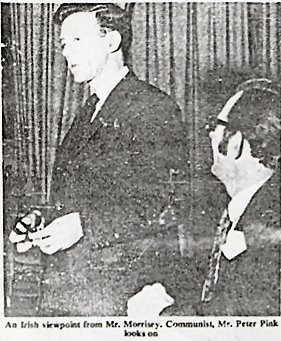
In February 1972, the Hayes Communist Party organised a meeting (According to Peter Pink one of their best) with Sean Morrisey as speaker. Civil rights leader and Chairman of the Turf Lodge Residents Association, he was also an Executive Committee member of the Communist Party.

Sean Morrisey, hit out at the British Army claiming “They shot down these people in Derry and thought that they’d finished us”

"But the struggle continued, he said doubting that a solution to the problems could be brought about by violence” – either by the Army or the IRA."

It was stated that, Mr Morrisey who lives in Belfast with his wife and three children continued “Although the civil rights movement supports the aims and objectives of the IRA, we do not support their methods."

“If we thought they could succeed we would all be members ourselves, We’re trying to get political action and bring northern Ireland back on the political platform"

"We don’t think any elitist group will about political changes in northern Ireland, it depends on the masses"

Mr Morrisey also attacked the Stormont Government.

Not only had the government failed to provide employment – 11% were out of work

but also to provide normal amenities

"If unionism and democracy cant exist together, one of them has to go, and its not going to be democracy"


The Irish trade union movement also came in for criticism but he said “the trade union movement is the one common platform which could bring the two sections of the community together”Chairman Mr Peter Pink said his Party endorsed the speakers view


Mr Morrisey returned home on Saturday following the meeting on Thursday at Townfield School. He was one of two Civil Rights leaders to visit Britain.s

Sean Morrisey Education Officer for Ireland Amalgamated Transport & General Workers Union
Speaking in 1980 he stated " When we explain the actual reasons for unemployment and the worsening living conditions to the workers, we show them that vital problems can be resolved not by patching up contradictions but by fundamentally changining the present socio-economic system, Our Party's strength lies in its ability to bring this truth home to the people"


the leader of the Labour Group and Hayes Parliamentary Labour Candiate was Peter Fagan, born in Dublin

In the 1980's a delegation of Sinn Fein Councillors were invited to various meetings in Hayes and to meet the Labour group Councillors, the delegation included Barbara de Brun (then Barbara Brown).

John McDonnell has used his position on the GLC and in the House of Commons to continue this tradition, including the GLC funding of the Hillingdon Irish Centre

Saturday, February 03, 2007

Hop Demonstration 1909 - The Workers Beer

Hop Demonstration 1908

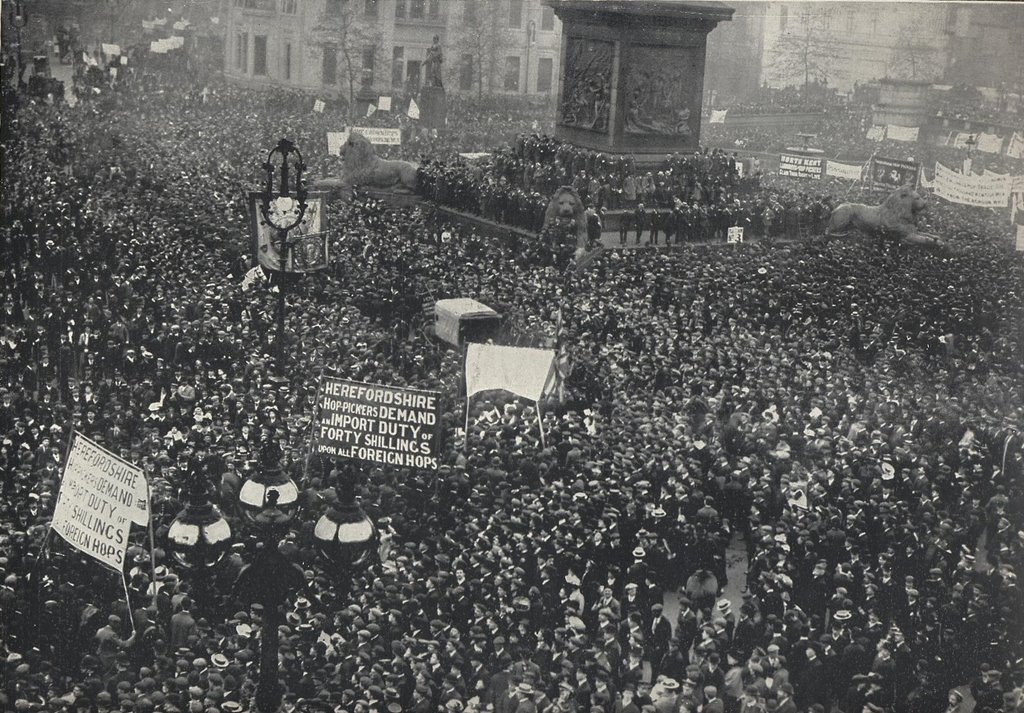
On May 16th 1908

“Hop Saturday” 

– around 50,000 people working in the hop trade travelled to London to demonstrate against unfair foreign competition and to demand the introduction of a tariff, on imported hops. It was the largest demonstration in Trafalgar Square for many years.
Special trains were laid on to London Bridge from where the demonstrators marched to Trafalgar Square, accompanied by bands playing and banners flying.


According to the Times, “One of the most conspicuous banners bore the words: ‘And shall hops picked by Chinamen make England's hop trade die, here's 50,000 Kentish men will know the reason why’". Another, appropriately above the plinth of Nelson’s column, read “England expects that every hop shall pay a duty”. A resolution was proposed demanding the imposition of an import duty of 40 shillings per cwt on all foreign hops. Having carried the resolution, the assembled gathering sang "Rule Britannia", after which the massed bands played the National Anthem and a verse of "Auld Lang Syne".
According to the London Illustrated News, one banner being carried in the demonstration on 16th May 1908, bordered in black, bore the words "In loving memory of 30,000 acrers of British hops"

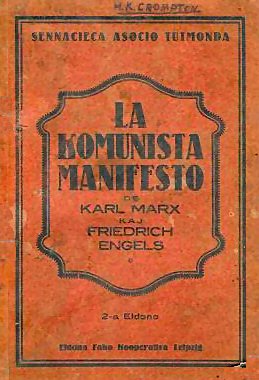
Esperanto Group formed at Hayes 1936


Esperanto Group formed at Hayes 1936

Ĉu vi parolas Esperanton?- Do you speak Esperanto ?

Mr S. Faulkner gave a talk at Lansbury Hall to the Hayes Mixed Co-Operative Guild on Monday 5th October 1936 on ”The international language problem and its solution”.

The speaker first outlined the enormous advantage to the modern world of an easy international auxiliary language, as compared with the difficulties met with in the use of foreign tongues. Mr Faulkner emphasised the fact that an auxiliary international language must be absolutely natural and belong to none of the existing nations
The audience was interested to learn that, some hundreds of artificial language schemes were on record, and that the known history of these attempts began in the 16th century.

Most of the language schemes however had remained on paper only and few had had any real practical trial.
It was merely necessary therefore Mr Faulkner stated, to show that one scheme had been adequately tested and had come so successfully through the ordeal as to make it worthy of serious consideration for general adoption.
This scheme was Esperanto the international auxiliary language created by Polish born Dr Ludovic Lazarus Zamenhof.

The history of the origin and spread of the language was then outlined by Mr Faulkner who stated that there were active Esperantists in about 100 different countries
It was now estimated that there were about two million Esperantotists in the world.
Mr Faulkner stated that, The ease with which Esperanto could be learnt was emphasised. Among the open secrets of its success were that the language was absolutely regular, there were no exceptions to the grammatical rules, the pronunciation was very simple and all verbs were conjugated alike. In contrast to the common experience in learning ordinary languages with their numerous grammatical and idiomatic pitfalls it was difficult to be misunderstood in Esperanto.
Most important for the average man or women was the fact that fluency in Esperanto could easily be acquired without any knowledge of foreign tongues. It was a common occurrence for a students to acquire a working knowledge of the language in a few months and by that time not only be reading Esperanto books and journals but if so inclined to be corresponding with fellow esperantists in 5, 10 or 20 foreign countries
The speaker stated that he himself corresponded with esperantists in 15 different countries.

Attention was drawn to the new international co-operative magazine published from Warsaw entirely in Esperanto which contained articles of interest to all co-operators.
Mr Faulkner stated he was endeavouring to form a class in Esperanto in Hayes, Middlesex for the winter months and he asked if anyone interested should get in touch with him at 27 Beechwood Avenue, Hayes.
The total initial outlay to potential Esperanto students would be 9d, instruction in the language being entirely free of charge

By January 1937, the local Advertiser & Gazette reported that great strides forward had been made by the local Hayes Esperanto Group, which now had seventeen members. The group meet every Friday evening at 18 Angel Lane, Hayes and the Hayes Esperanto Group was affiliated to the British Esperanto Association (Esperanto A Socio de Britio) and the London Esperanto Federation
Mr S. Faulkner was the secretary, treasurer and tutor of the Hayes Esperanto Group and he also represented the group on the British Esperanto Association (BEA) The Hayes Esperanto Group had nine representatives at the London forum
The group in 1937 had amongst its members one member who was totally blind and who was learning Esperanto from a text book in Braille.

The Hayes Esperanto Group hoped to set up a social club to converse in Esperanto

NOTE:
Their was also a specific Labour movement Esperanto Group formed in Britain, The British Labour Esperanto Association (BLEA) with its own Esperanto journal “Ruga Esperantisto” (Or Red Esperanto and an international grouping called International of Proletarian Esperantists (IPF) established in 1937

Monday, January 29, 2007

1936 Hayes & Harlington Urban District Council

Labour Party Candidates

Anna Bergitta Greenhead (ELECTED) South Ward
7,
Second Avenue, Hayes
Married Women
Chairman Hayes UDC 1935-1936, Secretary Hayes and Uxbridge Divisonal Labour Party

“Council work has become her full time occupation”
“Mrs Greenheads energetic devotion to the public work with which she has been associated herself is admired by all who has any knowledge of the extent of her efforts for the welfare of the district she serves”

John “Bill” Lipscombe
222 (or 223) Station Road, Harlington
Aircraft fitter Fairey Aviation
Secretary of Hayes Amalgamated Engineering
Union (AEU), Shop Steward Fairey Aviation. Resident of Harlington since 1927

John Edward Dickinson
132 Crowell Road, Hayes
Gramophone Motor Mechanic
member of the electrician Union (ETU), Secretary Wood End Park Tenants Association. formerly of
Essex. Came to Hayes 1930

George William Walker
Motor Fitter

73 Bourne Avenue, Hayes
Vice Chair Harlington Labour Party 1934-1935, National union of Railwayman since 1934

Douglas Page (ELECTED)
49 Central Avenue, Hayes
Beltman Engineer
(TGWU member) Joint Workers Union member at,
Governor Uxbridge County School

Gordon George Smith (ELECTED)
52 Woodrow Avenue, Hayes
Engineer Storekeeper
Former National Executive Committee member of the Transport & General Workers Union (TGWU), Secretary Grange park section of the Labour Party

William Cyril Mongor (ELECTED)
27 Wood End Park
Wood Machinist
members of National Society of woodcutting machinists. Resident of Wood End Park estate

Robert William Jones (National Unemployed Workers Union ) candidate
21 Acacia Avenue, Hayes
Wireless Engineer

NOTE:Labour Councillor, Robert W Gunton stood down at this election (1936) having been on Hayes UDC from 1915-1936

At his final Hayes UDC council meeting in March 1936 Gunton stated that he “wished to be associated with the great Housing estate (800 Botwell Estate, Hayes)”
(which had been considered the finest in the country and visited by delegations from America, Australia and Japan)

He had remained in the Labour Group and had fought his battles in the Group and in the Committee which was the place in which they should be fought”

In 1936 six Labour “Left” councilors broke away to form a "Genuine Labour" Group these included Wilfred Sutcliffe, Ernest Kirby Harding, William Cyril Mongor, Gordon George Smith, T.H. Denton,

Yiewsley & West Drayton UDC Labour Party Candidates 1936

Beatrix Alice Beaumont (Elected)
Housewife

17 Frays Avenue, Yiewsley
First elected women to Yiewsley & West Drayton UDC in 1933

Husband of Captain Hubert Beaumont elected to UDC in 1934, later Labour MP for Batley & Morley, West Yorkhsire (1939-1949) and Deputy Speaker in the House of Commons

Samuel “Sammy” Thorn (Elected)
NAULAW member also Salvation army

St Stephens Road, Yiewsley

George Varley (Elected)
Railway Clerk

18 St Stephens Rd, Yiewsley
Allotments, Local secretary of Horticultural society

Ronald Philip Brewerton
Baker Checker

67 Bentwick Road, Yiewsley
Local Branch Secretary of A.U.O.B.C

James Stevenson
Baker
1 Napier Close, West Drayton
member A.U.O.B.C.

John William Scott
Clerk
St Giles, Hatch lane, Harmondsworth
Chair Yiewsley Labour Party, Secretary Yiewsley Nursing Association

Harold William Dunster
Baker Roundsman LCS Co-Op

26 Castle Avenue, Yiewsley
Secretary of local National Union of Distribution & Allied Workers Union
Secretary Yiewsley Labour Party

Ruislip & Northwood UDC Labour Candidates 1936

Beatrice Georgina Reid (ELECTED)
Married Women
12 (?)
Morford Way, Eascote

William Charles Locke (ELECTED)
27
Abbotsbury Gardens, Eastcote
Carpent & Joiner

Cyril Alfred Dee
Engineer
49 Sharps Lane,

John Rowlinson
Trade Union Clerk

40 Cromwell Road

Jock Lulv Whitfield
Fitter

41 Brixham Crescent, Ruislip Manor

NOTE:

Beatrice Reid & William Locke (Ruislip South Ward) election in 1936, first ever Labour councilors elected to Ruislip & Northwood council

Wednesday, January 24, 2007

Hayes Labour Candidates

1974

London Borough of Hillingdon Council Elections

Alfred John Charles Beck
199 Station Road, Hayes
62 years old, Contracts Manager, member of the Labour Party and Trade union for over thirty years. Offices held include Hayes Labour Party Treasurer, Secretary and delegate to Labour Party conference. Leader of Hayes UDC and London Borough of Hillingdon Chairman of Finance, education and Works. Justice of the Peace 12 years. Member of Hospital management committee.

Elsie “Maggie” Broughton
37 Warley Road, Hayes
former registered nurse, 58 years old. 30 years member of the Labour Party. Belmore ward Secretary and Chair. Hayes Constituency Secretary. Election agent for Middx County Council election. Five years secretary of Co-Op Party and eight years Secretary of Hayes Women’s Co-operative Guild. Labour Councillor Hayes UDC 1963-1965 and
London Borough of Hillingdon 1964-1968. Hospital Committee six years. Local Old People’s Welfare Committee. Member of Hayes Trades Council since 1952. Voluntary secretary to Arthur Skeffington MP (born 25th april 1912 Handcross, Crawley, died Hillingdon 21st March 1997)

Robert John Came
40 Hunter’s Grove, Hayes
50 years Old. Member of ASLEF (the train drivers union). Held various posts in the Labour Party. Hayes Labour Party election Agent. Hillingdon borough Labour councillor 1964-1968. S.W. Middlesex Valuation Panel. Hayes G.V. Tenant’s Association, Justice of the Peace

Gwilym Arthur Childs
8,
Eighth Avenue, Hayes
50 years shop steward, convenor and Treasurer AEU/F. Former Hayes Constituency Labour Party Secretary. Secretary Labour Group Hayes UDC. Councillor Hayes UDC 1962-1965.
London Borough of Hillingdon 1964-1968 and again from 1970 Belmore by-election.

Stanley George Chilton
2 Hughes Road, Hayes
58 years old. Fire/Accident Insurance clerk. Treasurer Hayes Labour Party. Ward Chairman, Trade Union officer (ASTMS) and member of
London committee. Hayes UDC 17 years 1947-1962 and 1963-1965. London Borough of Hillingdon four years 1964-1968. West Middlesex Planning Committee eleven years. Chairman of Southall-Hayes Branch of RAF Association. Hillingdon & Ealing War Pensions Committee.

Ossie Garvin
44 Church Road Hayes
58 years. Foreman of EMI Hayes Pattern Shop. Served as Chairman and Vice Chairman of Hayes Labour Party. Ward Chairman and Secretary. TGWU, Trade Union branch Secretary and a member of London District Managing Committee. Eighteen years Councillor Hayes UDC 1950-1965. Hillingdon Borough Alderman 1964-1968. Justice of the Peace. Member of council Tenants Association

Simon Geldberg
43a
Station Road, West Drayton
44 years. Costing clerk. Treasurer and literature officer of Hayes Labour Party. Hayes UDC Councillor 1953-1965. Four years Alderman London Borough of Hillingdon. Treasurer of Yiewsley & West Drayton Tenants association. Union APEX.


Kenneth Arthur Gigg
368 Lansbury Drive, Hayes
48 years old. Plastics technologist. Member of ASTMS.
London Co-op Political Committee 1959-1962. deputy leader of Ealing Council Labour Group 1954-1957. Chairman of Hayes Labour Party 1964
Chairman Hayes council of Labour 1958-1960. Deputy leader Hillingdon Labour . Combine delegate and local ASTMS committee.

Ronald Williams
368 Yeading Lane, Hayes
45 years old. Draughtsman. Member of DATA union. Political Education Officer Hayes Labour Party 1968-1969. Secretary of
London West 1970. Chairman, Secretary of London South branch

Mervyn Charles Wheeler
12 Stormount Drive, Hayes
52 years old. Builders Contracts Manager. Branch Chairman and Secretary. London District delegate, 24 years trade union membership . President of Hayes Labour Party. Fourteen years Councillor Hayes UDC and four years Councillor on Hillingdon, Justice of Peace

Hayes Labour Top Ten


KEY
HAYES LABOUR PARTY

MEN AND WOMEN


Percy Langton
Henry Palmer
Juan Drenon
Robert William Gunton
Wilfred Sutcliffe
Douglas Page

Mrs Anna Bergitta Greenhead
Walter Ayles
Bill Lipscombe

Ernest Kirby Harding
Ossie Garvin
Peter Fagan
Peter MacDonald
John McDonnell

NOTE
This is just a rough attempt at highlighting key individuals in the Hayes & Harlington Labour Party - oh course I could have included many others.

Clara Barney, Mrs Frost, Chilton, Beck, Maggie Broughton,Simon Geldberg, Chris Rogers, Reg Neal, Reginald Bridgeman etc....

Tuesday, January 23, 2007


AYLES, Walter Henry

Born at 26 Thorne Street, Wandsworth Road, Lambeth, London on 24th March 1879, Walter H Ayles was one of the five children of a railway porter Percy Walter Ayles and his wife Elizabeth (nee Little), whose wages were 18’s week. At the age of 13, having passed the seventh standard, he went o work at a cardboard-box factory, but was afterwards apprenticed at the engineering works of the London & South-Western Railway. When the men were locked out, young Ayles, then 18, being unwilling to blackleg, put in his notice.

After six months' unemployment, he got a job in a newsagent's shop, and in March1899 went to Birmingham and resumed his trade as an Engineer. He was for three years Birmingham district secretary of the Amalgamated Society of Engineers (AEU), and afterwards, when living at Bristol, was treasurer until 1921 of four local branches of that union. His AEU officership lasted 17 years

.

In 1904 he joined the Independent Labour Party (ILP) and as a Labour candidate was elected to the Birmingham Board of Guardians (Aston) 1904-1907,

In 1910 Ayles moved to Bristol to become Bristol ILP branch full time General Secretary

During the first 18 months from his appointment the branch quadrupled its activities and greatly increased its membership.

In 1912 he was elected for Easton ward of Bristol City Council, a seat he retained until 1922. In his first year on the council he wrote a pamphlet "Bristols Next Step" and in 1923 (relected 1923-, Ayles wrote an ILP booklet on “What a Socialist Town Council Would Do”

Ayles elected to the National Council of the I.L.P 1912-1927. He has also been for the last nine years chairman of the Bristol Labour Party.


Walter Ayles persistently and energetically opposed the World War One as he had the Boer War. Arrested as a conscientious objector, he remained in the hands of the military and prison authorities for two-and-a-half years, and was confined in seven different jails. He held office in the No-Conscription Fellowship and the Fellowship of Reconciliation. In 1920 he helped found the No More War Movement (NMWM)

He was a local preacher for 20 years among the Methodists and Congregationalists, but after the war he joined the Society of Friends (Quakers). He has been for many years an active Rechabite.


Ayles stood for the parliamentary seat of Bristol East in 1918 but did not stand as he was in Prison and the ILP was short of funds. He stood for Bristol North in 1922 and was elected as Member of Parliament for Bristol North in 1923. Mr. Ayles was reputed the most effective speaker in the West of England. Election meetings at Bristol North have been described as occasions of an almost religious fervour. On the morning of polling day an ex-soldier slipped into the candidate's pocket a horseshoe which he had carried in his knapsack all through the war—and he had never received a scratch. When the numbers went up the soldier swore the horseshoe had done it. " No," said the new M.P., " it was the huge crowd of ex-Service men who worked for me."

He was Labour Member of Parliament for Bristol North 1923-1924 and 1929 1931

He fought Bristol North for a sventh time in 1935 and after defeat accepted that it was time to move on

He moved to Orpington near London and was soon elected as a Urban District Councillor in 1937

Elected 1945 for the parliamentary seat of Southall (which included Hayes) during a campaign which included attacks on Winston Churchill pre War record and calling for wide scale nationalisation.

Member of Parliament for Hayes & Harlington 1950- 1953

He retired to his house in Southall but planned to move to Scotland

His son was killed on active service during World War 2 (1943)

his first wife was Bertha Winifred Batt (m 1904) a Bristol ILP and Womens Freedom League member
His second wife was Jean Ogilvie Middleton (m1944)

Died 6 July 1953 at his home Kingussie, Invernesshire,Scotland


NOTE
Walter Ayles was selected as the Uxbridge Divisional Labour candidate in April 1937 beating Humbert Beaumont (nominated by Hayes Labour Party), Ernest Hamblin (ASLEF) and James Eldridge (an Engineer). Beaumont went on to be MP for Sunderland. Ayles was nominated by Uxbridge Labour Party.

Ayles links to Hayes, went back many years, in fact to 1915, when he helped the local Labour Party during the Hayes UDC election, I take it this contact had been through
his Engineering union contacts