West Drayton Gas Workers Union (Brickmakers) 1889
Buckinghamshire Advertiser and Uxbridge, Harrow and Watford Journal
S
aturday, October 4 1890, Edition
The Gas Stokers Union
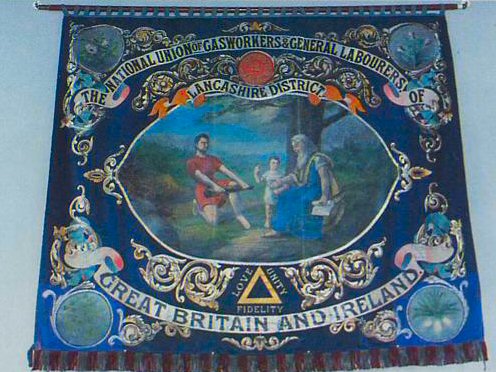
Unfurling of the new banner
The West Drayton branch of the National Union of Gas Stokers & General Labourers Union has during its twelve months existence (established 18th August 1889) been so successful, as regards finance that on Saturday last (27th September 1890) that they were able to unfurl a new banner
It has also been successful in the membership, so much so indeed the number is now estimated at 600.
The branch had lately been opened to women who work in market gardens and other places, and it is no doubt owing to this that the number of members has been considerably augmented.
On Saturday last a meeting was called at the De Burgh Hotel for the purposes of unfurling the new union banner, after which the party were to proceeded to West Drayton Green where a demonstration was held
A large number of people assembled at the hotel, and many more waited outside for the procession to form.
The proceedings commenced by Mr William Hastings a member
of the society saying that he thought that the occasion reflected great credit upon the banner committee and upon the worthy secretary for the energetic manner in which he had worked (applause)
Mr John Brown, the local branch secretary of the union said that some time ago according to the resolution of the branch he was instructed to wait upon Mr E. Humbert, and ask him if he would unfurl the banner that afternoon. That gentleman said he was very sorry but he had an engagement which necessitated his refusing the request. At the same time he assured Mr Brown that anything he could do for them on a future occasion he would do with pleasure and wished them success (applause)
That being the case it devolved upon Mr Brown to unfurl the banner himself but he could not help feeling that such a pleasing duty was not deserve by him. There were men in the branch who had done a great deal more for the cause than he had and he was sure they would all have liked one branch officers to have undertaken the duty.
Before unfurling the banner he might say that they had their own band there that afternoon and hoped they would do credit to West Drayton branch (applause)
Mr Brown then proceeded to unfurl the banner and upon being hoisted it was greeted with loud cheers
On one side of it was represented an employer and a labourer (the later baring a strong resemberlance to one of the members of the branch) shaking hands, while on the other side was a brickfield in the district. The recocognition of the portraits caused another cheer from the bystanders.
A procession was then formed and headed by the band, proceeded through Yiewsley and back to Drayton Green.
The banner it is understood was made by Mr William Ellen of 257 Hackney Road, London
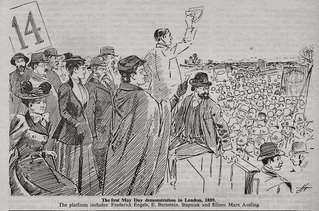
On arrival at the green the party once proceeded to business and a wagon which had been placed for the convince of the speakers was occupied by Mr John brown, Mrs Aveling (nee Marx) Mr William Thorne, Mr Watkinson, Mr Adams and others
In opening the meeting the chairman said it gave him great pleasure to see so many people there, for it showed that the work they had been engaged during the last twelve months had not been lost upon them
It had been said that there was no unity amongst brickmakers, but he thought that the members now on the books of the branch would show that there was unity, for since the last meeting on the green a great part of the 600 which they now mustered had been enrolled. The number that joined last quarter had been double that of the previous quarter
He did not think that there were many who had not now joined the union in the West Drayton district. It was the market gardeners and the agricultural labourers whom the union wanted to join.
They had at last been able to unfurl their banner and he thought they would agree with him that it was a great credit to the branch to have such a beautiful one (hear, hear)
There were branches which started before them, but they could not show such a banner. They had had great trouble in raising the money, but they had got it at last (applause) He remarked that it was rumoured that a strike would take place in the brickfields next year. Some people thought the Union was only formed to encourage strikes. That was the greatest mistake they ever made. The union was formed to prevent strikes and not encourage them. Strikes were not the least bit of good to the workman, but they all ended in favour of the capitalist, who soon as the men went out, would raise the price of bricks 5 shillings per 1,000.
He hoped that those who went about circulating such remarks would get to the truth of the matter before they ventured to say anything about it.
Will Thorne. General Secretary
Mr William Thorne, the general secretary, remarked that it gave him great pleasure to be there that day. He had been present on a similar occasion some time ago and after the meeting was over, he saw two men step out and fight. They did not want to see that sort of thing (hear hear) He must congratulate them on the splendid banner they had got. They noticed in one of the corners a man with a bundle of sticks trying to break them altogether and they saw how impossible it was to do it, but if he them one by one he would soon have the whole bundle broken.
The working men of England had been in just the same position. They had been divided and the governing classes had taken advantage of them. But to day their position was something similar to the man in the banner, they were united, and while they remained so the masters could not break them (hear, hear).
They as brickmakers, had been divided for many years and as a consequence the masters had taken advantage of them, but now that they had joined the union they could work more freely than they otherwise could have done. They had set an example to all brickmakers an example which he hoped would soon be followed (hear, hear) Before they joined the union they fought and competed like a lot of slaves but now they went about their work in a quiet way. Their example was being followed at Slough by the brickmakers there with one or two exceptions.
He heard that one or two fields about the district wanted to take 1d per 1,000 (later corrected by Chairman to 3d per 1,000) off the loading. As far as he could see, it was not the intention of the union to submit the reduction of wages (hear, hear) They must keep up the principle, for if they allowed themselves to depart from one of their rules in time the whole of them would be violated. The union would impress upon the men the necessity of being united in the event of the masters attempting anything against their rules, for it was the only way in which they would be able to stand, and in which they could get their demands. They found that there were men in some parts of the country who did not belong to the union, and it was these men that the masters flew when their own men had gone on strike. They were able to get these men to work for them and thus keep the union men out. He said he did not think it would be safe if that game were tried on at West Drayton ((hear, hear).
The master did not mind how much money they spent as long as they could beat the workmen. The only hope of the masters now was to keep the men out so long as to starve them. The union was formed to prevent this. The reason he congratulated them that afternoon was because they recognised they were beginning the great struggle which was taking place in all parts of the world between capital and Labour.
In Australia an association had been formed for the purpose of crushing the labour organisations, because the masters know they could deal with the men individually, if the men in Australia at last got divided through the master combination, it would affect labour in all parts of the world; no matter in what country the labour organisation fell through, it would affect the whole labour question throughout the world, it would have quite a damaging effect, for it would stimulate the masters and sometimes dishearten the men, and cause discussion. He, himself thought that the Australians would win in the long run. It would only be starvation that would make them give in at all.
Look at the mouths there were to fill, it was not the men who suffered so much, but the wives and children. He had no doubt the unions in Australia had felt the drain upon their money. There were 500,000 people looking for support outside their own unions. As Englishmen and Irishmen they were doing the best they could for them. As they know there was a one shilling levy for the Australians, and on Wednesday last they dispatched £150 for them. There was no telling one day from another when a dispute might be forced upon the labourers in England, for the masters might combine and try to get them out. In their turn the Australians would come to their support. They did not do so during the Southampton strike, but they came out nobly at the Dockers strike and he believed that if it had not been for their assistance their victory would not have been won.
The £31,000 they sent stimulated the minds of the men and renewed their determination,
If it had not been for that the new union would never have been formed (applause). He doubted whether, if they had been divided, they would have been in the same position as they were in today. He contended that it was their duty to assist one another. The interests of labour and capital were identical in all parts of the world. Such men as himself were told that it was through them that dissension existed amongst the working classes, but when they visited any factory the men would tell them their troubles, and they would instruct these men how to get what they wanted.
The men then joined the union, and those who had told them what to do were called agitators. These masters might call him what they liked. He knew what it was to be placed in the same position as the workmen of today. He knew what it was to go home on Sundays without anything for his dinner. Those who had suffered the same as the fellow workmen they were trying to help were the men who knew what alterations were wanted. (hear, hear). How was it possible, he asked, for any man living in the midst of luxury and ease and whose idea of the comfort of the working man probably consisted in seeing a man apparently enjoy a pipe of tobacco over a pint pot, to know what arrangements he required with regard to his work necessary for his comfort ?.
They did not like men like himself to tell the workmen how to better their position and that was the reason why they were called agitators.
The time was coming rapidly, when the working man would not be placed in the same position as at the present day, but, at the same time they must keep firm to the union (Applause).
He was glad to see that they had opened a women’s branch of the union. This question of women’s labour was one of the most important of the day. The masters now employed women where before they employed men. In fact, women did men’s work nowadays. And what was the reason for this ? It was because employers of labour could get a women to do as much work as a man for half the money. There were hundreds of cases where the wife was compelled to go out to work whilst her husband walked the streets. He advised young women who had sweethearts to throw them up if they were not union men.
Every man who stood outside the union was an enemy of his comrades, and the sort of man that benefited the employers (her, hear). He urged married women to keep their husbands in the union, and when it was a question of holding out against the employers never let them give in.
If it had not been for the women when the Dockers strike was on the men would have “funked” it.
In Conclusion, he asked them to buy their own special paper “The People’s Press”. The Labourers union of France brought out a daily newspaper of their own, and why should not their Labour Union publish a daily paper in time ?. (Applause He hoped what he had said had some effect upon them. There was nothing that gave him more pleasure than coming there and addressing such a united body of workmen (Applause).
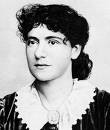
Eleanor Aveling (Karl Marx daughter)
The Chairman, in introducing Mrs Aveling said he did not think anyone present that afternoon could ever remember a lady speaking at a meeting on the West Drayton Green. He had tried several times to get Mrs Aveling to come and speak there, but she had always been engaged. One had to engage her some weeks beforehand.
Mrs Aveling then said that she was extremely pleased to be there, because she was simply performing a duty, ad if, as they had heard, she was the first lady who had ever spoken on the Green, she hoped she would not be the last, but that her example would be followed by other women, and that this was only the beginning of meetings where they could be addressed by women (hear, hear)
One of the reasons for which she was there that afternoon was to tell them the facts, that under that banner they recognised no difference of sex, and that men and women were both fighting the same fight. The men had at least come to understand that they could not fight the battle if they deprived themselves of half the army of labour (hear, hear) that half was the women. As they had been told once before that afternoon, women were doing men’s work and being paid half men’s wages. The union had come forward and said they would not let their women work under the ordinary wages of men (for less). This was the only chance of a women improving her position (hear, hear). It was necessary for women to help their husbands in the great fight. She had known instances in the Dockers strike, where a women said when the men were beginning to waver, “If my old man dares to give way. I won’t live with him” (Laughter, cheers)
The women knew best as to the miserable way in which they were starving – one could hardly call it living – at the present day. It was not right of married women to go out and do men’s work, and at the end of the week bring home just a few shillings, a little addition, they called it, to the “old man’s wages” for they occupied places which widows and young women, with no means of earning a living, might well fill, and be glad of. In many cases a girl could find work, and had to choose between starvation and prostitution; no matter how comfortable their position was no man or woman, she contended, had any right to content with that position while the present state of thing existed (hear, hear).
She was called an agitator, and she could assure them that she should keep on agitating so long as working men and women, who had lived honest, sober and hard working lives had nothing before them, when they could work no longer, but the workhouse (applause); so long as a woman worked 10 hours a day, and only got 5s or 6s a week, and so long as every women did not belong to a union. So long as these things continued she would continue to agitate (applause).
The great struggle had commenced between capital and labour. Capital had been victorious hitherto, simply because labour was not united, but when the second half of the labour army fell into the ranks, then would come the re-action, and where labour had failed, it would come off victorious (Applause) Therefore, they saw the necessity of being united. They must not rest until every working man and women in the kingdom belonged to the union. They had nothing to say against the capitalist individually; it was a fight between two classes.
In Conclusion, she congratulated the West Drayton branch on having such a beautiful banner (loud applause)
Mr Adams of Brentford In congratulating the branch on their work for the past 12 months, said they were shaming some of the London branches. The union wanted to bring about a spirit of understanding between employers and employed, and not a spirit of enmity. The union at Southall were increasing almost as fast as the west Drayton branch and Slough was coming on (Applause)
Other Speeches having been made, the procession reformed and marched back to the De Burgh Hall. It was estimated that 600 persons were in attendance during the afternoon.
Notes:
1889 Will Thorne Gas Workers Union General Secretary states at Southall
“The average length of the working man in Lambeth was 25 years, while at Westminster, two miles further on, they might see gentlemen with nothing to do who attended their clubs when 70 years old”
April 1889 Brick makes strike across Middlesex including Edmonton, Bush Hill Park, Ponders End, Temple Mills, Stratford, Woodford, Ilford, Wanstead Flats, Walthamstow, Mayor’s hill, West Green, Green Lanes and White Heart Lane, Tottenham 6d per 1,000 bricks rise
April 1889 Brick makers strike joined at Yiewsley, Cowley, West Drayton and Hayes (following 4d advance at Acton)
April Meeting of Brickmakers Mr Saunders spoke urging them “the necessity of forming a Society with a view to prevent strikes. He should also much like to see them at church or any place of worship”
May 1889 Brickmakers strike Two of the leaders (Moulders) Hancock and Knight victimised
15 August 1889 Great London Dock strike begins ended 16th September (According to Will Thorne Southall Gas workers union (brickmakers) donated more than any other branch of the union)
18th August 1889 West Drayton & Yiewsley branch of the Gas Workers’ union of Great Britain & Ireland meeting on West Drayton Green (1,200 people and Fulham drum & fife band present)
August 1889 Platelayers on railway meet to for, union (8th November Southall)
10th September 1889 West Drayton & Yiewsley branch of the Gas workers Union committee elected at a meeting at De Burgh Hall Mr W. P. Clayton presided and Mr John Brown of Colham Bridge, Yiewsley Secretary, union committee elected
21st September 1889 Advertiser Editorial - Meanwhile the agitation has not by any means been confined to dockyard labourers. Labouring men of all classes are calling attention to the insufficiency of their wages, and the ferment has even spread to this neighbourhood
12th November 1889 West Drayton Gas Workers union meeting addressed by Will Thorne Union General Secretary 418 members (same number as Southall)
16th January 1890 West Drayton Gas Workers union branch has 500 members
17 August 1890 first anniversary branch, rally at West Drayton green. Speakers John Brown local Branch secretary, Watkinson President of the union; W. F Ward Assistant Secretary, J. Duffy, Fulham; F. Adams, Brentford; and J Bracey Poplar. The branch now had 600 members. Fulham Drum & fife present but a collection taken for formation of a local West Drayton band
28th September 1890 meeting of the Gas Workers Union held in Harefield “invasion by canal boat” speaker John Brown and union national president W. Watkinson. The Harefield branch established year ago in 1889, local union Secretary Rev H. C. Field (Baptist Minister) Members at the Asbestos Factory
1891 Brick makers strike (17 weeks) much hardship in Yiewsley
May 1891 at national conference of Gas Workers Union 1891 held in Dublin at Whitsun, John Brown West Drayton Branch Secretary elected to the National Executive Committee and Mark Hutchins president
June 1891 Edward Taylor, James Coker, William Castle, William Salter and George Green, brickmakers of Yiewsley summoned to court for intimidation during strike
August 1893 meeting of Southern Counties Labour League
March 1894 Joseph Arch’s National Agricultural Union established Denham
----------------------------------------------------------------------------------------------------------------
Dock Workers Strike 1889
21st September 1889 Editorial in Advertiser
“In all probability one result of the strike will be that the Dockyards will, as much as possible employ a regular staff of labourers, and dispense with much of the casual labour hitherto so largely in request. One of the most painful sights in the Eat of London has been the struggling mass of humanity at the dock gates seeking for employment, and if this change should take place, for a time at least the pressure is likely to increase. Ina all probability the prospect of earning 6d an hour will tempt many an agricultural labourer to wend his way to the Metropolis
Meanwhile the agitation has not by any means been confined to dockyard labourers. Labouring men of all classes are calling attention to the insufficiency of their wages, and the ferment has even spread to this neighbourhood
NOTE
In January 18th 1890 edition of the Buckinghamshire Advertiser reported that the West Drayton branch of had union membership of 500