Sunday, April 30, 2006

Councillor Anna Begitta Greenhead - First Chairwoman Hayes UDC

First Woman Chairman of Hayes Urban District Council 1935

Mrs Anna Begitta Greenhead moved to Hayes in 1915 and had first been elected onto Hayes Urban District Council in 1930, in 1935 she was elected as the first woman Chairman of the Council.

She had joined the Labour movement in 1920 and had been elected to the Board of Guardians in 1925 and by 1936 was elected President of Uxbridge Divisional Labour party.

Saturday, April 29, 2006

National Unemployed Workers Movement - Hayes 1936


National Unemployed Workers Movement 1936 Hayes

Robert William Jones an active member of the National Unemployed Workers Movement, a wireless engineer living at 21 Acacia Avenue stood as a candidate in the 1936 Hayes Urban District Council.


The first NUWM candidate to stand locally

The unemployed in Hayes and Harlington


  UDC area in October 1936 was 610 (419 men and 106 women by October 1937 it had doubled to 1,013 (633 men and 380 women)

The Squatters Movement for Housing Hillingdon1946

The Squatters Movement for Housing 1946

In 1946 the shortage of housing had become critical, the Communist Party took a leading role in encouraging a massive “Squatters” movement.
This was a campaign where people without homes or in poor accommodation simply took over empty buildings.

In September 1946 Yiewsley Labour Councillors D.J. Davies and George Pemberton helped local families occupy Providence Road Nursery.
Meanwhile in Uxbridge leading Communist Dickie Bond along with fellow communists Glitz and Newman helped families occupy Coaxden hall.

(flats in Ickenham were also squatted).

NOTE
Fred Glitz, Communist worked at Bell Punch a AEU member (allegedly once a member of the black & tans in Ireland ?)
1901 census refers to a Frederick Glitz 22 born Shadwell, London a Private in the Royal Marines

Hayes WEA 1946

Workers Education Association established 1946


A Hayes branch of the Workers Education Association was established in Hayes in 1946 under the leadership of Mr G. C. Clamp of 222 Station Road and Reg Neal a Yeading Teacher

Lancashire Hunger Strikers 1936

Lancashire Hunger Strikers 1936

250 Lancashire hunger strikers part of a 2,000 contingent were meet in Uxbridge on the 17th day of their march by a welcoming committee organised by Hillingdon and Ickenham Co-Operative Guild they had made a banner with white letters and a red background and marched with them to Southall. the secretary of the welcoming Committee was Mr Hill of 123 Manor way.

later, Jarrow Hunger marchers were present at Hendon West and some of their number spoke to the boys at Harrow school

Blind Hunger March 1936

Blind Hunger Marchers 1936

A contingent of blind people led by G.A. Costance from Swansea marched through Uxbridge, Middlesex in November 1936 to a rally in Hyde Park, to meet other contingents of Blind marchers from other parts of the country including Leeds and Manchester.

Mr G. A. Constance had been an ex elected Councilor for Middlesex County Council between 1928 and 1931 and done much for the blind while on the Council.

Southall Anti Fascism 1936


No Fascism in Southall (1936)

In late October 1936 fascists in Southall organised a rally in Southall park. A counter demonstration was organised under the banner "No fascism for Southall" and a conference was called to oppose fascism in Southall the secretaries being Mr D. Romney and Mr J. Ross

Hayes Labour vote 1964 -1986

Labour vote in Hayes (Hillingdon) 1964-1986

1964 Council
Labour 65.2%
Con 31.7%
CP 3%

1966 General
Labour 62.2%
Con 36.0%
CP 2%

1968 Council
Labour 38.6%
Con 55.8%
CP 5.5%

1970 General
Labour 57.6%
Con 41.2%

1971 General
Labour 74.7%
Con 25.2%
1971 Council
Labour 67.2%
Con 31.7%
CP 3%

1974 Council
Labour 59.3%
Con 35.2%
CP 3%

1978 Council
Labour 45.1%
Con 49.8%
All 5.1%

1981 GLC
Labour 50.1%
Con 33.7%
Lib 14.3%
CP 2%

1982 Council
Labour 33.6%
Con 38.1%
Lib 28.3%

1983 General
Labour 29.9%
Con 40.3%
All 29.0%

1984 GLC By Election Labour victory

1986 Council
Labour 50.4%
Con 32.4%
Lib 17.2%

Hayes Labour Hall 1930 - Pump Lane

The Hayes Labour Hall 1930


During the early days of the party meetings and socials were held at Clayton Road School or Hayes Restaurant in Clayton Road, The Harmboro recreation Restaurant and Botwell House.

In April 1915 the same month Councillor Gunton stated “Hayes Labour Association has already initiated a scheme to build a Trades union hall to seat 500 people and that club premises with every convenience for members will be built above”
“Labour/Trade union hall would provide silent evidence of the strength of the Labour movement in Hayes.”

Already several sites are under consideration and it is hoped that next year (1916) would see if not completion, the start of the erection of a building””
The President of Hayes Labour Association, Mr H. Booth stated “The social side is an important one because social gatherings helped them to know one another and created a good fellowship”.

Little more is heard of the Labour hall until the local Gazette reports in May 1923 that the Labour hall Committee had meet and had decided to call a special conference at which representatives of Trades Unions etc will be present to discuss possible methods of raising £250 required for the hall and stating that various sites were under consideration.

At the next meeting of the Committee in late may 1923 held at the Hayes restaurant the secretary and president of Southall Labour hall were present, their secretary Mr Hamblin gave an outline of the ways and means adopted in Southall in obtaining their hall thus the provincial committee which had recently been formed was dissolved and a regular committee set up to bring about definitive proposals before the Trades Council & Labour Party..

The Uxbridge divisional Labour party (which included Hayes) mad a gift of £3 towards the monies required for the erection of a Labour hall

Later Mr A. E. Knight was appointed Secretary and Mr Glenister Chairman and a committee of 21 was agreed
An appeal for £1 loans for the Hall raised just £15.

The Committee later exchanged a parcel of land in pump Lane for a larger area of land in the same road, but still the committee did not have enough money for the hall.
Eventually a “corrugated” hall formerly owned by the Hayes Wesleyan Church was purchased, This establishment and the extra land cost the Labour party £164.00 secured through a mortgage on top of which was a piano purchased at the cost of £3.
Their only liabilities were to shareholders to the extent of £70,10s (later revised to £75) which was repaid at one tenth each year or 1s 10d each year.

The Hayes Labour hall was finally opened by Dr Marion Phillips MP for Sunderland on 28th June 1930. When she was presented with a sheaf of roses by master Philip Hurn.

Soon after its opening, substantial alterations were made to the hall costing £200. these included painting the exterior, the two cloakrooms were built, a kitchen was built, a stage erected, and a partition built in order that two meetings could be held on the same evening.

Mr P Brown who presided over the official opening after the refurbishment in October 1930 He

 “welcomed them to the supporters of the hall to their new home which was the result of continuous efforts on the part of some of their fellow members of the various organizations in the district, some of these workers were not now associated with the task but the efforts had to be borne in mind at such a time as this”.
He went on “the opening of the hall filled a real need in the district and he felt that the various organizations would not be sorry to have a meeting place in which there was a security of tenure without appealing to the generosity of anybody”.
They had not the perfect place perhaps but with time and suggestions from the people using the accommodation he thought they would be able to make themselves comfortable”.

Many socials were held in aid of the “building fund” and due to the efforts Tuffer Bowman and John salt in selling door to door London Labour Party bingo cards in the mid 1980’s money was raised for the improvement of the hall.

Note
Charles Henry Glenister, Railway Supervisor of 7 Halsway,Hayes, Middlesex, later Hayes & harlington Urban District Council, Labour Councillor
Glenister Flats, Avondale Drive

Monday, April 24, 2006

Early Hayes Labour Association Councillors

Henry Palmer (Bricklayer) 1911-1913

Oak Cottages, High Road

Percy Osborne Langton (Clerk) 1912-1915

18 Angel Lane, Hayes End

Juan Colonna Drenon (Bookseller) 1913-1917 (UDC Chair 1915)

Barra Hall, Wood End, Hayes

William Rawlings (Packing Case Maker) 1914-

(Chair 1919) 1 Sydney Villas, Blythe Rd

Frederick V Mason (Machinist) 1914-1920

6 Silverdale Rd

Robert William Gunton (Civil Servant) 1915 -1936

1 West Gate Villas, High Road, Hayes

F Woodard 1914 -1920

W. Herbert Rhodes (Painter) 1915-1919

17 Cranmer Rd, Hayes End

Fredrick Henry Conway (Woodworker)

11 Austin Road, Hayes

George Alfred. Manley (Sanitary Engineer) 1919-(Chair 1920)

6 the Parade, High Road

H. Booth 1917-1919

Launcelot Fowler 1919-

J.W Davies 1919 ???????

Robert John Leach (Engineer) 1920

1 Clare Villas, Clarendon Rd

Albert Edward Knight (Insurance Agent) 1920-

The Nursery, Pistill Lane

Horace Sydney Greenhead (Engineer) 1920

19 Tudor Rd

Agricultural Workers Union in Middlesex 1872

Agricultural Workers
in West Middlesex

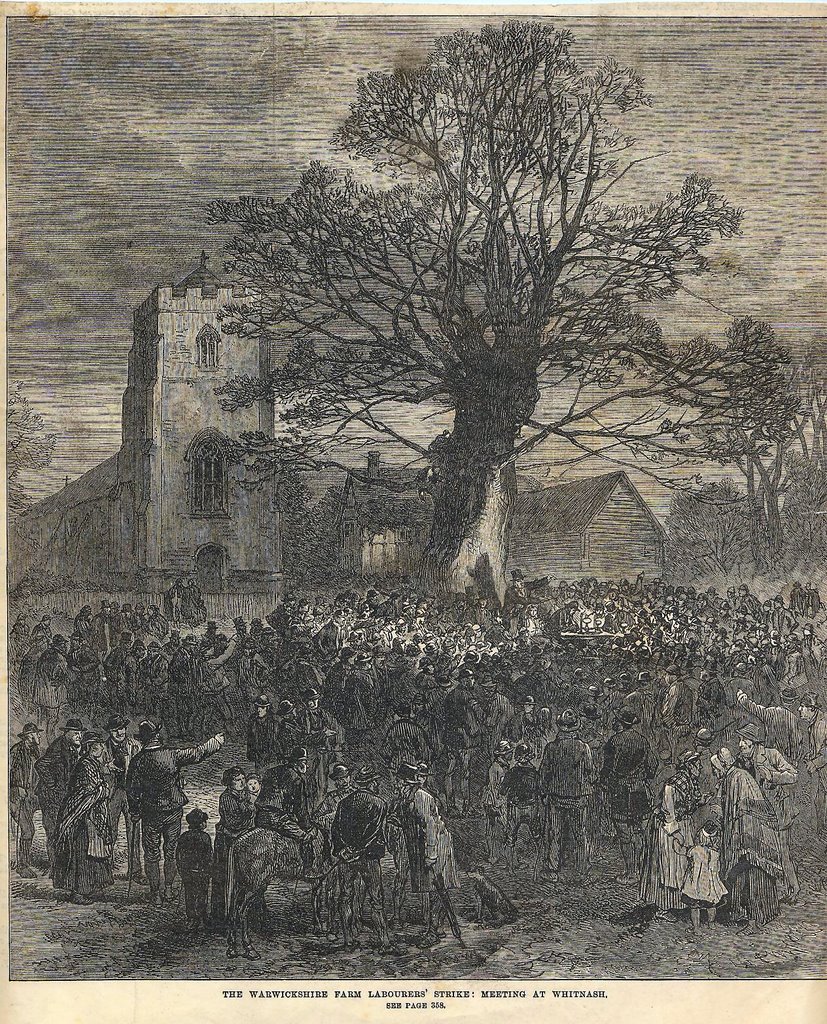
The agricultural workers in this part of Middlesex were not immune to the ebbs and flows of the agricultural workers struggles.
 
While many local agricultural workers were forced into migration to Australia, New Zealand and Canada because of poverty. (especially from the Yiewsley area)

Other workers did try to resist the Land owners. Swing riots came to close Hayes and while no riot took place locally, a man arrested for “agitation’ in Hayes was released because no one in Hayes would testify against him.
 
This at a time, when even owning a print of the Peterloo massacre was an imprisonable offense.
However, when in February 1872 Joseph Arch set about organising Agricultural Workers in what Karl Marx referred to as the “great awakening” the response was huge.
Arch spoke for over one hour and recalled "These white slaves of England with the darkness all about them, like the children of Israel waiting for someone to lead them out of the land of Egypt"

On May 29th 1872 a meeting of sixty delegates from England and Wales at Leamington, Temperance Hall, Warwickshire to establish the National Union of Agricultural Labourers (NUAL)


The local Uxbridge newspaper reported that
“The agitation amongst the agricultural labourers is now spreading into the remote parts of Buckinghamshire un-traversed by railways and far away from large hives of industry Editorial 25th May 1872.


One of those leading the union campaign locally was Uxbridge radical and former Chartist leader John Bedford Leno. he spoke on behalf of the union in many villages in the home counties including, Middlesex, Berkshire, Buckinghamshire Huntingdonshire, Cambridgeshire.

It was John Bedford Leno, who along with Robert Clay spoke at the inaugural meeting of the Denham branch of the National Union of Agricultural Workers when it was established on 12 April 1872 . When some 40 local agricultural workers joined the union .
 
Leno stated “John Ploughman had awoke”
But joining the union was not without consequences and a number of agricultural workers were victimized and sacked.
Another union, the Buckinghamshire Labourers’ union led by School teacher Edward Richardson of Dinton was also active in 1872 in recruiting agricultural workers into unions.

In July 1872 John Bedford Leno spoke to agricultural workers in West Drayton
“If the masters feared the union, it was a reason why the men should cherish it, he did not advice them to strike that was a very serious thing but if necessary…he had been accused of being a disturber of the public peace he had been into several counties in England and was happy to inform them that the rights of the agricultural labourer were beginning to be recognised”.

In January 1891 the Dock and Riverside Workers union reported that the position of the Dockers was seriously prejudicial by the great influx of into the metropolis of individuals from agricultural districts who, dissatisfied with conditions of life there or having no employment at all flock to London and are in due course at the dockyard gates ready to do the work at any price statement by Dock & Riverside.
As a result the Dockers union (and the local branch of the Gas Workers union who were active amongst the brick makers) tried to organise the burgeoning market gardening workers in the West Drayton area
Meanwhile, in Berkshire, Lorenzo Quelch (brother of Harry Quelch of the socialist SDF (Social Democratic Federation) organised the Berkshire Agricultural & General Workers Union around 1893.
 
Joseph Arch’s union collapsed towards the end of the eightieth century (1896), however a new union was established in Norfolk in July 1906 changing its name to the National Agricultural Labourers & Rural Workers Union in 1910 , of which a branch was established at Longford, West Middlesex in October 1913. The speaker was Mr Harry Maskell who pointed out that local agricultural workers were paid just 18s 7d a week in West Middlesex while in Lancashire they were paid 19s 2d.
As a result of the meeting a branch of the union was established but was followed by the inevitable victimisations, when six Longford members were sacked for daring to join the union.
 
Another branch of the National Agricultural Labourers and Rural Workers Union was established at Harmondsworth, West Middlesex on 23 August 1918 and meet at the Five Bells .
 
The inaugural meeting speaker was F.W. Paul organising secretary for Essex who stated
“The labourer was waking up, already a hundred thousand members were enrolled in the twelve hundred branches, and members were coming in at the rate of a thousand a week”

”Education was largely a sham to the sons of labourers who had to leave school at ten and who had no opportunity for continuing their studies”
“The housing condition s of agricultural labourer’s in many parts of the county , he did not say Middlesex was an absolute disgrace".


NOTE
In 1920 the union changed its name to the National Union of Agricultural Workers and in 1982 became part of the TGWU now Unite

Hayes Labour Party 1954

1954 HAYES & HARLINGTON CLP
Labour Party General Management Committee


Mrs M Abbott Co-op Party
J.E Allsopp AEU Yeading Lane
I Anthony TGWU 1/212
M. E. J Armstrong League of Youth
Mrs L Armstrong Harlington Ward
J Barker ASW Hayes End
Mrs R. E Beard Womens Co-Op Guild Wood End
A.J.C Beck CAWU Hayes No:1
A.D Boness TGWU 1/212
Mrs Elsie E Broughton East Ward
R.C Came South Ward
Mrs I Carter Harlington Ward
P.C Carter Harlington Ward
W Carter TGWU 1/212
G. F Chaffer Hayes & Harlington Trades Council
W Chapman NUM &GW
G.C Clamp ETU Electronics No:2
E Clark East Ward
W Clark NUR Paddington
H Clarke NUSMW&B
F Conway NUM &GW
B.E Cooper AEU Yeading Lane
A.J Cummins East Ward
R.H Dixon ETU Hayes
S Drayton ETU Electronics No:2
Eric G Evans TGWU 1/690
R Evans TGWU 1/212
W.F Field AEU Hayes End
F.A Fordham NUSMW&B
H.M Fox AEU Hayes No:2
Ossie Garvin ASWCM Hayes
Mrs S Garvin South Ward
Simon Gelberg Harlington Ward
J.E Goff TGWU 1/690
E.H Hammond ASWCM Hayes
E. K Harding East Ward
M Hodgson ASW Hayes
W.G Hohl AEU Hayes No:3
T Hornby ASW Hayes

Hucknall Harlington mixed Guild
F Huish East Ward
R Hurle AEU Hayes No:3
1954
HAYES AND HARLINGTON GMC
J.C. Jeffrey ACT Technicolour
Mrs K.M. Johnson Harlington Ward
J Johnson Harlington Ward
F Jones ASW Hayes End
T. J Jones AEU Yeading Lane
L. F Jordan South Ward
H King Harlington Ward
T Latter West Ward
W. J Lipscombe AEU Hayes No:1
F. W Loft West Ward
Miss P Long League of Youth
H Mathews AEU No:1
J Millett West Ward
Mrs W Millett Co-op Party
W.C Mongor Labouur Council Group
F.E. Newton AEU No:2
E.G Nightingale ASLE&F
Mrs L Nightingale East Ward
J.O O’Farrell NUR Paddington No:2
J. W Ord AEU Hayes No:4
Mrs L.C Palmer West Ward
S.J Parmenter AEU Hayes No:2
F.W Passmore ASW Hayes
J.W Patterson AEU Harlington
E.C Perkins East Ward
Mrs J.B Perkins East Ward
C.A Peters AEU Hayes No:3
Mrs E.M Pink CAWU Hayes No:1
R Price TGWU/690
L.G.H Rose NUM&GW
W Seeley AEU Hayes No:2
N.L Shakespeare AESD London West (DATA)
A.W Skelton NUR Paddington No:2
G Smith Harlington ward
L.G Smith NUM&GW
H Spencer AEU Hayes No:3
G Stevens ASLE&F
W Taylor South Ward
F Thompson West Ward
M.A Thompson AEU Hayes No:1
H Tovey Hayes & Harlington Trades Council
T Turnbull AEU Hayes No:3
1954
HAYES & HARLINGTON GMC
G.S Warren AEU Hayes No:3
J Weeks NUR Southall
M.C Wheeler NASH&SP & D
Mrs M Whitmore TGWU 1/690
Mrs C. J Walters Womens Section
M Wilkinson League of Youth
J Woods TGWU 1/690
F.C Woods West Ward
Mrs M.M Woods West Ward
F Woolcock AEU Hayes No:1
A Wroth South Ward


HAYES & HARLINGTON CLP GENERAL MANAGEMENT COMMITTEE 1955
T Abbott AEU Hayes End
J.E Allsopp AEU Yeading Lane
I Anthony TGWU 1/212 from Oct West Ward
M Armstrong League of Youth
Mrs L Arnold Harlington Ward
E Ayerst Co-op Party
Mrs Ayerst Harlington mixed Guild
J Barker ASW Hayes End
S Barsted CAWU
Mrs R. E Beard Womens Co-Op Guild Wood End
A.J.C Beck CAWU Hayes No:1
R.D Benford NUR Paddington No:2
A.D Boness TGWU 1/212
Mrs Elsie E Broughton Co-op Party
G Burton NUR Southall
R.C Came South Ward
Mrs I Carter Harlington Ward
P.C Carter Harlington Ward
W Chapman NUM &GW
G.C Clamp ETU Electronics No:2
E Clark East Ward
W Clark NUR Paddington
H Clarke NUSMW&B
F Conway NUM &GW
B.E Cooper AEU Yeading Lane
A.J Cummins East Ward
W Demyer Harlington Ward
R.H Dhon ETU Hayes
S Drayton ETU Electronics No:2
Eric G Evans TGWU 1/690
R Evans TGWU 1/212
W.F Field AEU Hayes End
H.M Fox AEU Hayes No:2
R.B Gardner Co-op Party
Ossie Garvin ASWCM Hayes
Mrs S Garvin South Ward
Simon Gelberg Harlington Ward
J.E Goff TGWU 1/690
E.H Hammond ASWCM Hayes
E. K Harding East Ward
J Harrison AEU Yeading lane
T.M Hill AEU Hayes No:2
1955
HAYES & HARLINGTON GMC
W Hinton TGWU 1/690
W.G Hohl AEU Hayes No:3
W.J Hockings AEU Harlington
T Hornby ASW Hayes
F Huish East Ward
Mrs M Huish East Ward
R Hurle AEU Hayes No:3

Hutchinson West Ward

Jeffrey South Ward
Mrs K.M. Johnson Harlington Ward
J Johnson Harlington Ward
D Jones NUM&GW
F Jones ASW Hayes End
T. J Jones AEU Yeading Lane
H King Harlington Ward
T Latter West Ward
J Littleford NUM&GW
W. J Lipscombe AEU Hayes No:1
F. W Loft West Ward
Miss P Long League of Youth
J MacIntosh ACT
H Mathews AEU No:1
J Millett West Ward
Mrs W Millett London Co-op Society Political
W.C Mongor Labour Council Group
H.A Nappin Hayes & Southall Trades Council
F Newton AEU No:2
E.G Nightingale ASLE&F
Mrs L Nightingale East Ward
J.O O’Farrell NUR Paddington No:2
Mrs L.C Palmer West Ward
S.J Parmenter AEU Hayes No:2
F.W Passmore ASW Hayes
J.W Patterson AEU Harlington
B.T Perkins East Ward
E.C Perkins East Ward
G Perkins TGWU 1/212
Mrs J Perkins Women’s section
C.A Peters AEU Hayes No:3
George Philpot South Ward
Mrs E.M Pink CAWU Hayes No:1
Mrs J Potty CAWU
R Price TGWU/690
Mrs C Roberts ETU Electronics No:2
1955
HAYES & HARLINGTON GMC
L.G.H Rose NUM&GW
N.L Shakespeare AESD London West (DATA)
A Smith West Ward
A.H Smith Harlington Ward
L.G Smith NUM&GW
H Spencer AEU Hayes No:3
G Stevens ASLE&F
J Stoneman AEU Yeading Lane
W Taylor South Ward
F Thompson West Ward
M.A Thompson AEU Hayes No:1
W.C Trafford AEU No:6
T Turnbull AEU Hayes No:3
G.S Warren AEU Hayes No:3
J Weeks NUR Southall
M.C Wheeler NASH&SP & D
Mrs C. J Walters Womens Section
M Wilkinson East Ward (also League of Youth)
Mrs B Williams ETU Electronics No:2
E Wiltshire AEU Hayes No:2
J Woods TGWU 1/690
F.C Woods West Ward
Mrs M.M Woods West Ward
F Woolcock AEU Hayes No:1
R Wright AEU No:6
A Wroth South Ward

Wednesday, March 08, 2006

Hayes & Harlington Labour Candiates from1918 -

HAYES LABOUR PARTY
PARLIMENTARY CANDIDATES


1918 Harry Gosling
1920** PPC Captain Frank Goldstone did not stand at 1922
1922 W.J. Brown
1923 Robert Small
1924 Robert Small
1929 Reginald. F. 0. Bridgeman
1931 L.M.Worsnop
1935L.M.Worsnop
1945 Walter H Ayles (Elected)
1950 Walter H Ayles (Elected)
1951 Walter H Ayles (Elected)
1953 Arthur M Skeffington (By Election) (Elected)
1955 A.M.Skeffington (Elected)
1959 A.M Skeffington (Elected)
1964 A.MSkeffington (Elected)
1966 A.M Skeffington (Elected)
1970 A.M.Skeffington (Elected)
1971 Neville Sandleson (By Election) (Elected)
1974 Neville Sandleson (Elected)
1979 Nevile Sandleson (Elected) (later defected to SDP)
1983 Peter Fagan
1987 Peter Fagan
1993 John McDonnell
1997 John McDonnell (Elected)
2001 John McDonnell (Elected)
2005 John McDonnell (Elected)
2010 John McDonnell (Elected)
2015 John McDonnell (Elected)

Sunday, March 05, 2006

Hayes Labour Association Estb1910


The Establishment of Hayes Labour Association

The Labour Representation Committee had been established in 1903 as primarily a parliamentary organisation to co-ordinate Labour MP’s.


A few areas such as Ealing experimented with the establishment of local Labour Representation Committees (LRC), however it was not until 1909 that the Labour Party was encouraging the establishment of local Labour Parties.


The initial meetings of the Hayes Labour Association took place in a cottage in Hayes 1910 when Percy Langton was elected as the Association's first Secretary .
Contemporary reports state the “foster mothers” of the Hayes Labour Association were Percy Langton and Henry Palmer.

Percy Osborne Langton was a decorator and plumber of Angel Lane. He was born in Hayes in 1889 the son of Walter Langton.
While Henry Palmer was a bricklayer “with a heart of gold and a tongue like a lash of whip silver” he was also an active campaigner for allotments. Langton stated” It had been a conversation between two working men of whom Mr. Palmer had been one and he would remember with pride had been the other” April 1915.

It was largely due to Henry Palmer that the Hayes Labour Association had been established Labour to Power Percy Osborne Langton referred to origins of the Hayes Labour Association.

In the local council elections of 1910 the Hayes Labour Association embarked upon an electoral strategy that would secure its meteoric rise to power. The Association planned to field its first candidate. Percy Langton however he stood down in favor of Henry Palmer . 

The previous year 1909, Henry Palmer had stood as a “Working Man’s” candidate, losing by just 34 votes.” He was a bricklayer with a heart of gold and a tongue like the lash of a whip of silver” wire” at this his second attempt and now as a Labour candidate Palmer failed by a mere 6 votes.
At the following 1912 council election the Hayes Labour Association had secured the election of three Labour Councillors onto the Urban District Council - Henry Palmer, Percy Langton and William Rawlings, the later a packing case worker.

“Much had been made out of the labour party being socialist, he for one was not ashamed of owning up he was a socialist, but the whole of the Labour party were not socialist” Palmer May 1912

George A Sellwood had by 1914 become the joint secretary of the Hayes Labour Association.

At the 1914 Council election, Labour succeeded in having elected Juan Colonna Drenon a Bookseller and Frederick Mason a machinist.

The rapid advance of the Hayes Labour Association had not gone unnoticed and the London (Evening) Standard which warned in February 1913 that Hayes was now a “danger spot” in the Uxbridge Parliamentary Division
‘There is one danger spot in thoroughly Unionist (Conservative)Division Uxbridge it is only a spot at present but it wants watching “

”At present no radical candidate is before the constituents and it really is not a matter of surprise, it is no joke to fight in the radical interest in this division”
“There is a weak spot on which more guns require to be directed at Botwell, Hayes. The population and electorate are very rapidly increasing. Many of the newcomers are not landowners seeking fresh air and the amenities of rural Middlesex. They are largely importations from the North and Midlands."
“Gradually radicalism has been sown and the Hayes District will be important in the future fight”.

The Labour Party was not only being attacked from the right, the left, notably by the Uxbridge branch of the Social Democratic Federation established in 1908 in the guise of Mr A. D. Notley and Mr Barr. It was also attacked by John Hoffman of the Socialist Party of Great Britain who witheringly stated
“To call the Labour Party Socialist, which contains for the most part job hunting trade union officials making sheep’s eyes at the capitalist class”.

At the1914 election the Hayes Labour Association secured the election of five Labour councilors out of a possible nine, thus securing a Labour majority on the Hayes Urban District Council for the first time, The five included
Percy Langton
William Rawlings
Juan Drenon
Fredrick Mason
Robert Woodward

Merlane Chair of the HLA stated June 1914

“The Hayes Labour Association held a meeting after every meeting of the council and their representatives hold a meeting after every meeting and their representatives had to report to them as to the work done and the Association brought forward certain propositions and left the members to carry them out if they did not carry out their wishes of the Association they were asked why”

The Hayes Labour Association’s stunning success in securing a majority on the council was unrivalled by any other Labour Party, certainly in Southern England, The success should be measured against the fact that Labour strongholds such as Acton, Poplar, Battersea and Rhondda did not fall to Labour until 1919.

The relatively early electoral success of the Labour Party in Hayes helped undoubtedly to consolidate the Party during the forthcoming period of political instability caused by the outbreak of World War 1. Elsewhere the War unquestionably slowed the advance of the Labour Party and sowed confusion in its ranks, as jingoism replaced normal politics.

Despite national setbacks by 1915, Hayes Labour Association could claim an astonishing two-thirds majority on the council with Robert William Gunton being elected. The Labour councilors first action was to elect Councillor Juan Drenon as the first Labour Chairman of Hayes UDC.

Juan Drenon was born in 1864 in Liverpool, he was an inspirational man who through himself fully into the work of the Association. He is credited with pushing ahead with the early council housing scheme's and it could have been no accident that he was elected the first Labour Chairmen of the council


Note
Note: Photo Palmer 28 Feb 1913 pg5 Gazette

Hayes Labour Association

The impact of the first ten years of the Hayes Labour Association 1910-1920
“Not his masters voice - but the workers voice”

INTRODUCTION - PART ONE

Hayes in 1901 was a sleepy agricultural village in West Middlesex owned by just a handful of landlords. With a population of 2,594. However, at the turn of the twentieth centaury it was transformed in the space of ten years into one of British Empires major centres for the mass production of the new technologies of the day, such as gramophones, typewriters, and printing. Its population increasing from 4,261 in 1911 to 8,394 by 1921.

It was the decision of Hayes Development Company to acquire land adjacent to Great Western Railway (GWR) in 1899 to build modern factories upon. The choice of Hayes for the site of so many new factories was according to the local newspaper no accident “The Advertiser February 1907” for the following reasons: -
a) The short distance from London
b) Accessibility to rail and canal routes
c) Lower council rates
And ironically
d) Because the labour market in London was not controlled by the London Trades Union Council

Ironic because, Hayes would become one of the most trade unionised areas in Britain, exerting considerable influence on a local Labour party which itself would dominated Hayes politics for the next one hundred years.

The formation of Hayes Urban District Council The original Hayes Parish council was established in 1894, it was reported that the councillors consisted of “five socialists and four gentlemen” this is however very doubtful. With the national re-organisation of Local Government the Hayes Urban District Council was formed in1904 but with only limited voting rights for men and non for women.

As with many other councils at the time, a number of local dignitaries were elected to govern. Indeed such was the lack of political debate on the new council that the councilors referred to themselves as the “happy family”.

The landlords of Hayes were renound for their refusal to sell land for small holdings or to build houses and accordingly were viewed with bitterness by the local working people of Hayes who were expected to “doff their hats and curtsey” to Shackle family and other landlords, a bitterness that remained palpable amongst a number of early Labour Party activists well into their old age such as Clara Barney.

During this period key debates at council meetings revolved around issues such as the treacherous state of the Hayes roads, often impassable because of mud and the hazard to health of Hayes pond.

Early yeas of twentieth century their was increasing unemployment in the West Middlesex area, George Lansbury who would later become famous for the Poplar Council revolt, spoke on unemployment at Uxbridge town hall October 1905. But the only real option for many poor in the district was migration to Canada and Australia.

By 1905 the Liberals felt strong enough once again to challenge the Conservative monopoly of on the Uxbridge Division, It had not even contested the previous election. As perspective Parliamentary Liberal candidate Sidney Pocock pointed out “Liberalism had been dead and dormant in the division for 20 years” . Locally on Hayes Council attempts to maintain the “happy family” in power were helped by the lack of political activity.

At the 1906 Hayes Council election it was stated “Election fever is apparently unknown to Hayes”At present no radical candidate is before the constituents and it really is not a matter of surprise, it is no joke to fight in the radical interest in this division”

But things were starting to change George Moses a Grocer of stood as a “progressive” and was elected in 190 he was joined by George Lowe a famous horticulturalist in 1908, as was the staunch independent but progressive leaning Israel Ellis, Headmaster at the Hayes Industrial School for Jewish boys.

One of the key reasons for the move to secure the election of progressive candidates to local councils, was in order to secure trade union rates of pay for council employed staff, this was known as “fair wages” and it was around this that political debates on Hayes UDC crystallised in July 1908.

The local newspapers attitudes to political developments was polarised with the Gazette wholeheartedly supporting the Conservative Party and taking every opportunity to attack the emerging Liberal, Labour and Socialist movements. Meanwhile the progressive forces had in Mr Hanson the editor of the Middlesex Advertiser from 1906 a close friend of the Labour Party founder Kier Hardie The Gazette warned in 1908 for example that

“The coming enemy is socialism and socialism of the Victor Grayson, Blatchford, H.G Wells and G.B.Shaw are not to be answered by a policy of sops they must be met by a railing back to the united principle that have led the United Kingdom and the Empire on a path of sure and sane, if apparently slow progress”.

Meanwhile the progressive cause recievied a major injection of radicalism, when the newly completed factories required skilled and un skilled labour. These positions were often filled by unemployed workers from the Midlands, North of England and Wales. These workers not only brought with them a strong commitment to trade unionism but also to the newly emerging Labour Party.

While work could now be found in Hayes accommodation and lodgings were hard to come by and of dubious quality. It was estimated that two thirds of the workers employed in the new factories traveled from the surrounding conurbations of Southall and Acton. An early survey conducted by the Hayes Labour Association highlighted the level of the problem. According to the Association over 2,000 men traveled to Hayes by rail and a further 1,000 by bicycle, tram or walking. The Association noted that some workers traveled over 21 miles to work in Hayes. It is therefore unsurprising that housing would later become such a dominant issue in the rise to power of Labour Party in Hayes and would leave an indelible mark upon the future geography of Hayes.
OUR HISTORY

This site was established as part of "Our History" project. To provide information on the part played by working men and women to impove our Society.